



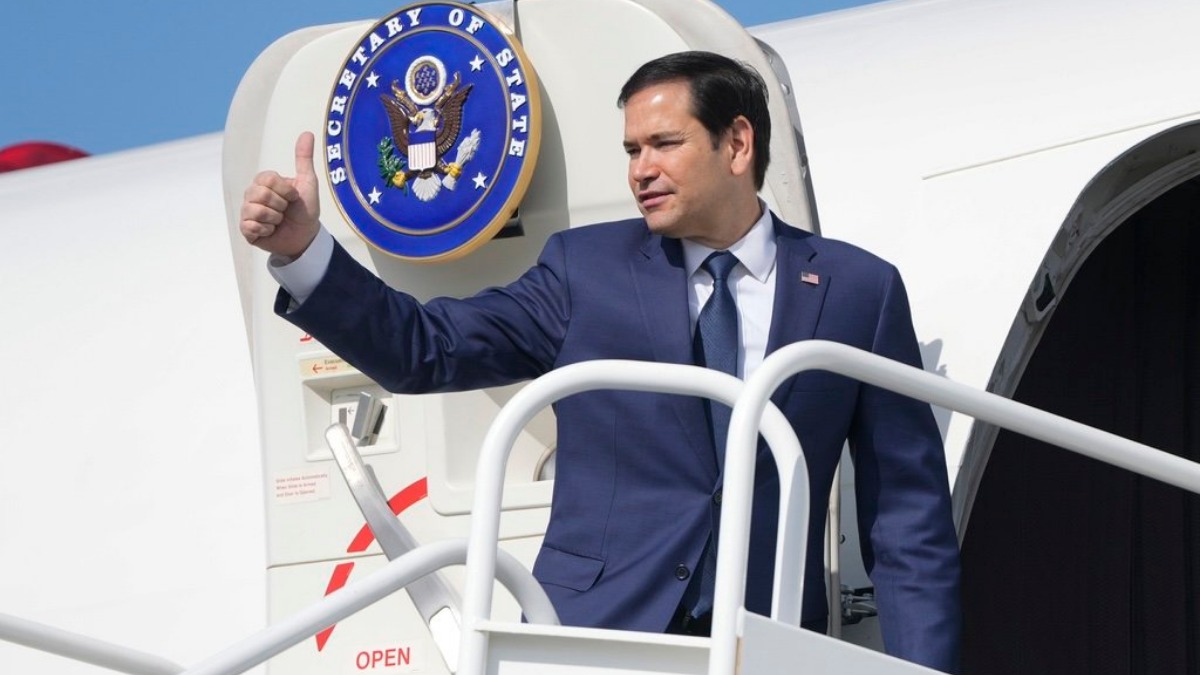

China has successfully navigated a complex bureaucratic hurdle to allow Secretary of State Marco Rubio to enter the country for a high-stakes summit between President Trump and Chinese President Xi Jinping, The Hill reported. This week marks a significant moment in diplomacy, as it is the first time a United States president has visited the Asian power in nearly a decade.
The visit includes Secretary of State Marco Rubio, who is traveling aboard Air Force One with the President. This trip is particularly notable because it involves an individual who was previously subject to formal government sanctions that prohibited his entry into the country.
The path to this visit was cleared by a subtle linguistic adjustment. Shortly after Marco Rubio took office in January 2025, the Chinese government and official media began using a different Chinese character to represent the first syllable of his surname. The previous transliteration was the one associated with the sanctions imposed on him back in 2020. By shifting the character used for the syllable lu, the government effectively created a technical loophole.
The sanctions were initially imposed on Marco Rubio while he was serving as a United States senator
Two diplomats noted that this change appeared to be a calculated way for China to bypass the restrictions that were originally tied to the old spelling of his name. When asked about this change last year, China’s foreign ministry spokesperson Mao Ning stated she “had not noticed it but would look into it” according to sources in Chinese state media.
The Chinese government targeted him twice due to his vocal criticism of Beijing regarding the treatment of the Uyghur population in the Xinjiang region and other alleged human rights abuses. As a senator, Marco Rubio was a primary author of legislation that imposed wide sanctions on China over the alleged use of forced labor, charges that Beijing has consistently denied.
He also gained a reputation for speaking out against the government’s actions in Hong Kong. Because of these activities, China retaliated by using a tactic frequently employed by the United States against its own adversaries.
Despite this history, the Chinese embassy made it clear that the current political climate takes precedence over past grievances. Chinese embassy spokesperson Liu Pengyu stated on Tuesday that the country would not block the secretary’s travel. “The sanctions target Mr. Rubio’s words and deeds when he served as a US senator concerning China,” Liu Pengyu said.
This clarification suggests that the government is choosing to interpret his current role as distinct from his past legislative actions. A State Department official confirmed that Marco Rubio is indeed traveling with the President for the duration of the summit.
Marco Rubio, who is now 54, has long held a firm stance against the Chinese government. During his confirmation hearing in January, he famously described the nation as the “most potent and dangerous” near-peer adversary the United States has ever faced. His presence on the trip has garnered plenty of attention, including online discussions regarding his attire.
After the White House released a photograph of the Secretary of State lounging in a Nike tracksuit, internet users noted the resemblance to the attire worn by Venezuela’s ousted president, Nicolas Maduro, when United States forces apprehended him in January.
While his past rhetoric was focused on human rights, his current approach has aligned with the broader goals of the current administration. President Trump has characterized Xi Jinping as a friend, shifting the focus toward building a robust trade relationship while placing less emphasis on the human rights concerns that once defined the relationship.
However, Taiwan remains a critical point of interest for the administration. Marco Rubio has been a staunch advocate for Taiwan, and he recently assured supporters that the administration would not trade away the future of the self-governing democracy to secure a trade deal.
“I’m sure Taiwan will be a topic of conversation; it always is,” Marco Rubio told reporters last week. “I think both countries understand that it is in neither one of our interests to see anything destabilizing happen in that part of the world. We don’t need any destabilizing events to occur with regards to Taiwan or anywhere in the Indo-Pacific.” As the summit progresses, it is clear that the diplomatic landscape is changing rapidly. The use of a simple transliteration change to bypass a formal entry ban highlights how flexible international relations can be when both sides have a vested interest in keeping the conversation moving. The world is watching to see how this newly managed relationship develops on the ground.







Published: May 14, 2026 02:15 pm