



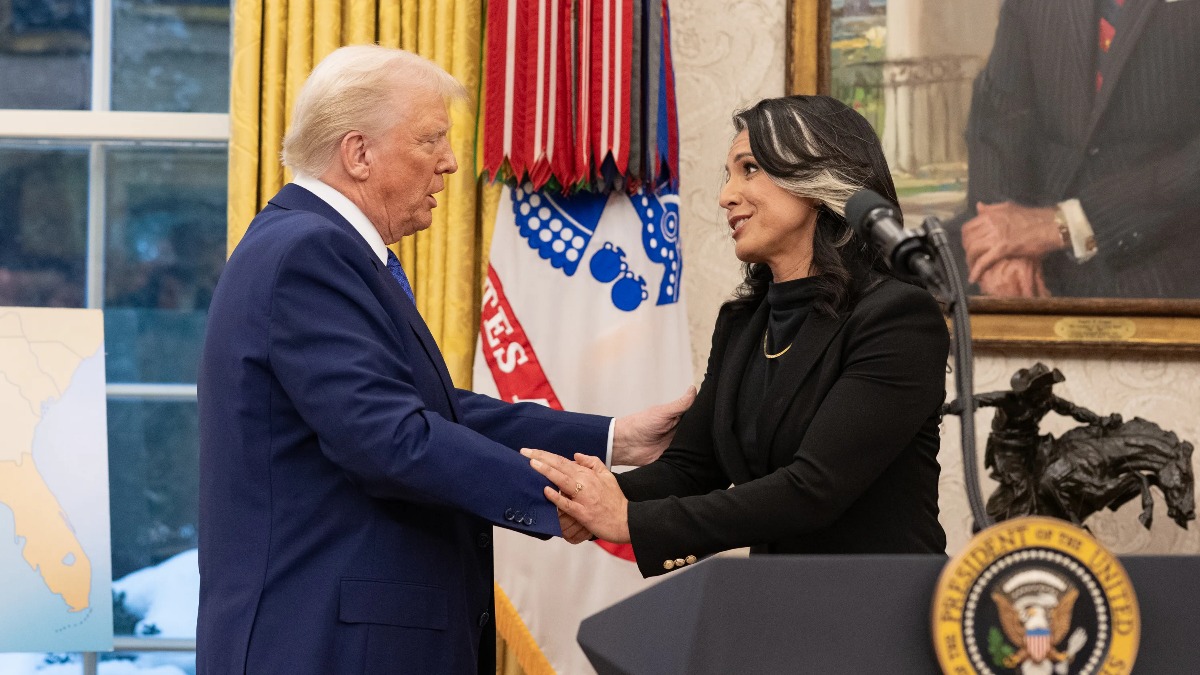

Tulsi Gabbard announced her resignation as President Donald Trump’s director of national intelligence, saying her husband had recently been diagnosed with a rare form of bone cancer. But a source close to the matter revealed that her departure was not as voluntary as it appeared. The White House had been unhappy with Gabbard’s performance for quite some time, and her exit was ultimately a result of that dissatisfaction.
Gabbard’s time as Director of National Intelligence (DNI) was marked by controversy from the start. She was appointed by Trump despite having no deep intelligence experience, and her decisions, such as trying to declassify documents related to the death of former President John F. Kennedy, investigating the security of election machines, and probing the origins of COVID-19, were widely seen as misguided, reports Reuters.
The tension between Gabbard and the White House had been growing for months. Multiple sources told Reuters that Trump had expressed displeasure with her. She was also left out of key discussions between Trump and his top national security advisers on major foreign policy issues, including the U.S. military operation that removed former Venezuelan President Nicolas Maduro from power, the Iran war, and Cuba.
Gabbard was pushed out, not just stepping down for personal reasons
In her resignation letter, posted on X, Gabbard thanked Trump for the opportunity to lead the Office of the Director of National Intelligence and pointed to her husband’s cancer diagnosis as the reason she was leaving. However, the source close to the matter told a very different story. “The White House has been unhappy with her for quite some time,” the source said. “She was pushed out by the White House.”
Trump, for his part, praised Gabbard publicly, saying she had done a “great job” but that her husband’s cancer diagnosis made it necessary for her to step down. Despite this, the source made clear that her departure was not entirely her own choice, and that the White House had been looking to remove her from the position for some time.
Gabbard had already drawn sharp criticism in her role, including allegations that she shared classified NSA intel with Trump’s chief of staff and then instructed the agency to keep quiet about it. Following Gabbard’s exit, Trump appointed Aaron Lukas, a former CIA officer and analyst, as the acting director of national intelligence.
Lukas is known as a loyalist to the Trump administration, and his appointment has drawn criticism from Democrats. Many see it as a move by the White House to tighten its grip over the intelligence agency. Gabbard’s resignation raised real questions about the stability of the DNI and the White House’s ability to manage it effectively.
As DNI, she played a key role in advising Trump on intelligence matters, and her sudden departure left a noticeable gap in the agency’s leadership at a sensitive time, particularly given the ongoing tensions between the United States and Iran, reports Politico.
The White House moved quickly to downplay the significance of Gabbard’s exit after she left, but the circumstances surrounding her tenure are hard to ignore. She had no deep background in intelligence work when she took the job, and her decisions during her time as DNI drew heavy criticism from many observers who felt she was politicizing an agency that is supposed to operate above politics.
Earlier in her tenure, she had also turned her fire on Democratic opponents over anti-ICE protests, drawing further controversy. Her removal, however it was framed publicly, reflects a broader effort by the Trump administration to put loyalists in charge of key government institutions and maintain tighter control over how they operate.








Published: May 23, 2026 02:30 pm