



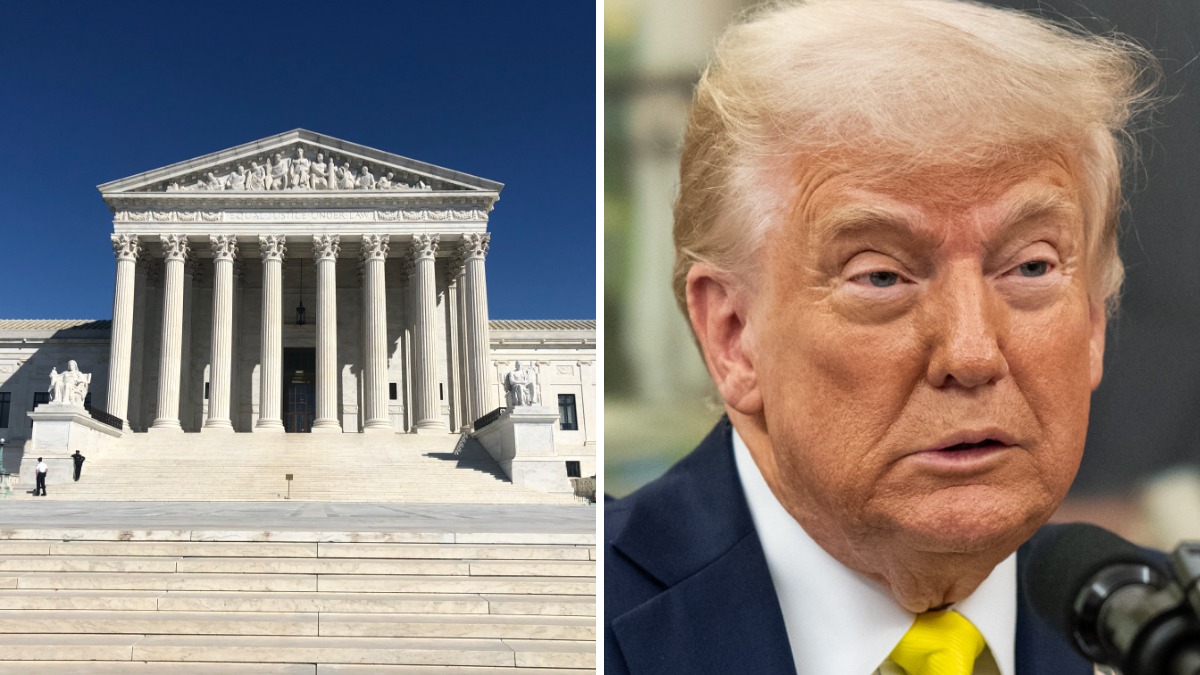

The Supreme Court delivered a major ruling on Tuesday that effectively shuts down the executive order signed by President Donald Trump on the first day of his second term, NPR reported. In a 6-3 decision, the justices upheld the long-standing interpretation of the Fourteenth Amendment, confirming that virtually everyone born on United States soil is automatically a citizen.
This is a massive moment for American law, as it reinforces a principle that has been settled for 160 years. Chief Justice John Roberts penned the court’s opinion, emphasizing that the Constitution’s promise is meant to be kept for every person born in the country.
It is worth noting that this executive order never actually went into effect. Before reaching the Supreme Court, every lower court judge who reviewed the policy flagged it as what one judge famously called “blatantly unconstitutional.” The order was designed to deny citizenship to babies born to parents who were in the U.S. illegally, as well as those living and working here legally on temporary visas. If this had been allowed to move forward, it would have impacted more than a quarter of a million babies born in the U.S. each year.
The legal debate centered on the Citizenship Clause of the Fourteenth Amendment
The clause states, “All persons born or naturalized in the United States and subject to the jurisdiction thereof, are citizens of the United States.” Donald Trump had argued that this language was only intended to apply to former slaves and was not meant to allow anyone from anywhere to occupy the United States. However, the court pointed to the historical context of how the framers of the amendment deliberately chose broad language to define citizenship.
Chief Justice Roberts wrote, “Citizenship, then and now, was the right to have rights—to freely participate in our political community. The Framers of the Fourteenth Amendment extended that promise to ‘every free-born person in this land.’ We keep that promise today.”
The court relied heavily on the 1898 landmark case of Wong Kim Ark. In that instance, a child born in San Francisco to Chinese immigrant parents was denied re-entry to the U.S. after a visit to China. The Supreme Court ruled in his favor, establishing that children born on U.S. soil are citizens, with the only real exception being the children of foreign diplomats.
This interpretation has remained remarkably stable throughout American history. Even during World War II, when Japanese citizens were held in detention camps, their children born on U.S. soil were still granted American citizenship.
The ACLU’s Cecillia Wang, who argued the case before the Supreme Court in April, noted that the men who wrote the Fourteenth Amendment intentionally chose to confer citizenship on the child rather than the parent. She explained, “In America we do not punish children for the sins of their fathers, but instead we wipe the slate clean. When you’re born in this country, we’re all American, all the same.”
While the outcome was a 6-3 vote, the internal alignment of the justices was nuanced. Chief Justice Roberts was joined by Justice Amy Coney Barrett and the three liberal justices in ruling that the amendment itself guarantees citizenship. Justice Brett Kavanaugh provided the sixth vote for the outcome, but he did so based on a federal statute rather than the constitutional interpretation itself.
This is a critical distinction because it means he joined the dissenters in agreeing that the President’s order did not necessarily violate the Constitution directly, theoretically leaving the door open for a future Congress to try to change the law.
The dissenting justices, Clarence Thomas, Samuel Alito, and Neil Gorsuch, would have upheld the restrictions. Justice Clarence Thomas wrote a lengthy 91-page dissent, arguing that the court’s decision was an “extraordinary step” and claiming the Fourteenth Amendment was repurposed for political projects rather than its original purpose of securing rights for freed Black people.
Donald Trump expressed his frustration with the ruling, calling it “too bad for our Country” and suggesting that Congress could “easily” address it through legislation. However, since the majority of the court based their ruling on the Constitution itself, it would take a constitutional amendment to overturn this precedent, which is a much higher bar than simple legislation.







Published: Jun 30, 2026 04:00 pm