



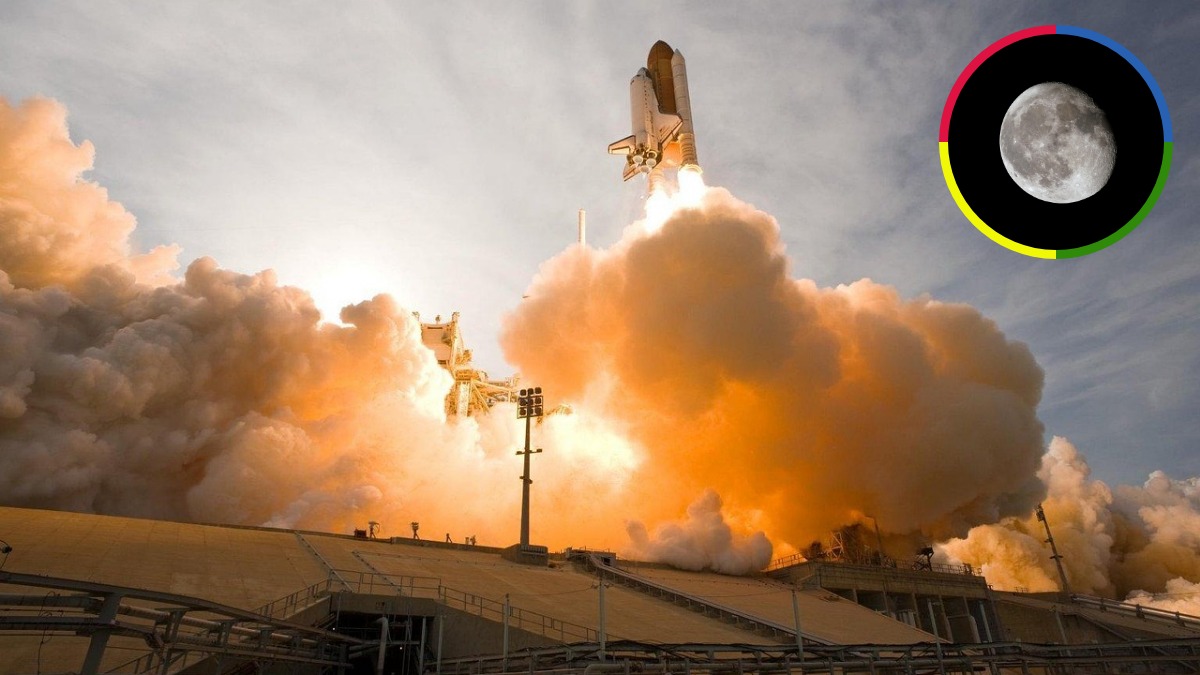

Space junk rarely makes headlines after a mission ends. This time, a discarded SpaceX rocket has scientists eagerly searching the moon for the evidence it left behind.
A Falcon 9 upper stage that spent more than a year drifting through space is believed to have slammed into the lunar surface late Tuesday, The Hill reported. Researchers say the collision created a brand-new crater and scattered debris across the impact site. Although nobody witnessed the crash directly, experts are confident it happened exactly where predictions suggested.
The unusual impact has also given scientists a rare chance to study how human-made objects behave when they collide with the moon. The findings could prove valuable as lunar missions become more frequent in the coming years.
It’s wild to think a forgotten rocket ended up leaving a fresh scar on the moon
A discarded Falcon 9 upper stage struck the moon at about 2:35 PM EDT, according to KTLA. The school bus-sized rocket was traveling around 5,400 mph, or roughly seven times the speed of sound. Scientists believe the impact created a crater measuring about 60 to 90 feet wide near Einstein Crater. The site sits close to the boundary between the moon’s near side and far side.
The rocket originally launched from Florida on Jan. 15, 2025. As reported by The Associated Press, it carried two spacecraft toward the moon before completing its job. Unlike most Falcon 9 upper stages, this one could not return to Earth because it was traveling on a lunar trajectory at extremely high speed.
Instead, SpaceX performed a maneuver designed to leave the stage in a safe orbit. However, Space.com reported that the moon’s gravity and solar activity slowly changed its path. Over time, the roughly 9,000-pound rocket entered an unavoidable collision course with the lunar surface.
No one saw the impact itself because experts expected the flash to be too faint for Earth-based observers. However, telescopes in Chile and Arizona detected what researchers believe was a cloud of sodium-rich and lithium-rich material rising from the crash site.
Boston University scientist Carl Schmidt said his team is “100% certain” the observations captured the impact. Retired astrophysicist Jonathan McDowell added there was “no doubt” the rocket shattered into small fragments after the collision.
NASA has not yet released images confirming the impact site. According to SpaceX, the agency’s Lunar Reconnaissance Orbiter and the ShadowCam instrument aboard South Korea’s Korea Pathfinder Lunar Orbiter are expected to search for before-and-after images in the coming days.
Researchers say the crash offers a valuable opportunity to understand how artificial objects strike the moon and how debris behaves in the lunar environment. The data could help prepare future robotic missions and astronauts as lunar exploration continues to expand.
The scientific impact of SpaceX’s missions comes at a time when the company itself continues to grow rapidly. SpaceX’s potential IPO and soaring valuation have placed the company at the center of wider conversations about the future of commercial space exploration.
The incident also highlights growing concerns about space debris beyond Earth’s orbit. Scientists note this is the second known accidental rocket impact on the moon after a Chinese rocket stage struck the lunar far side in 2022. While experts say there is no immediate danger, they believe stronger space traffic management will become increasingly important as missions to the moon become more common.
The conversation around SpaceX’s growing launch activity has also extended beyond space itself. Residents near the company’s South Texas launch facility have filed a lawsuit over alleged impacts from rocket operations, raising separate questions about how the expansion of commercial spaceflight affects communities on Earth.









Published: Aug 8, 2026 02:45 pm