


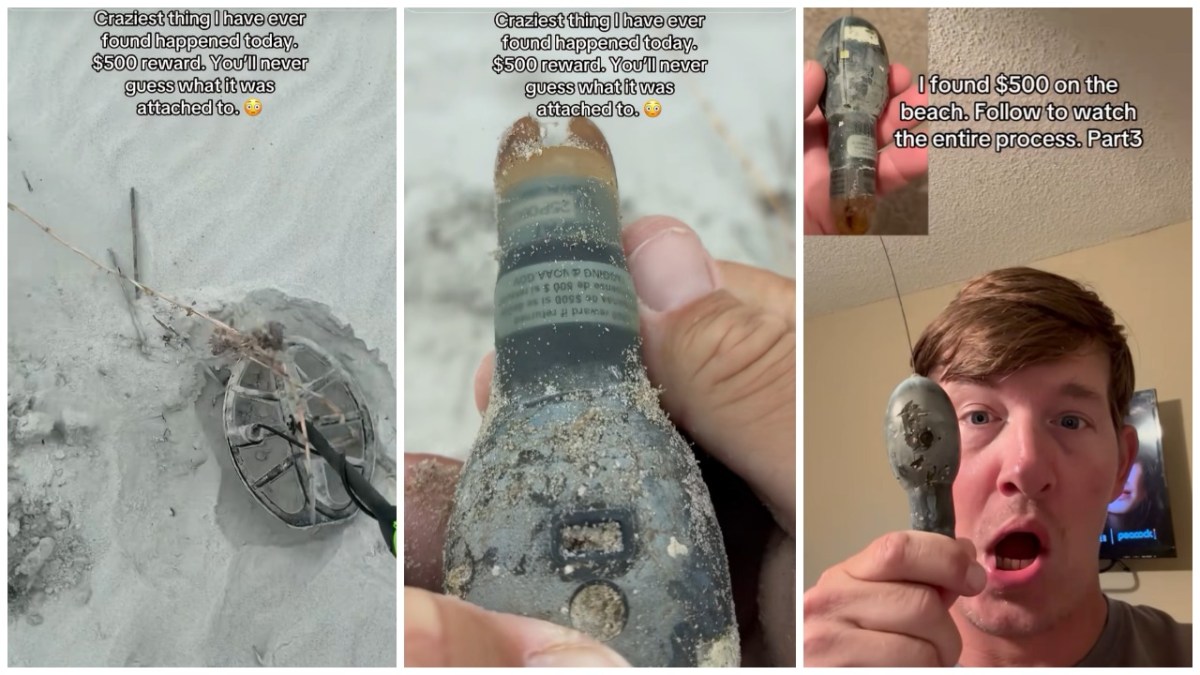

Metal detectorist Joseph Cook considers himself a treasure-hunting expert, but found himself stumped when he found a strange device on a beach in Saint Augustine, Florida. In a series of videos on Instagram (joedigger2021) and TikTok (joedigger), with over nine million views, he and his viewers identified the elongated, bulb-like device with an antenna. In the first video, Cook pulled the object from the sand and first banged it against his shovel to clear the sand, saying, “What the h*ll is that?”
As he rubbed the sand off the translucent white material covering the device, a light came on, startling him, and he hunted for any identifiers, finally noticing a label at the base of the bulb. Cook was shocked by what he read, saying, “Oh, reward if returned. What?! Wait really?… Whoa! I just found 500 bucks, man!” However, while he thought it was his “coolest find” of the month, he still asked his viewers for help identifying it.
His users came through with answers, but there was a larger flood of anxious messages about how he had treated the device when he picked it up. One user summarized the concern, writing, “I kinda winced when you started banging the grenade-shaped metal object around.”
The animal tracking tag made Cook and his viewers excited
Users in the comments believed that the device was an ocean-specific tracker used by marine researchers. Many scientists and research students came to the comments asking Cook to return the device quickly. As one person wrote, “That’s probably someone’s whole research project in your hand, and they’d love to have it back!”
According to Wildlife Computers, the device was a pop-up satellite archival tag, known as a MiniPAT. It is a sophisticated tool that combines archival and satellite technology to track the behavior of large marine life like sharks and whales. It collects data on depth, temperature, and light levels, storing them in onboard memory. Once a pre-programmed date arrives, the tag releases from the animal, floats to the surface, and transmits a summary of the data to satellites.
In a follow-up video, Cook came to tell his viewers that he had done a lot of research into it and realized why so many viewers asked him to return it. He told his viewers that when the device detaches, scientists can only download some data. The company offers a reward for the return so that “they can download all of the high-definition data.” Tags like these also track the location and health of animals like sharks and spot anomalies that might indicate problems like illegal fishing.
In his third video, Cook joked about the many messages he got about the device looking like a bomb, announcing, “Y’all, I found a bomb.” In a previous message where a viewer had expressed concern about him hitting what looked like a bomb, Cook joked, “Yeap Joe Dirt lived hitting things on his scoop.”
Cook then shared the conversation he had with the organization. The representative, a woman named Maya, seemed excited and asked him not to clean the tag, stating that researchers prefer to see it in its found condition. His viewers are now waiting for additional updates.







Published: Nov 21, 2026 07:00 am