



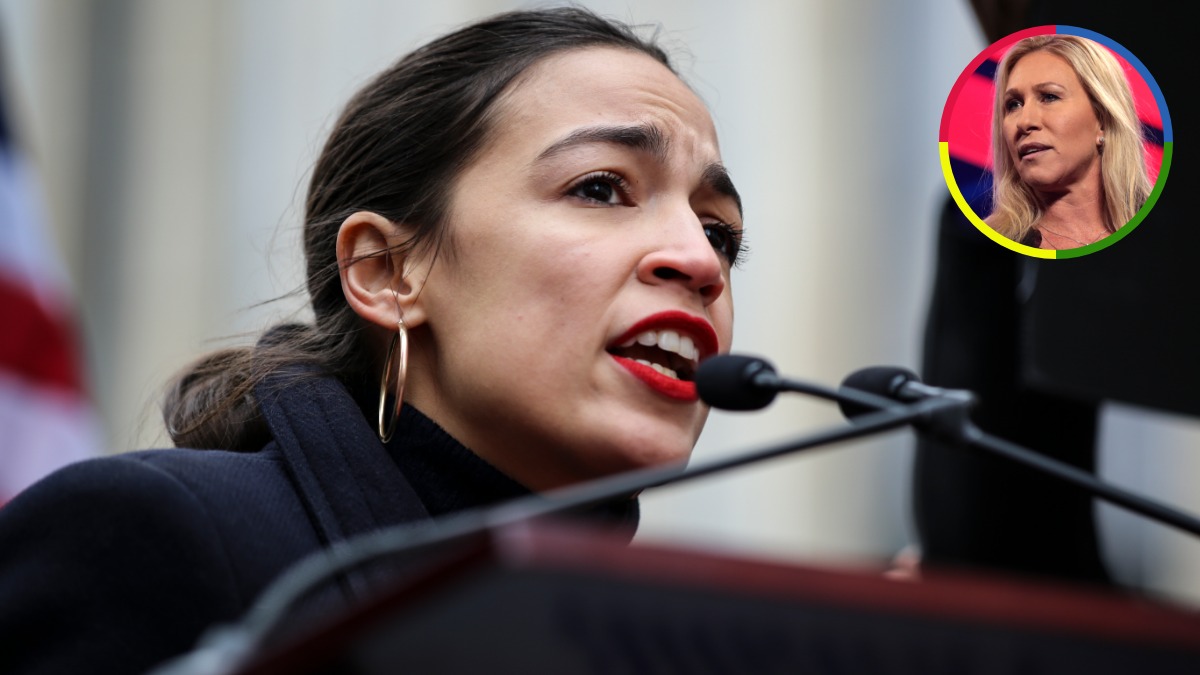

Representative Alexandria Ocasio-Cortez drew a firm line in the sand regarding potential alliances with former Representative Marjorie Taylor Greene. During a conversation at the University of Chicago Institute of Politics, Ocasio-Cortez made it crystal clear that she has no intention of working with the former Georgia Republican, despite some members of the progressive left suggesting that such partnerships could be mutually beneficial, NBC News reported.
Ocasio-Cortez did not mince words when asked about the possibility of aligning with Greene on specific issues, such as foreign policy regarding Israel and Gaza. She stated, “I personally do not trust someone like Marjorie Taylor Greene, a proven bigot and antisemite, on the issue of what is good for Gazans and Israelis.” She went on to explain her reasoning, noting that she does not believe it serves the progressive movement to align with white nationalists.
Greene, who resigned from Congress in January, did not take the comments lightly. In an interview on Monday, she pushed back against the labels used by Ocasio-Cortez. “I’m not a bigot. I’m not an antisemite,” Greene said. She claimed that her opposition to funding Israel was based on her belief that the United States should not be involved in such foreign spending, rather than the motivations attributed to her by Ocasio-Cortez. Greene also dismissed the notion of toxic politics, stating that she does not participate in that style of discourse anymore.
AOC’s stance highlights a significant internal divide within the political left, especially as the shadow of the 2028 presidential cycle begins to loom over Washington
The disagreement has sparked a broader conversation about political strategy. While Ocasio-Cortez is holding firm to her ideological boundaries, other prominent voices on the left are frustrated by her refusal to work with someone who has broken with party leadership on key issues. Representative Ro Khanna, a fellow Democrat and a potential 2028 contender, has taken a different approach. Khanna has successfully partnered with Republicans, including Greene, on specific legislative goals, such as the effort to force a vote on the release of the Jeffrey Epstein files.
Khanna explained his perspective in a conversation on Monday. “I was raised with Midwestern values in Bucks, Pennsylvania, where we extended grace to our neighbors. I guess I still believe in trying to find common ground where possible as Americans to keep us out of foreign wars and hold the Epstein class accountable,” he said. He added that he believes it is possible to maintain a commitment to a multiracial democracy while still finding areas of agreement with political opponents.
This divergence between Ocasio-Cortez and Khanna underscores the muddled nature of modern American politics. The fact that the left flank of the Democratic Party is split on this issue shows that the traditional rules of coalition building are being tested. Some progressives argue that the focus should be on results, especially when it comes to challenging corporate power or ending foreign wars.
Even Senator Bernie Sanders has previously signaled a willingness to look past partisan labels. In a town hall back in October 2025, Sanders praised Greene as a “good Republican” for her decision to prioritize her constituents over party loyalty regarding the Epstein files. This puts Ocasio-Cortez, who is often seen as the political heir to the movement built by Sanders, in a difficult position. She is attempting to balance the need for ideological purity with the practical realities of a highly polarized political environment.
The tension also brings up questions about the future of the Democratic Party as it looks toward the 2028 election. Ocasio-Cortez and Greene both represent powerful, yet distinct, populist movements. If Ocasio-Cortez decides to pursue a run for the White House, her refusal to align with figures like Greene will likely be viewed as a defining feature of her platform.







Published: May 12, 2026 06:00 pm