



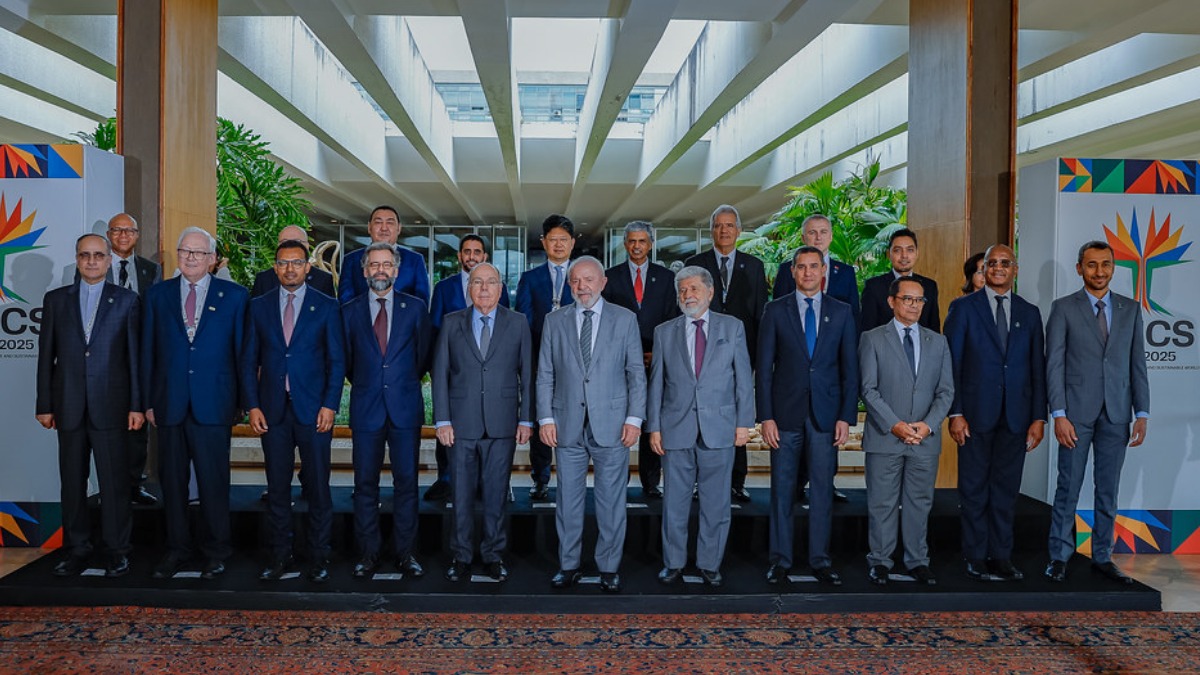

The BRICS Foreign Ministers meeting recently concluded with a significant push for the creation of an independent and viable State of Palestine. This development, finalized at the conclusion of the summit, explicitly calls for a sovereign state within the pre-1967 borders, with East Jerusalem serving as its capital, The Hindu reported.
While the group found common ground on the issue of Palestinian statehood, the summit was far from a total consensus on every topic. In fact, the level of disagreement between member delegations was high enough to prevent the release of a traditional Joint Statement. Instead, the attendees had to settle for a Chair’s Statement and Outcome Document, which reflects the complex and often fractured nature of the alliance.
The Chair’s Statement was quite specific about the path forward, noting, “They reaffirmed their support for the State of Palestine’s full membership in the UN in the context of the unwavering commitment to the two-state solution in accordance with international law, including relevant UN Security Council and General Assembly resolutions and the Arab Peace initiative, that includes the establishment of a sovereign, independent and viable State of Palestine within the internationally recognized 1967 borders, which included Gaza Strip and the West Bak, with East Jerusalem as its capital, to achieve the vision of two States living side by side in peace and security.”
This puts the bloc on a clear collision course with the current geopolitical strategies favored by the United States and Israel
Despite this agreement on the core framework, the atmosphere inside the Bharat Mandapam was tense. Specifically, the delegations from the United Arab Emirates and Iran were locked in what sources described as extensive exchanges. The friction became public when Iran’s Foreign Minister, Seyed Abbas Araghchi, held a press conference on May 15, 2026.
When asked about reports that a member state had blocked specific language regarding the Gaza Strip, Araghchi did not hold back. He stated, “Everybody knows which country blocked anything against Israel. This country provided in-depth help to the US and Israel with their military bases. As far as we are concerned, they are a direct party to this aggression and should be held responsible.”
This tension is tied to the future administration of the Gaza Strip. The BRICS document characterizes the territory as an “inseparable part of the Occupied Palestinian Territory” and advocates for unifying the West Bank and the Gaza Strip under the Palestinian Authority. This transition would involve moving control away from Hamas, which has been blamed for the October 7, 2023 attacks on Israel. Because of the ongoing conflict, both Iran and the UAE raised objections to the specific wording used in these sections of the document.
The disagreements didn’t stop with the Middle East conflict. There was also significant resistance from Iran regarding the document’s language on the Bab Al-Mandab Strait and the Red Sea, where Houthi militias have been active.
Araghchi also addressed the situation in the Strait of Hormuz, which he described as a complicated maritime region. He insisted that the area falls within the “territorial waters of Iran and Oman” and rejected the idea that it should be treated as an international maritime zone. He clarified his position by saying, “Iran and Oman are two countries involved in the two sides of the Strait of Hormuz. The Strait is located in the territorial waters of Iran and Oman, and there are no international waters in between. So, everything should be managed between Iran and Oman.”
The Chair’s Statement ultimately acknowledged these divisions, noting that “There were differing views among some members as regards the situation in West Asia/Middle East region.” While the document urged a return to dialogue and diplomacy, it also highlighted the need for the “safe and unimpeded flow of maritime commerce through international waterways.” This phrasing was a clear pushback against Iran’s stance on the Strait of Hormuz, even though Araghchi maintains that the future of the waterway is a matter to be settled between his country and Oman.
Meanwhile, other members of the bloc were focused on different priorities. Russian Foreign Minister Sergey Lavrov used the summit to assure India of continued energy supplies and to discuss the North-South Transport Corridor and nuclear energy cooperation. Araghchi also touched on regional connectivity, describing the port of Chabahar as a “golden gate” for India to access Central Asia and the Caucasus and then Europe.





Published: May 18, 2026 05:30 pm