



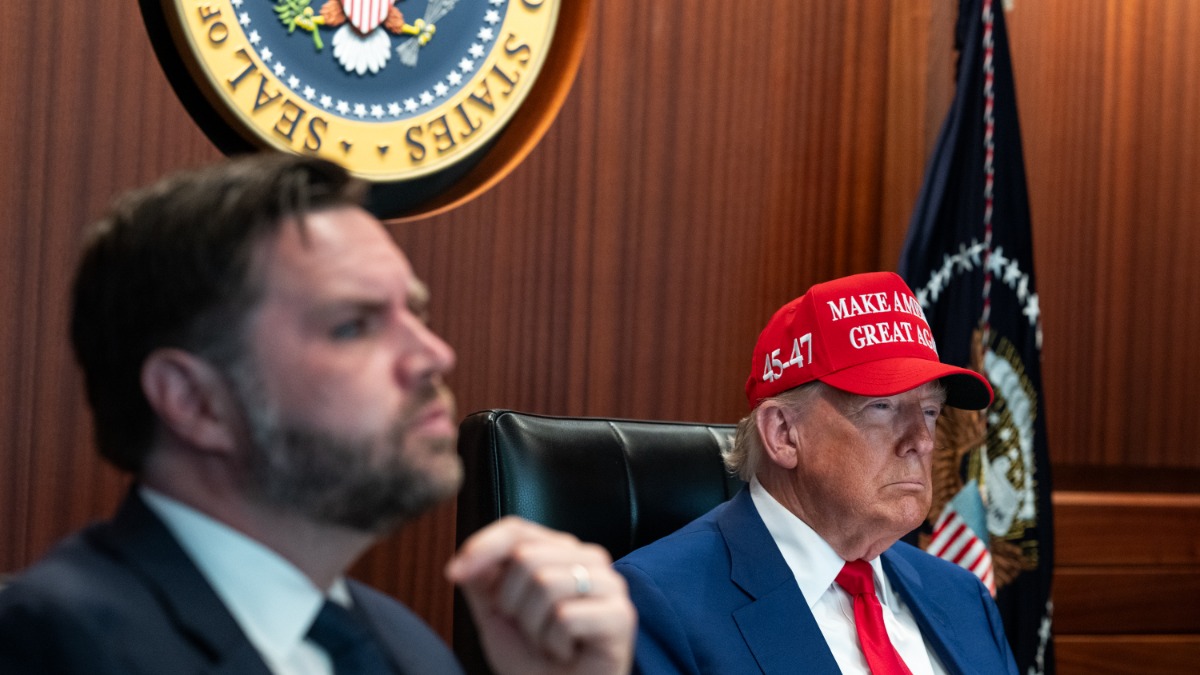

The United States is preparing for a possible return to conflict with Iran as a ceasefire is set to expire in just three days. President Donald Trump held an emergency Situation Room meeting at the White House on Saturday to address the growing crisis around the Strait of Hormuz and the ongoing negotiations with Iran.
Iran’s Supreme National Security Council said on Saturday that it is reviewing new proposals put forward by the U.S. during mediation talks led by Pakistani army chief Asim Munir. However, no new meeting date has been set between U.S. and Iranian negotiators, which means the risk of talks falling apart and fighting resuming remains very real.
Iran’s announcement about closing the Strait again, along with multiple attacks on vessels in the waterway, came less than 24 hours after Trump said a deal could happen “within a day or two.” According to Axios, a senior U.S. official warned that if no breakthrough happens soon, the war could resume within days.
The U.S. naval blockade and Iran’s closure of the Strait are pushing the two sides closer to the edge
The Situation Room meeting was attended by Vice President Vance, Secretary of State Marco Rubio, Defense Secretary Pete Hegseth, and Treasury Secretary Scott Bessent. White House Chief of Staff Susie Wiles, White House envoy Steve Witkoff, CIA Director John Ratcliffe, and Joint Chiefs chairman Dan Caine also took part.
This all comes at a time when the White House has been making headlines on multiple fronts, including a major event Trump is planning at the White House for his 80th birthday. The renewed crisis came after both sides had actually made some progress in closing the gap on issues like Iran’s uranium enrichment and its stockpile of enriched uranium.
According to a source familiar with the talks, Iran’s decision to close the Strait is a response to what it sees as the U.S. acting in bad faith. The closure has effectively disrupted the flow of oil tankers and commercial ships that pass through the waterway daily, adding pressure on both sides to reach a resolution quickly.
The U.S. has pushed back on that claim. Trump said Iran “wanted to close up the strait again” and that “they can’t blackmail us.” He added, “It’s going actually along very well, and we’ll see, but we’ll have some information by the end of the day.” Meanwhile, the Trump administration has also been facing scrutiny over a new government app with privacy concerns that critics say collects excessive user data.
The U.S. Central Command stated that since the naval blockade of Iranian ports began on Monday, 21 ships have been turned back to Iran. Per NBC News, the Central Command says the blockade applies to “ships attempting to enter or exit Iranian ports.” Iran’s military has pledged to maintain control over the Strait of Hormuz for as long as the U.S. blockade stays in place, making it unclear how either side backs down without appearing to give in first.
The Strait of Hormuz is one of the most important waterways in the world, connecting the Persian Gulf to the Gulf of Oman. Roughly 20% of the world’s oil supply passes through it, and a prolonged closure would send oil prices surging and shake global energy markets. The U.N. has urged restraint from all parties, and the European Union has offered to help mediate talks between Washington and Tehran.
With no clear deal on the table and the ceasefire window closing fast, the situation remains highly unstable. Both governments appear to be holding firm on their positions, and unless one side makes a significant move in the coming hours, the path to renewed conflict looks increasingly likely.









Published: Apr 19, 2026 08:00 am