



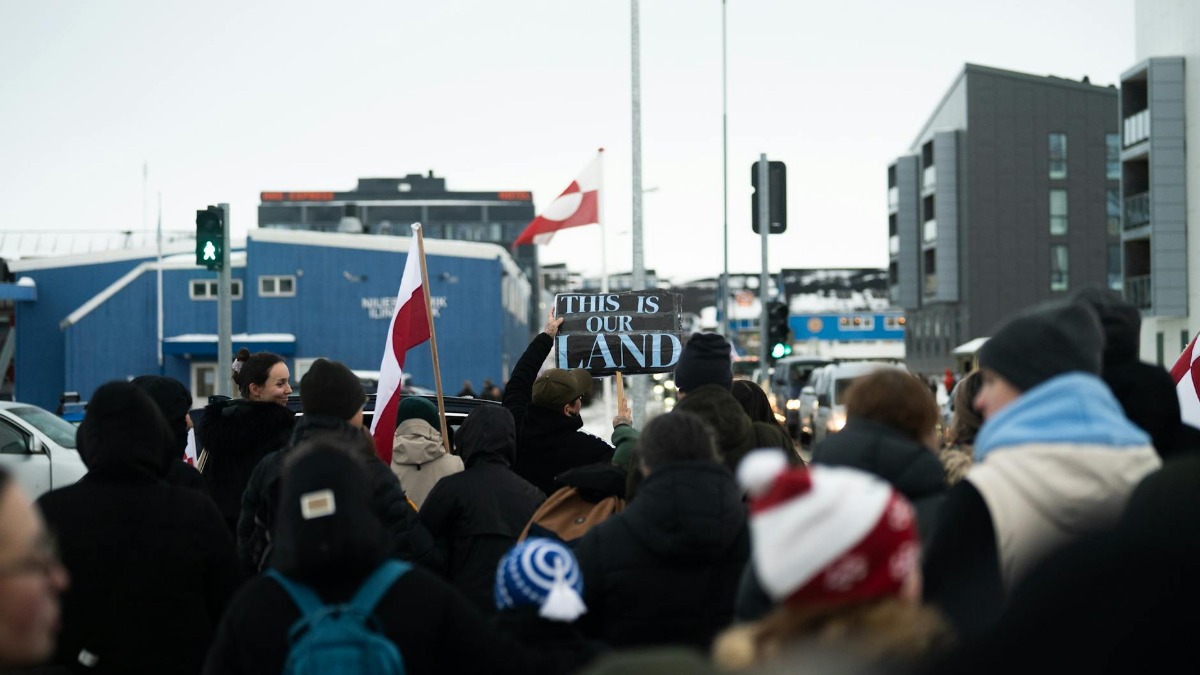

The streets of Nuuk, Greenland’s capital, were filled with protesters chanting “No means no” and “Greenland belongs to the Greenlanders” outside the new U.S. consulate. They were responding to a visit by Louisiana Governor Jeff Landry, who was appointed as a special envoy to Greenland by President Donald Trump in December. Landry met with Prime Minister Jens-Frederik Nielsen and Foreign Minister Múte Egede during his visit.
The next day Trump posted an image on his Truth Social account showing himself looking over Greenland’s colorful A-frame homes. According to Newsweek, the post was simply captioned “Hello, Greenland!” and was met with anger from many Greenlandic people, who see Trump’s actions as a direct threat to their sovereignty and way of life.
Greenlanders have been clear about their opposition to Trump’s plans. “We don’t want to be Americans,” said Qarsoq Høegh-Dam, a lawmaker who represents Greenland in the Danish parliament and supports independence from Copenhagen. “This is an f-ed up situation,” he added. “This is not an accredited diplomatic envoy, but nonetheless this is someone who has close ties to the highest office in the United States.”
Greenland’s history of colonization makes Trump’s ambitions feel deeply personal to its people
For many Greenlanders, this is not just a political issue, it is about their culture and identity. “We have already been through colonization once,” said Sara Olsvig, a former lawmaker in both the Greenlandic and Danish parliaments. “And we don’t want to go through it again.”
Olsvig is now chair of the Inuit Circumpolar Council, which represents 180,000 Inuit people across Alaska, Canada, Greenland, and Russia. She stressed the importance of respecting the rights and autonomy of indigenous peoples, something she feels Trump’s actions are putting at risk.
Greenland has a long history with colonization, going back to the 18th century when Denmark-Norway established a settlement on the island. Denmark has maintained control over Greenland since then, with the Greenlandic people having limited autonomy and self-governance. In recent years, some Greenlanders have been pushing for full independence from Denmark, reports NBC News.
The United States has had a long-standing interest in Greenland since World War II, when it established a military base there. Today, the U.S. operates a space base at Pituffik, used for both military and scientific purposes. Trump has repeatedly said he wants to expand U.S. influence over Greenland, pointing to concerns about Russia and China’s growing presence in the region.
In fact, reports suggest Trump has even considered teaming up with Russia and China against a common enemy as part of his broader geopolitical strategy. While the U.S. and Denmark remain committed to their alliance on issues like security and trade, Greenlandic people are not willing to give up their sovereignty.
Many are concerned not just about politics, but also about what U.S. control could mean for their environment and their cultural identity, which they have fought hard to protect for generations. Trump’s foreign policy moves have been drawing intense scrutiny lately, including reports that he was leaning toward launching a strike on Iran while managing several other major decisions at the same time.
The protests in Nuuk are a strong signal that Greenlanders are not willing to sit back and watch their future be decided by a foreign leader. Demonstrators gathered outside the U.S. consulate made their message clear, and the chants of “No means no” reflect a deep and widespread resistance among the population. Local lawmakers and civic leaders have both spoken out, showing opposition to Trump’s ambitions.
The Greenlandic people have made it clear they will not be pushed around or stay quiet in the face of Trump’s ambitions. As protests continue and tensions remain high, the situation is still unresolved, and what comes next for Greenland is very much an open question.







Published: May 24, 2026 06:30 am