



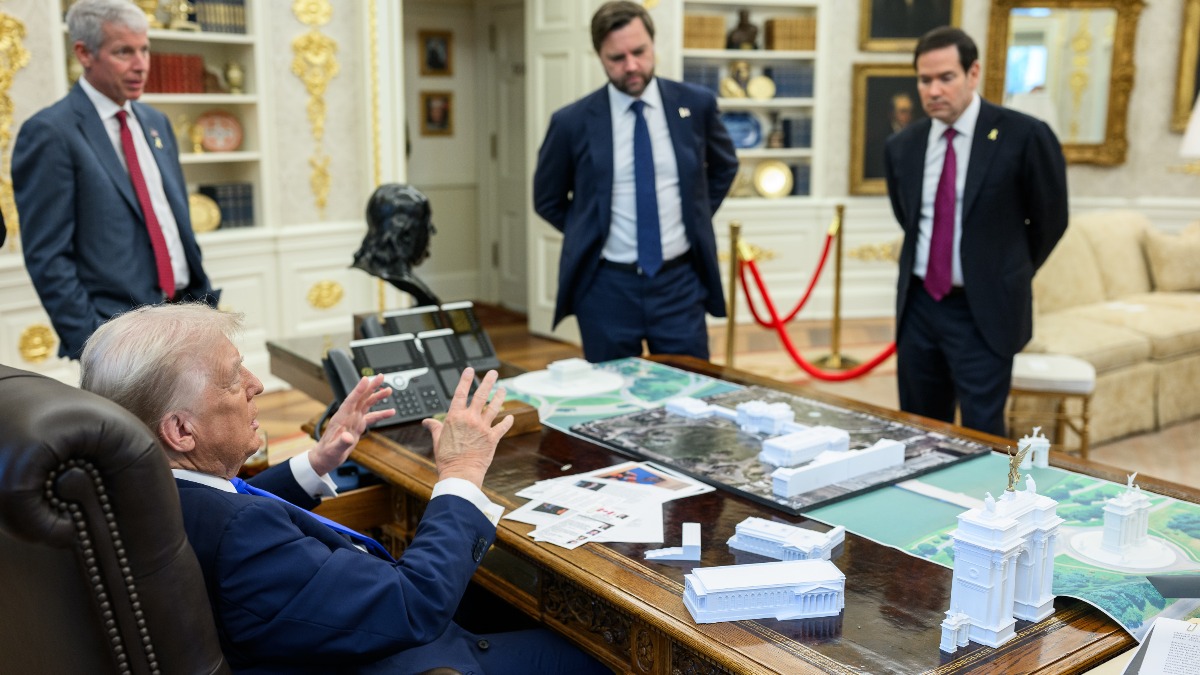

President Trump has repeatedly said his ballroom would not cost taxpayers any money. But a new analysis from The New York Times shows his building spree relies heavily on public funds. The President has often described these projects as gifts to the country, paid for by private donors.
Across 18 major projects that are either underway or finished during his second term, the total possible cost is over $1.2 billion. A large part of that amount falls directly on taxpayers. The biggest project is a new 90,000-square-foot ballroom being built in the East Wing. Trump first said the $400 million project would be paid for entirely with private money, but the actual funding picture is unclear.
Trump’s allies in Congress have openly offered to use taxpayer money to help pay for the ballroom’s construction. The Secret Service has also said that hundreds of millions of dollars in security upgrades tied to the project will be paid for by the public.
Officials have offered public money for the ballroom project
There is also little transparency about the private donations for the ballroom. The White House has released only a partial list of donors and has not shared how much money each individual donor gave. Separately, questions about White House transparency have come up elsewhere, including a report describing how a federal office tracked visitor activity online.
Beyond the ballroom, the administration wants to build a $400 million security center and military bunker under Sherman Park. A funding request for this project was removed from a recent spending bill. However, the administration has already shifted more than $350 million from the Secret Service’s budget to pay for various security upgrades across the White House grounds.
This pattern of moving money around shows up in other projects too. The renovation of the Lincoln Memorial Reflecting Pool grew to $16.4 million in cost. The administration skipped the usual competitive bidding process and gave out no-bid contracts, saying the work needed to be finished quickly before a July 4 deadline.
Since then, the project has run into problems with algae blooms and peeling paint. The President has blamed vandals for these issues rather than the rushed construction work. Other projects also depend heavily on federal money.
The Interior Department is directly paying for the $5.1 million project to gild statues near the National Mall. The Eisenhower Executive Office Building is being repainted white using money from the executive branch’s regular maintenance budget. The $250 million set aside for repairs at the Kennedy Center also comes from federal taxpayer dollars.
The funding source for the proposed 250-foot Triumphal Arch is still not clear. However, the National Endowment for the Humanities has already committed $15 million toward the project. Several smaller projects follow the same pattern of unclear funding.
These include the $2 million renovation of the Rose Garden, now renamed the Rose Garden Club, along with marble upgrades in the Lincoln Bedroom and the Palm Room, whose costs have not been made public. In each case, the administration has not provided clear details about where the money is coming from.
A White House spokesman recently said that taxpayer money would likely cover most of these projects. The spokesman also noted that ongoing costs for maintenance and repairs will eventually be paid by various government agencies. The spending has also drawn criticism from political opponents, including comments from Biden accusing Trump of corruption.
Other planned or ongoing work includes turning the East Potomac Golf Links into a championship-level golf course, along with renovations to the West Colonnade and the Oval Office, both of which remain unclear in terms of funding. While the President continues to describe these projects as privately funded gifts to the nation, the data suggests taxpayers are covering a significant share of the costs.





Published: Jul 1, 2026 09:30 am