



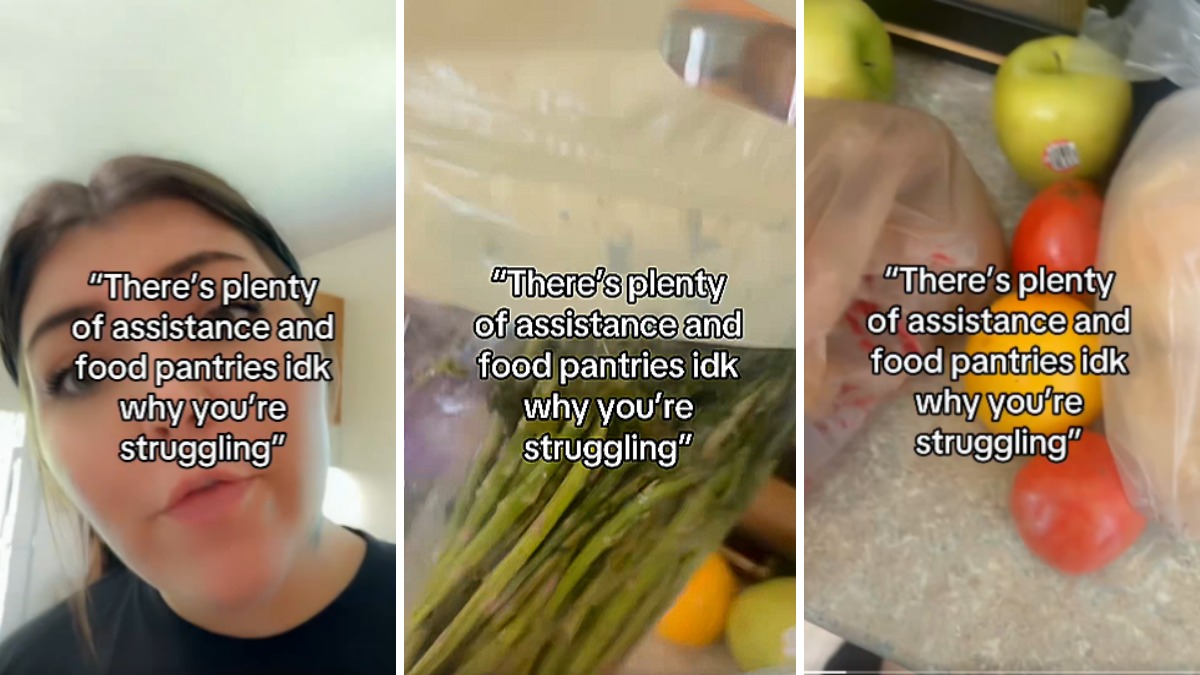

A woman recently shared her frustrations after visiting a local food pantry, highlighting a stark disconnect between the intended purpose of these services and the reality of what she received. As reported by Daily Dot, the situation came to light through a video posted on X, where the woman documented the poor condition of the items in her care package.
In the video, the woman walks the viewer through her haul, clearly disappointed by the state of the produce. She states, “You want to know what I get when I go to the f***** food pantry? Moldy cucumbers. Moldy blackberries. Wilted and molded asparagus. Wilted and molded basil. Mushy apples. Mushy tomatoes. Mushy potatoes.”
She didn’t stop there, though. She also pointed out bread and muffins that were being distributed on August 10, despite having printed dates from mid to late July. She expressed her frustration by saying, “This has to be thrown away. I don’t care if it doesn’t have mold on it. July 11th is f***** crazy.” She concluded the video with a blunt, “I f***** hate it here.”
What the law actually requires from food pantries
While the Bill Emerson Good Samaritan Food Donation Act was designed to encourage the donation of food to nonprofit organizations by limiting liability for donors, it relies heavily on the concept of “apparently wholesome food.” Under this law, donated items should meet quality and labeling standards, even if they aren’t perfectly marketable due to minor issues like appearance or age. However, when those standards drop to the point of distributing moldy or severely expired goods, it suggests that the system is failing to meet the basic needs of the people it is meant to serve.
Interestingly, the narrative surrounding food pantries isn’t always uniform. After sharing the woman’s video, the account that posted it offered a very different perspective, claiming that their own experience at a food bank in Florida was much more positive. They described waiting in a drive-through line for about 45 minutes and receiving a haul that included eggs, various cheeses, plant-based meat, hummus, cold brew coffee, chicken, turkey, pasta, rice, and canned goods.
They went as far as to argue that people could “eat better than people who do go to work” without needing a job, though this claim was not supported by any data. Others focused on the quality of donations, specifically pointing to the role of large grocery chains. A similar case surfaced when a dad’s front-yard food pantry went viral, showing a very different side of what these programs can look like.
It is clear that the quality of food pantries can vary wildly depending on the location, the donors, and the management. While the law protects those who donate in good faith, it doesn’t solve the problem of ensuring that the items reaching the end recipient are actually fit to eat.








Published: Aug 17, 2026 03:45 pm