



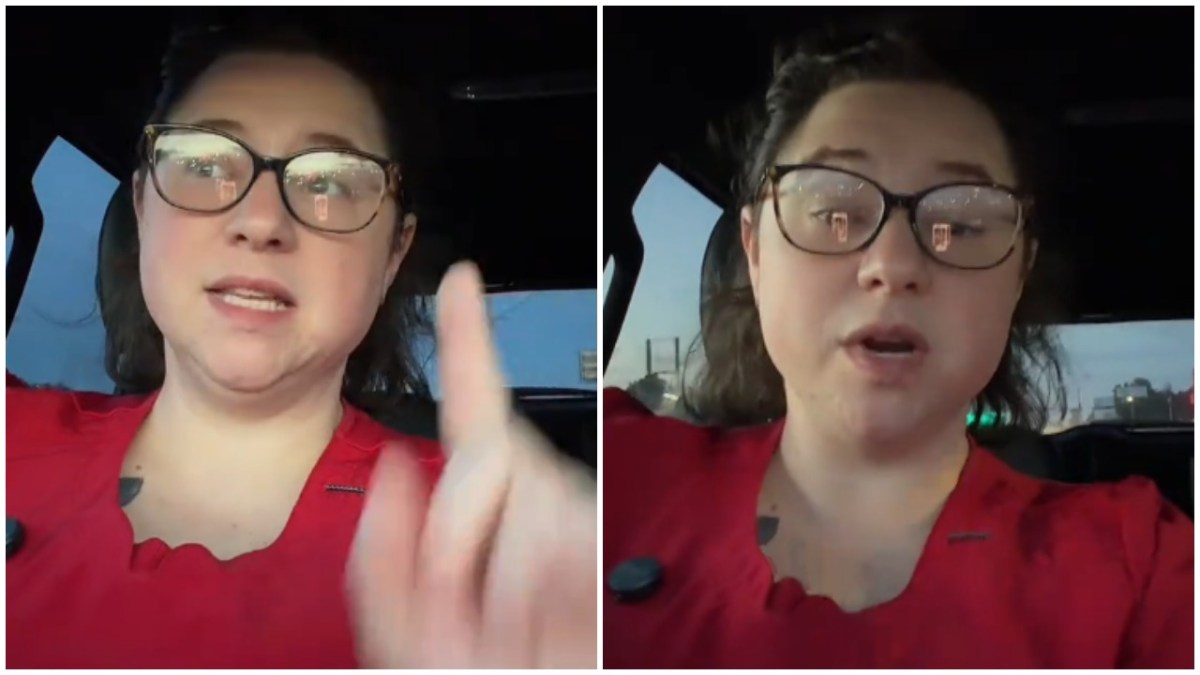

A nurse who posts on TikTok as Seslie Jones (@lesliewithans) said in a video that she finished three straight 12-hour shifts and then drove for DoorDash until 9:30 p.m. each night. The clip has drawn about 1.1 million views, 148,300 likes, and 5,220 comments. On-screen text asked, “Wanna know how bad it is?” Her caption read, “The economy we live in is killing me. How about you?”
Jones said she is a nurse in the United States and a single mother. A brief shot in the video showed a baby in a car seat. The car display listed Monticello, AR, and 91°F. She stated she got off work at 7 p.m. and DoorDashed afterward on all three days.
She claimed the country is facing the biggest depression it has ever experienced. She then compared today’s conditions with the Great Depression and said she is not making almost six figures after nearly 16 years as a nurse.
Historical average family income in the early 1930s was recorded as an annual figure
Jones said that during the Great Depression “the average household was making $8,400 a month.” She added that people who kept their jobs had pay “cut in half, which left them making about $4,200 a month.” She said a calculator put that later amount at “about $95,000 a year” in today’s money. “And I don’t know about you, but me, I’m not making almost 6 figures a year. I’m not,” she said.
However, the Gilder Lehrman Institute of American History has written that by 1933, average family income had tumbled 40 percent, from $2,300 in 1929 to $1,500 four years later. Those Institute figures are annual totals. Divided across 12 months, $2,300 in 1929 comes to about $192 a month, and $1,500 in 1933 comes to about $125 a month.
Jones also told viewers that if they are making it, even while having to “bust your f–king a– every day, be proud of yourself because times are hard. Times are very f–king hard.” Such economic anxieties are not unique to her, as seen when a former president commented on recent inflation figures.
A Gallup survey reported by Axios in April 2026 found that 55% of respondents said their financial situation was getting worse, the highest share in that 25-year series since 2001. The figure was up from 53% the prior year and 47% in 2024. Axios reported it was the fifth consecutive year that more Americans said their finances were worsening rather than improving. When asked for their most important financial problem, 31% cited the cost of living, and 13% mentioned energy costs.
The Guardian reported in August 2026 on a mid-April survey of more than 30,000 adults by the McKinsey Institute for Economic Mobility and the W.K. Kellogg Foundation. Sixty percent of respondents said a better life in three to five years would mean greater financial security.
Forty percent described themselves as “getting by but financially vulnerable” or “struggling to meet basic needs.” Ninety percent listed groceries and food as their top cost-of-living concern. The same article cited a Harris poll finding that 95% of Americans believe the country is undergoing an affordability crisis.
Viewers responded to Jones’s video with their own accounts of work and bills. One commenter wrote, “I stopped paying my credit, student loan, medical bills. I don’t care anymore. I am tired and I never have money for my f–king self.” Another wrote, “I’m a single mom making $18 an hour. I’m mentally, physically and financially drained.”
One person said, “I have talked to many nurses and 95% have a second job.” Another wrote, “I’m an engineer and I DoorDash on the weekends….” A different commenter said, “nurses are getting paid a lot…it’s always the spending issue, lol.”
Someone else wrote, “I’ve never worked so hard for so little it’s absolutely horrendous.” Another commenter wrote, “The economy is just f–king absurd. AI stole my job in compliance & ethics just last week.”





Published: Sep 29, 2026 12:45 pm