




Astronauts on the Artemis II mission are facing a rather unexpected challenge: their Microsoft Outlook isn’t working, with one crew member reporting two non-functional instances of the email client. This bizarre tech hiccup emerged during the early Earth-morning hours of their historic journey around the Moon, as reported by 404 Media.
The issue came to light around 2:00 AM ET, spotted by VGBees podcast host Niki Grayson on a NASA livestream. Mission control acknowledged an issue with a process control system and offered to remote in, much like your friendly IT support person would log into your computer to fix a password issue. Astronaut Reid Wiseman, one of the four crew members, coolly responded that while they were at it, he also noticed he had “two Microsoft Outlooks, and neither one of those are working.”
This little incident reminds me of another peculiar moment in space history. Back in 1969, during the Apollo 10 mission, which served as a crucial dress rehearsal for the first lunar landing, astronauts Thomas Stafford and Gene Cernan flew their lunar module within 10 miles of the Moon’s surface while John Young orbited in the command module.
You can train for decades, learn to operate complex spacecraft, and prepare for the vacuum of space, only to be foiled by a software bug that plagues countless office workers here on Earth
The mission was a huge success, an inspiring moment for humanity, but it also gave us one of the most memorable transcripts: “Who did what?” Young asked. “Where did that come from?” Cernan added. Then Stafford chimed in with, “Give me a napkin quick. There’s a turd floating through the air.” The origin of that particular piece of space debris remains a mystery, much like why Wiseman has two copies of Outlook that both refuse to function.
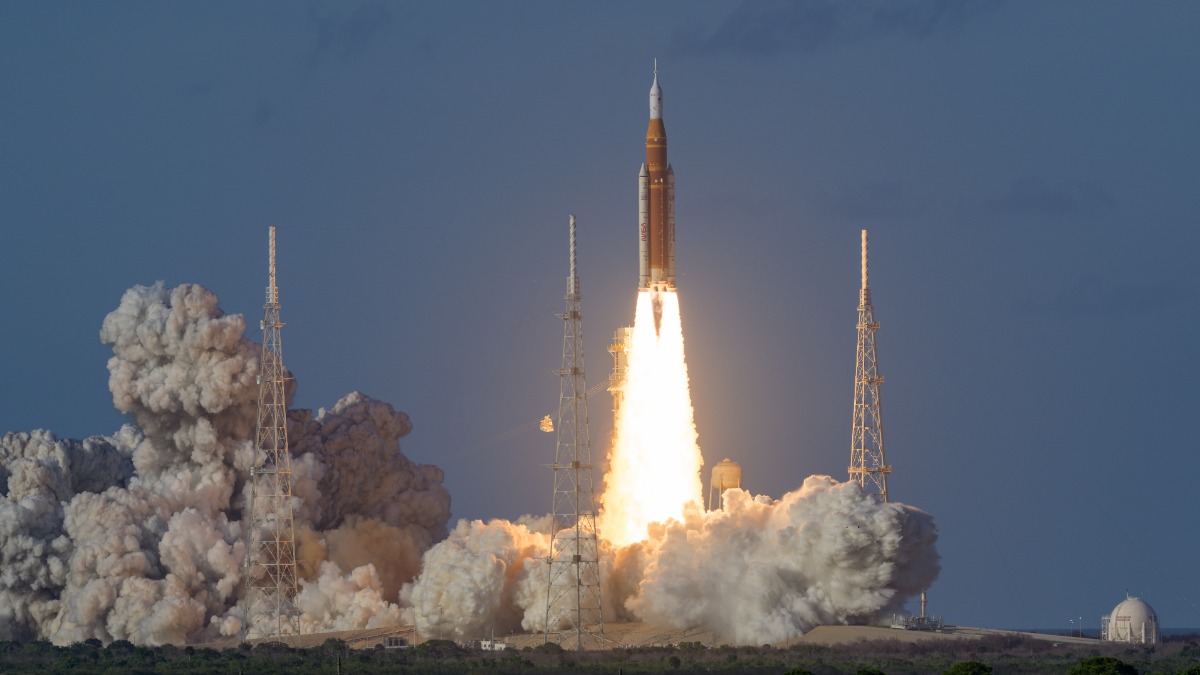
The Artemis II mission itself is a truly significant undertaking, marking the first time in over 50 years that humans are flying around the Moon. After a postponement due to technical reasons, this 10-day test flight began on April 1, when NASA’s SLS (Space Launch System) rocket and Orion spacecraft successfully lifted off from Launch Pad 39B at the agency’s Kennedy Space Center in Florida at 6:35 PM EDT.
The crew consists of NASA astronauts Reid Wiseman, Victor Glover, Christina Koch, and CSA (Canadian Space Agency) astronaut Jeremy Hansen. These folks are some of the smartest, most resilient people on the planet, trained for decades in incredibly grueling environments, which makes their Outlook problem even more ironic.
After reaching space, the Orion spacecraft, which the crew named “Integrity,” immediately got to work. It deployed its four solar array wings, which are vital for receiving energy from the Sun. The crew and ground engineers then started the intensive process of transitioning the spacecraft from launch to flight operations, meticulously checking out all the key systems.
This is a critical period for gathering data and learning from every step, as Dr. Lori Glaze, acting associate administrator for the Exploration Systems Development Mission Directorate at NASA Headquarters, explained. She emphasized that each milestone reached marks meaningful progress for the entire Artemis program.
About 49 minutes into the test flight, the SLS rocket’s upper stage fired, propelling Orion into an elliptical orbit around Earth. A second planned burn by this stage then sent Orion into a high Earth orbit, extending roughly 46,000 miles above our planet, where it spent about 24 hours undergoing further system checkouts.
After this crucial burn, Orion separated from the stage, flying free on its own. The crew then performed a manual piloting demonstration, testing Orion’s handling qualities by using the ICPS (interim cryogenic propulsion stage) as a docking target. Following the demonstration, Orion executed an automated departure burn, safely backing away from the ICPS. The stage then performed its own disposal burn, re-entering Earth’s atmosphere over a remote region of the Pacific Ocean. Before its re-entry, four small CubeSats were also deployed from the SLS rocket’s Orion stage adapter.
The crew has been incredibly busy, completing a host of other tasks since launch. They’ve successfully transitioned to the Deep Space Network for communications, which is essential for staying connected with Earth. They’ve also had time to acclimate to the space environment, complete their first rest periods, and even perform the first flywheel exercise to maintain their physical condition.
In a less glamorous but equally important development, they managed to restore the spacecraft’s toilet to normal operations. All these preparatory steps were crucial before the successful completion of the translunar injection burn, which accelerated Orion and its crew to break free of Earth’s orbit and began their outbound trajectory toward the Moon.







Published: Apr 3, 2026 05:00 pm