



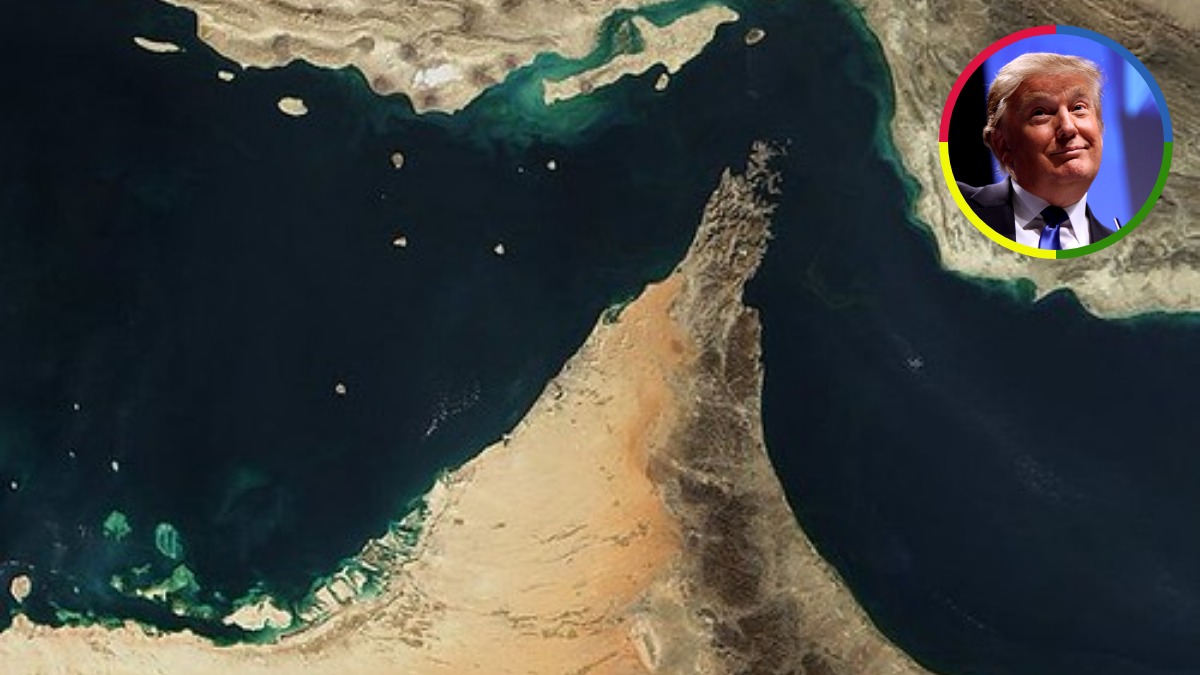

President Trump has informed his aides that he’s prepared to conclude the U.S. military campaign against Iran, even if the crucial Strait of Hormuz remains largely inaccessible, effectively ceding Tehran’s continued control over the vital waterway. This decision appears to push the complex operation of fully reopening the strait to a later date.
Administration officials revealed that President Trump and his team recently determined that a mission to forcefully open the chokepoint would extend the conflict beyond his preferred four-to-six-week timeline. Instead, the current strategy focuses on achieving the primary goals of crippling Iran’s navy and its missile capabilities, then winding down active hostilities, as reported by The Wall Street Journal.
The plan is to then pressure Tehran diplomatically to restore the free flow of trade. Should that fail, Washington would then lean on European and Gulf allies to spearhead efforts to reopen the strait. While military options remain on the table, they aren’t President Trump’s immediate priority.
The longer the Strait of Hormuz stays closed, the more it will destabilize the global economy and drive up gas prices
This approach has drawn sharp criticism from experts. Suzanne Maloney, an Iran expert and vice president at the Brookings Institution, didn’t hold back, calling the idea of ending military operations before the strait is open “unbelievably irresponsible.”
Maloney stressed that the U.S. and Israel initiated this conflict and can’t simply walk away from the consequences. She pointed out that energy markets are inherently global, meaning there’s no way to shield the U.S. from the economic damage already occurring, which she believes will worsen exponentially if the strait remains closed.
Several countries, including U.S. allies, are already feeling the pinch from the reduced energy supply that once flowed freely through this critical chokepoint. Industries relying on essential items like fertilizer for food production or helium for computer chips are facing significant shortages. Without a swift return to safe passages, analysts predict Tehran will continue to threaten world trade until the U.S. and its partners either negotiate a resolution or forcibly end the crisis.
President Trump’s desire for a quick end to the conflict seems to clash with other moves he’s making. Just this past weekend, the USS Tripoli and the 31st Marine Expeditionary Unit entered the region. He has also ordered elements of the 82nd Airborne to deploy and is reportedly considering sending an additional 10,000 ground troops to the Middle East.
Despite these significant deployments, President Trump has, at times, referred to the war as “an excursion” and “a lovely stay.” Yet, he’s also reportedly weighing a complex and risky mission to seize the regime’s uranium.
White House Press Secretary Karoline Leavitt told reporters that the U.S. is “working towards” normal operations in the strait. However, she notably didn’t list it among the core military objectives of targeting Iran’s navy, missiles, defense industry, and its ability to develop a nuclear weapon.







Published: Mar 31, 2026 03:45 pm