



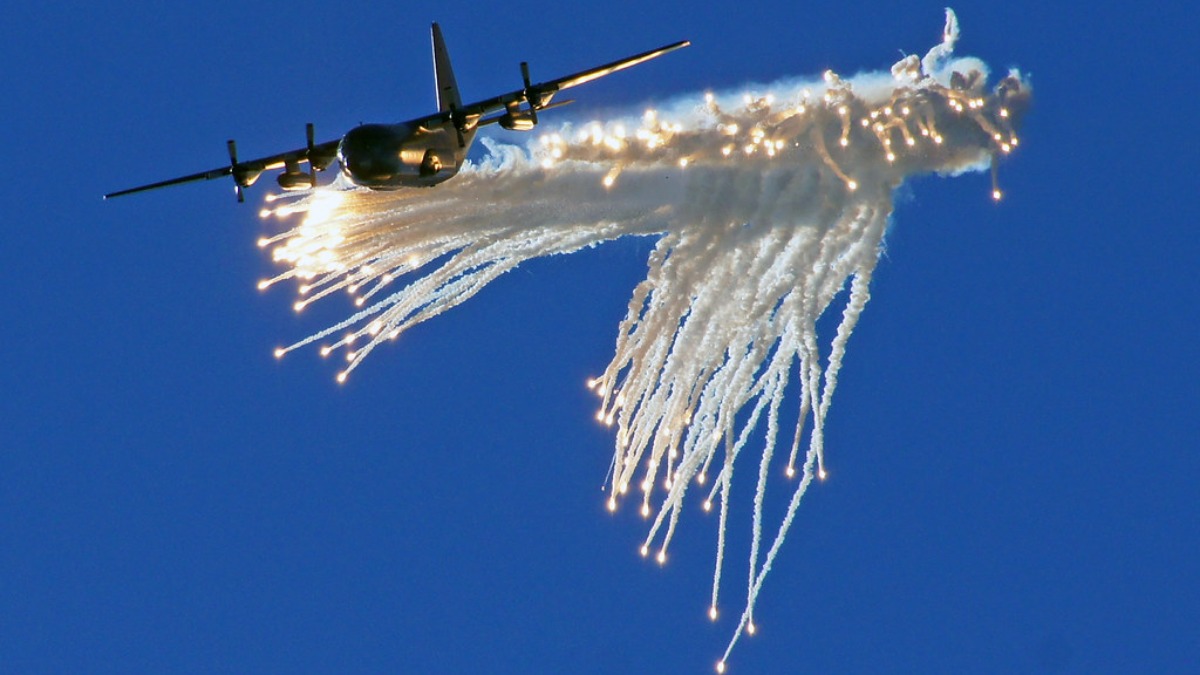

The U.S. military recently blew up two of its own transport planes, each worth over $100 million, to stop them from falling into enemy hands during a rescue mission in Iran. American forces carried out the operation to recover an F-15 airman who had been shot down. The mission made it clear that the U.S. military puts human life above costly equipment.
President Donald Trump announced early Sunday that the U.S. had successfully rescued the aviator, nearly two days after his F-15E Strike Eagle crashed over Iran. It was the first U.S. aircraft to be shot down by Iranian fire since the conflict between the U.S., Israel, and Iran began on February 28. According to Fortune, Trump wrote on Truth Social, “This is the first time in military memory that two U.S. Pilots have been rescued, separately, deep in Enemy Territory.”
The first crew member was rescued on Friday, shortly after the F-15E went down, in what Trump described as “broad daylight.” The White House stayed quiet about it to avoid putting the second rescue at risk. That second operation unfolded overnight from Saturday into Sunday, involving what Trump called “dozens of aircraft,” all armed and ready. Iranian forces were actively searching for the downed airman and reportedly even offered a reward for his capture.
The decision to destroy two $100 million planes was the only practical option
Trump described the situation, saying, “This brave Warrior was behind enemy lines in the treacherous mountains of Iran, being hunted down by our enemies, who were getting closer and closer by the hour.” The rescued airman, a colonel, suffered serious injuries but was expected to make a full recovery. Details about the first crew member’s condition were not made public.
Iranian state TV showed images of black smoke, claiming it came from a destroyed American transport plane and two helicopters. An intelligence official confirmed that a technical malfunction forced the U.S. to bring in extra aircraft to complete the mission, and two transport planes had to be left behind. To keep them out of Iranian hands, the U.S. military destroyed them.
According to Simply Flying, the two aircraft destroyed were MC-130J Commando IIs, each costing over $100 million. These are highly specialized planes built for covert infiltration and exfiltration in hostile territory. They carry advanced electronics, electronic warfare systems, and defensive tools designed to defeat modern threats including infrared-guided missiles. If Iran had recovered them intact, it could have gained valuable intelligence that would compromise future U.S. operations.
The rescue mission involved a large, multi-domain force using airpower, intelligence, cyber tools, and space-based assets. One airman was rescued relatively quickly, but the second remained isolated for nearly 48 hours. You can read more about how the hidden airman survived in Iran’s mountains before special forces pulled him out.
MQ-9 Reaper drones provided surveillance and reportedly engaged hostile forces that came too close to the survivor. Special operations troops were inserted into the area at night, supported by the MC-130Js, which are vulnerable to layered air defenses and uncertain landing conditions when operating deep in hostile airspace.
This 2026 mission draws a sharp contrast with Operation Eagle Claw in April 1980, which aimed to rescue American hostages in Tehran but failed when a helicopter collided with a C-130 during refueling, killing eight servicemen. That mission exposed serious weaknesses in how U.S. military branches coordinated joint operations.
The 2026 rescue, by comparison, succeeded through unified command structures, real-time surveillance, and advanced platforms like the MC-130J and MQ-9 Reaper, capabilities that simply did not exist in 1980.
Iranian state media also claimed on Friday that a second U.S. plane, an A-10, had crashed after being hit by Iranian forces. The U.S. military has not commented on that claim. In a separate incident, a U.S. refueling plane went down in western Iraq, adding to the growing number of incidents in the region.
Despite the loss of the two transport planes, both F-15E crew members were successfully rescued, and no U.S. personnel involved in the operation were reported killed. The outcome reinforces a long-standing military principle: getting personnel home always comes first, even when it means destroying millions of dollars worth of equipment.







Published: Apr 6, 2026 09:00 am