



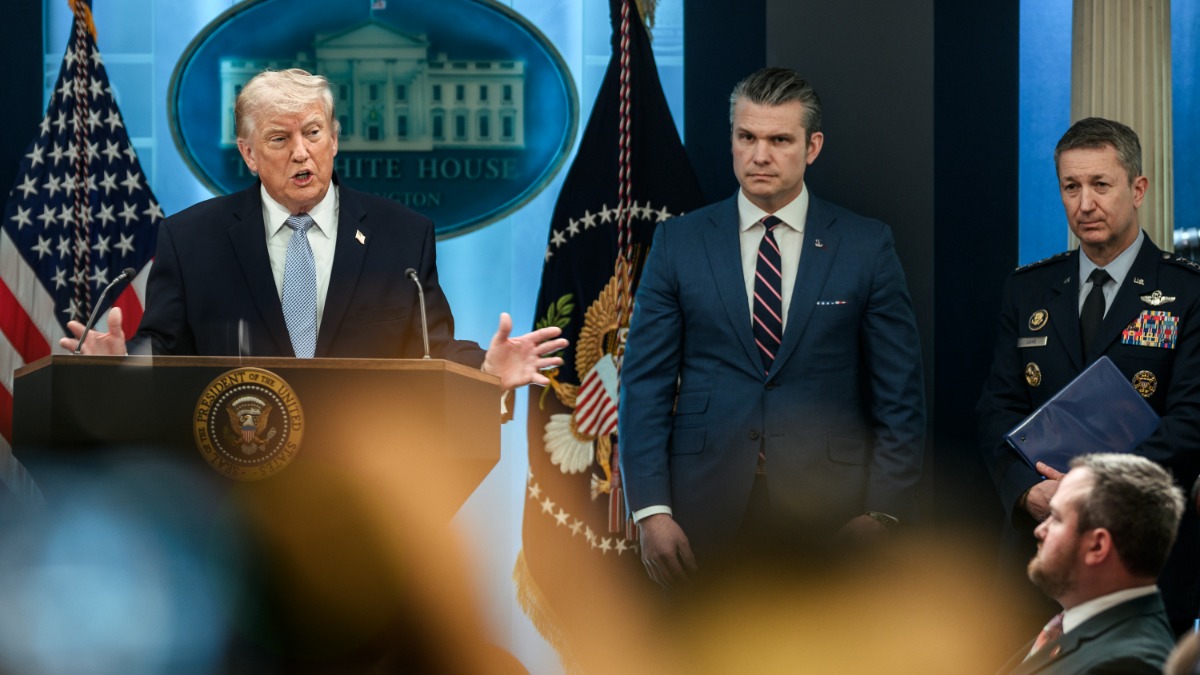

It has been three weeks since the United States and Iran agreed to a ceasefire, and the deadline is closing in. Under the War Powers Resolution, President Donald Trump had until May 1 to secure congressional approval for the war on Iran. However, the administration argues that the ceasefire has effectively paused that clock.
The War Powers Resolution requires the president to notify Congress within 48 hours of sending US forces into conflict zones. It then gives Congress 60 days to either authorize the military action or end US involvement. The administration’s claim that the ceasefire pauses this deadline is now being disputed.
Speaking at the Forum Club of the Palm Beaches, Trump said the United States “may be better off not making a deal at all” with Iran, reports Huffpost. He said he is “not satisfied” with Iran’s latest proposal, which was submitted to mediators in Pakistan, and that Iran is asking for things he “can’t agree to.” He also said the war with Iran has been “terminated” due to the ceasefire.
The legal debate over the War Powers Resolution puts Trump in a difficult position
When Trump launched the war from Mar-a-Lago, he promised Iranians would seize their own government once the bombing ended. That hasn’t happened. Neither has the unconditional surrender he demanded days later. The Supreme Leader is dead, but his son now holds the title. Trump has drawn parallels to Venezuela, where US forces seized President Maduro and left Caracas compliant, but Tehran shows no signs of following that script.
Trump later claimed that regime change was never the goal of the US-Israeli operations against Iran. He emphasized dismantling Iran’s nuclear program, but has little to show for it. Right now, re-opening the Strait of Hormuz has emerged as the key objective, but the waterway was open and accessible for all before the conflict began.
Democrats and legal experts are pushing back against the administration’s claim that the 60-day deadline has been paused. They argue that the law contains no provision that allows for a pause once the deadline has started, and that the definition of “hostilities” is central to this debate. Bruce Fein, a US constitutional and international law expert, warned that the administration’s interpretation of the resolution “turns it into simply a paper tiger.”
He also noted that Trump knows he would lose a vote in Congress if he asked for a declaration of war, “which is why he has not done so.” The core issue is that the White House and its critics cannot agree on what legally counts as “hostilities,” and until that question is settled, the administration’s legal standing remains shaky.
The War Powers Resolution was passed in 1973 after US involvement in Vietnam, to limit the president’s power to wage war without congressional approval. However, past presidents have also ignored or challenged the law, arguing that parts of it are unconstitutional.
The Authorization for Use of Military Force is another legal tool that could be used to justify ongoing military operations, as it allows the president to deploy force for defined objectives. Trump has also faced pushback on other fronts recently, including how the White House responded to criticism over Trump’s FIFA peace prize.
Congress is unlikely to authorize continued military action against Iran. On Thursday, a sixth attempt in the Senate to limit Trump’s military authority using the War Powers Resolution was defeated by a vote of 50 to 47, with members voting almost entirely along party lines, reports Al Jazeera.
Despite the ceasefire, US and Iranian forces have continued clashing in and around the Strait of Hormuz. On April 20, the US military fired on and seized the Iranian-flagged container ship Touska, and Iran later captured two foreign commercial vessels. This has led some to suggest that the administration is simply starting a new operation under a different name to get around the deadline.
Richard Goldberg, a former director for countering Iranian weapons of mass destruction at the US National Security Council, has recommended that the administration launch a new operation, which he suggested could be called “Epic Passage.”
He said this new mission would focus on reopening the Strait of Hormuz while keeping the option of offensive action open to restore freedom of navigation. Trump has also been making headlines for other public moments, such as when Trump addressed Melania directly during a royal visit.









Published: May 2, 2026 05:30 am