



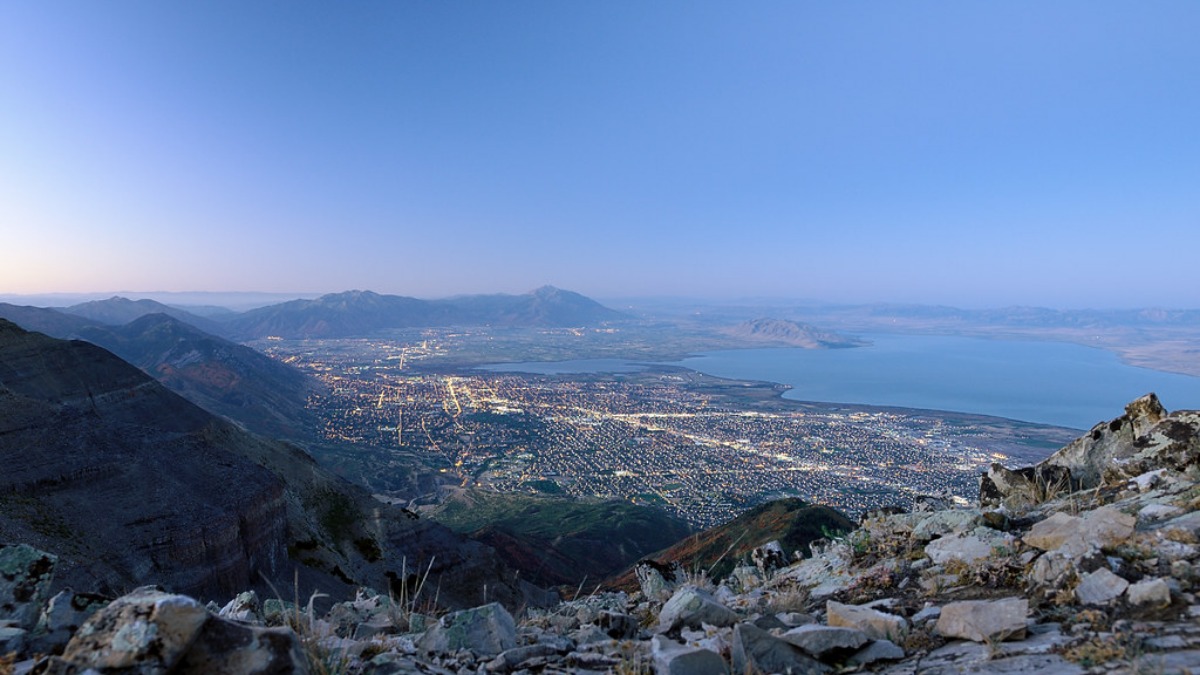

The proposed Stratos Project in Box Elder County could generate enough waste heat to function as a massive heat island, potentially changing local temperatures and putting strain on the environment near the Great Salt Lake. Robert Davies, a physics professor at Utah State University, has looked at the scale of the facility and concluded that the project’s impact on the local climate is far more serious than previously thought.
Davies ran calculations based on the project’s energy needs, which are expected to reach 9 gigawatts at full build, more than double the electricity currently used by the entire state of Utah. Because computer servers convert the power they consume into waste heat, just like any other electronic device, the facility will produce an extra 7 to 8 gigawatts of thermal energy.
And when you add the power generation and the computing load together, the data complex creates a 16 gigawatt thermal load in total. According to The Salt Lake Tribune, Davies described this as the “equivalent of about 23 atom bombs worth of energy dumped into this local environment every single day.” This energy will be concentrated in Hansel Valley, a high desert area located at the north end of the Great Salt Lake.
The scale of the heat impact could turn a Utah desert valley into something resembling the Sahara
The potential consequences for the area are serious. Davies predicts that this constant release of heat could raise local daytime temperatures by five degrees Fahrenheit, with nighttime temperatures potentially rising by as much as 28 degrees. Ben Abbott, an ecology professor at Brigham Young University who reviewed the estimates, noted that this shift would be extreme.
“That’s the difference between Utah’s semi-arid climate and the Sahara Desert,” Abbott said. “This would absolutely change the landscape.” Scientists also fear that such a spike in heat would lead to increased evaporation and the potential disappearance of the local dewpoint, which could devastate wildlife and local vegetation, while potentially turning Hansel Valley into a new source of dust along the Wasatch Front.
Despite these concerns, Box Elder County commissioners approved the development, choosing not to hear public comment because they said they lacked control over environmental issues like air quality and water supplies. Utah has been at the center of several heated public debates lately, including a controversial new proposal that could allow guns at Jazz games and other public venues.
Developer Kevin O’Leary has defended the project, stating that modern facilities can use closed-loop systems to manage water and air-cooled turbines to handle temperatures. He has also argued that many of the criticisms against the project are coming from professional protesters.
However, the lack of transparency about the specific technology to be used remains a key concern. Davies noted that developers are citing non-disclosure agreements and proprietary technology, which he views as a red flag. He suspects the project might use the Allum-cycle, a technology that produces electricity with lower emissions but generates water as a byproduct at around 100 degrees Fahrenheit.
Managing this hot water is a difficult challenge, as air-cooling it in the high desert would require massive infrastructure, and using the local aquifer could have serious ecological consequences. Logan Mitchell, a climate scientist with Utah Clean Energy, pointed out that if the project relies on industrial-scale natural gas generators, it would be the equivalent of thousands of diesel engines running around the clock.
While O’Leary has promised total transparency, local residents remain skeptical, raising concerns about water supplies, higher utility bills, and their overall quality of life. Utah residents have grown increasingly vocal about strict regulations affecting everyday life in the state, and the Stratos Project is adding to that frustration.
An application to divert water from the Salt Wells Spring stream was recently pulled back after thousands of complaints from Utah residents. Critics like Abbott argue that the focus should be on preserving the natural landscape rather than bringing in massive industrial projects. “If we’ve got this behemoth dumping heat, pollution and noise into the environment, we lose a big chunk of that,” Abbott said, reports Business Insider.









Published: May 10, 2026 11:30 am