



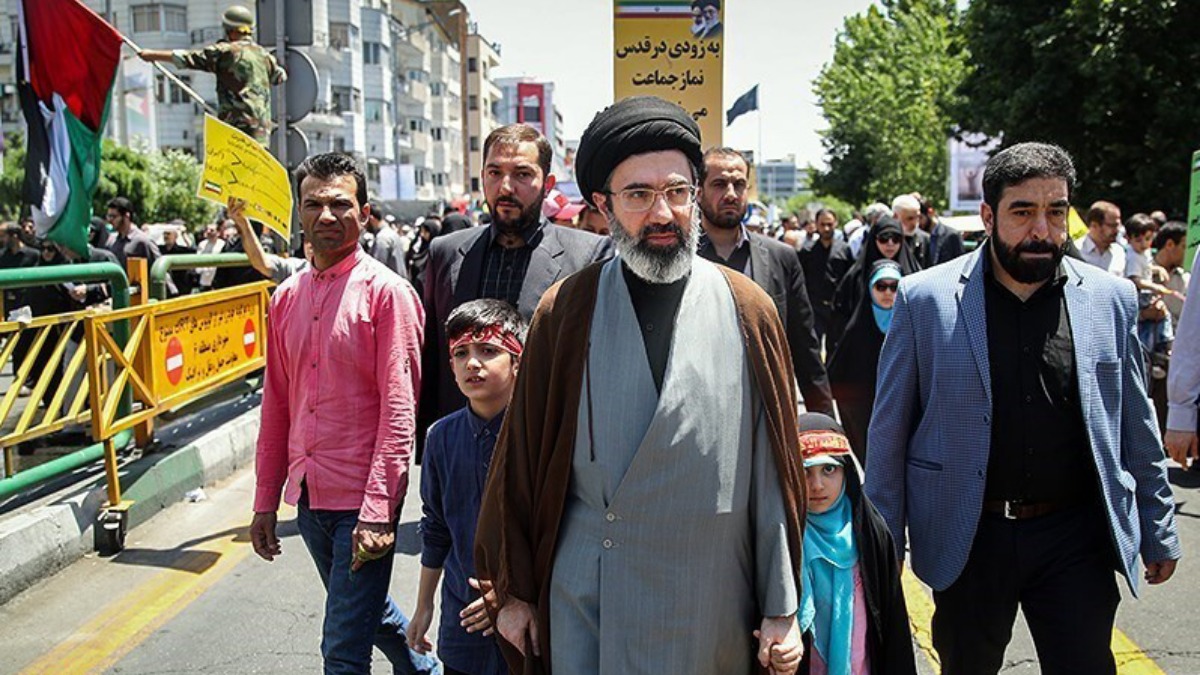

US intelligence believes that Iran’s new supreme leader, Mojtaba Khamenei, is playing a key role in shaping war strategy, even though he has not been seen in public since he was injured. Iran’s leadership appears increasingly divided, making it hard for outside observers to understand who is really in charge.
He has not appeared publicly since suffering serious injuries in an attack that killed his father and several other top military leaders at the start of the war. He is not using any electronic devices to communicate, leaving him largely isolated and relying on in-person visits or messages delivered by a courier. Sources say he is receiving medical treatment for severe injuries, including serious burns on one side of his body affecting his face, arm, torso, and leg.
There is considerable uncertainty about how much control he actually has. According to CNN, one source said he appears fairly removed from decision-making and is only occasionally reachable. As a result, day-to-day operations are largely being handled by senior Islamic Revolutionary Guard Corps officials and Iranian Parliament Speaker Mohammad Bagher Ghalibaf.
Mojtaba Khamenei’s authority remains deeply in question as Iran’s fractured leadership struggles to present a united front
A second source noted that while there is no proof he is not giving orders, there is also no clear sign that he is doing so on a regular basis. This has led some intelligence analysts to question whether certain figures within Iran’s power structure are claiming access to the leader in order to use his authority for their own purposes.
One source described the entire situation as a mix of the Wizard of Oz and Weekend at Bernie’s. Some political observers who have been warning about the dangers of Iran’s leadership vacuum say the situation could spiral further if no clear authority emerges soon.
Iranian officials have pushed back against reports about his condition. On Friday, Mazaher Hosseini, the head of protocol in the office of the supreme leader, said that Khamenei is healing and is now in complete health. He claimed the injuries to his foot and lower back were minor and that a small piece of shrapnel had struck him behind the ear.
Hosseini told a crowd, “The enemy is spreading rumors and false claims,” and urged people to be patient until the leader is ready to speak. Iranian President Masoud Pezeshkian also told state media that he had a two-and-a-half-hour meeting with Khamenei, which was the first reported in-person interaction between the new leader and a senior official.
The broader conflict continues under a ceasefire that has now lasted more than a month. US intelligence reports suggest the war has weakened Iran’s military, but has not destroyed it. Recent assessments show that two-thirds of Iran’s missile launchers survived US strikes, partly because the ceasefire gave the military time to dig out launchers that had been buried during earlier attacks.
A separate CIA report suggests Iran could potentially hold on for up to four more months under the current American blockade before facing a complete economic collapse. The Trump administration is continuing to pursue a diplomatic solution to the conflict, though US officials say the fractured state of the Iranian regime has made those efforts more difficult.
Secretary of State Marco Rubio said on Friday that the “dysfunctional and fractured system” in Iran may be slowing down efforts to end the war. White House spokesperson Anna Kelly stated that the blockade is causing growing damage and that the regime’s internal divisions have made it harder for Iran to bring unified proposals to American negotiators.
Mojtaba Khamenei, 56, was chosen as his father’s successor shortly after the strike that injured him, per BBC. His selection stands out because the Islamic Republic’s ideology holds that a supreme leader should be chosen based on religious standing and leadership ability, not family ties. Iran’s constitution includes a built-in succession process designed for this exact scenario, though whether it will hold under the current pressure remains to be seen.
Throughout his life, Mojtaba has kept a very low profile, never holding government office or giving public speeches. While some media outlets and officials close to power have begun calling him an Ayatollah to boost his standing, he remains a mid-ranking cleric, which could make it harder for him to gain full acceptance as leader.



Published: May 10, 2026 12:00 pm