




Dawa Sherpa, a 52-year-old Nepali guide, has been found alive and crawling toward base camp on Mount Everest, a full week after he was reported missing and while his family was in the middle of performing his funeral rites, The Guardian reported. His family had already begun the traditional multi-day rituals to honor his memory. It is the kind of story that reminds you just how unpredictable and unforgiving the world’s highest peak can be, even for those who spend their lives navigating its slopes.
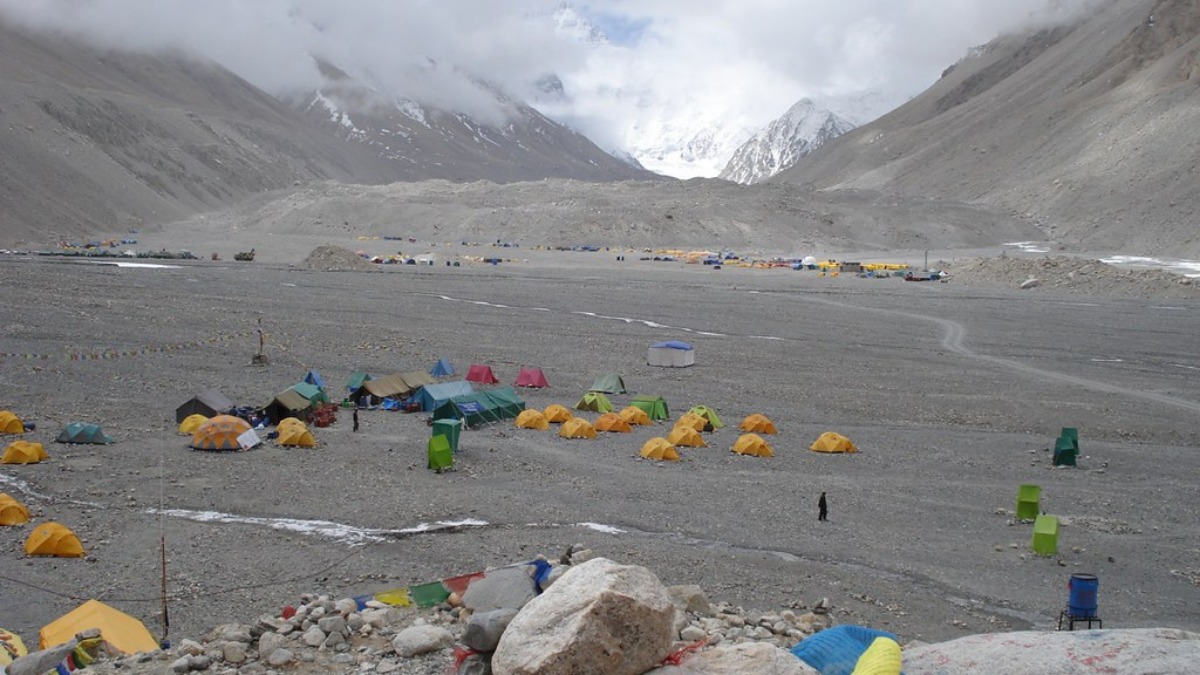
The rescue occurred on Thursday morning when a climbing support team from the Sagarmatha Pollution Control Committee spotted him. They found him struggling down the snowy slopes near the Khumbu icefall, which is located just above the base camp. The committee members, who are responsible for maintaining the ropes and ladders throughout the climbing season, were able to intercept him before he could succumb further to the elements.
According to Pemba Sherpa of 8K Expeditions, which coordinated the search efforts, the guide had visible frostbite on his hands but was otherwise in surprisingly good health. The team immediately provided him with food and water before he was airlifted by helicopter to a hospital in Kathmandu.
This is an absolutely incredible turn of events for the mountaineering community
His wife, Damu Sherpa, and their teenage daughter, Mendo Lhamu Sherpa, were waiting for him at the hospital, having spent the previous days mourning a man they thought was lost to the mountain forever. Damu Sherpa noted that they first received word that he was still alive through local news reports. Mendo Lhamu Sherpa shared that they were on the second day of a funeral ritual when the news reached them. She said, “When we first heard about it [the rescue], we could not be sure if that person was indeed our father.” She added, “So to be certain we asked for photos to be sent and then only we were sure and very happy.”
Dawa Sherpa, who is also known as Hillary Dawa Sherpa in honor of the legendary climber Edmund Hillary, was last seen on 29 May. He had been guiding a Polish climber for a Kathmandu-based company called Himalayan Traverse. British climber and former Royal Marine Chris Thrall encountered Dawa Sherpa on the mountain and later posted a video tribute, believing the guide had perished.
Thrall described a moment where Dawa Sherpa sat down to rest on the descent. Thrall said, “I turned and I said: ‘Hillary, are you OK, brother?’ He said: ‘Yes, yes, fine Chris, please go, go!’” Thrall eventually found the Polish client suffering from frostbite and a lack of oxygen, prompting him to assist the client while assuming the experienced guide would manage his own descent. Thrall remarked, “The weather was so changeable and so bitter,” adding, “Tragic. Unfortunate. But it’s the high mountains. That’s it.”
The area where Dawa Sherpa was last seen is known as the death zone, located near the Yellow Band above camp 3 at an altitude of 7,200 metres. In this region, oxygen levels are so low that they cannot support sustained human life, making his survival for a full week truly baffling to experts.
Ang Tshering Sherpa, a prominent figure in the mountaineering community, called the survival miraculous. He explained that the Sherpa people possess a unique resilience developed from growing up in these environments. He stated, “This is nothing short of a miracle surviving so many days on the mountains facing such harsh conditions,” and added, “Sherpas are built tough growing up in the mountains,” and “If there was someone else in his place, they might not have survived.”
This year proved to be the busiest climbing season on record for Mount Everest, with over 1,000 climbers and guides scaling the peak this May. The season was delayed by two weeks due to a massive ice block that required clearing. While five people have died this season, the debate continues regarding the high volume of traffic allowed on the mountain, which frequently creates dangerous bottlenecks in the death zone.
The peak itself, which stands at 8,849 metres, has a long history, having been first climbed on 29 May 1953 by Tenzing Norgay Sherpa and Edmund Hillary. For the Sherpa community, who historically lived as yak herders and traders before Nepal opened its borders in the 1950s, their expertise has made them the backbone of the Himalayan climbing industry. Seeing one of their own return from the brink of death is a moment of profound relief for everyone who follows the sport.








Published: Jun 4, 2026 05:45 pm