



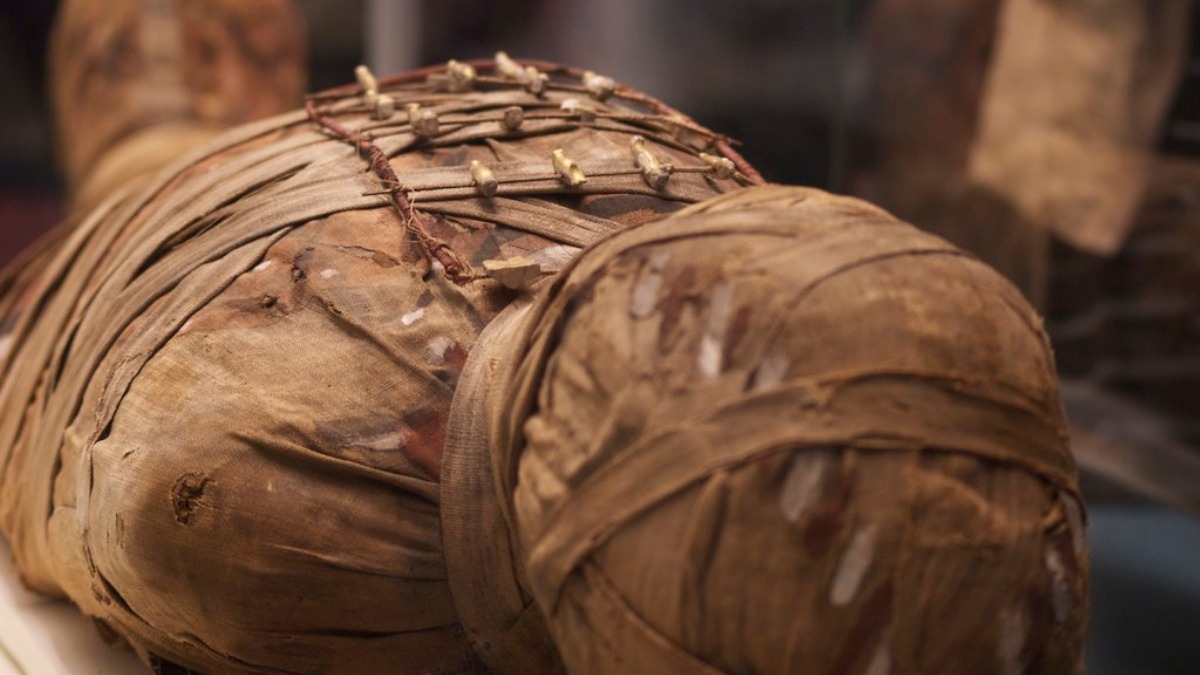

Researchers have uncovered traces of ancient microbes inside a mummy, revealing unexpected signs of life that may have persisted for more than 5,300 years. This fascinating discovery, published in the Springer Nature journal, centers on Ötzi the Iceman, the famous mummy discovered by a tourist inside a glacier in the Alps in 1991.
The study offers a unique look at how microorganisms interact with ancient human remains over thousands of years. While Ötzi’s remains date back to 3300 B.C., appearing long before the construction of the Egyptian pyramids or Stonehenge, his body is still hosting a complex community of life. Ötzi was between 25 and 35 years old when he died, standing roughly 5 feet 2 inches tall.
While initial theories suggested he perished due to exhaustion or exposure while crossing the Alps, later examinations revealed an arrowhead lodged in his left shoulder. This suggests he likely bled to death. However, during his post-mortem journey, experts at Eurac Research have found that his remains still contain a mix of ancient and modern microorganisms. By using tissue samples, swabs, and genetic analysis, the team successfully differentiated between the microbes present during Ötzi’s life and those that colonized his body after his death.
The scientific community is learning a lot from these types of investigations
The researchers analyzed ice from the surface of the body, meltwater from inside the mummy, and intestinal tissue to get a complete picture. They also utilized stomach-content data from previous studies. One of the most surprising findings was the presence of cold-adapted yeast species. These yeasts likely originated from the glacial environment and have managed to persist on the mummy’s body to the present day.
Frank Maixner, who serves as the director of the Institute for Mummy Studies at Eurac Research, noted that these findings point to a continuous presence of specific microorganisms throughout the mummy’s long history. “These yeasts have accompanied Ötzi on his long journey through the millennia,” Maixner said in a statement. He further explained that Ötzi is “not a static relic, but a dynamic biological system.”
The study also highlighted that Ötzi’s microbiome contains gut bacteria that you simply do not find in the intestines of modern humans. This makes his remains a vital baseline for understanding Copper Age intestinal ecosystems. According to Eurac Research, “Ötzi therefore offers a rare glimpse into humanity’s microbial past.” Some of these microbes might even exist in a dormant state more than 5,000 years after his death, while the body is housed at the South Tyrol Museum of Archaeology in Bolzano, Italy.
Conservation is a massive priority for the team, as the conditions inside the remains are not yet fully understood. Marco Samadelli, a conservation expert and co-author of the study, noted that the conditions “are not yet fully understood,” but added that “this study expands our knowledge in this area.”
Elisabeth Vallazza, the director of the South Tyrol Museum of Archaeology, described the mummy’s current preservation condition as “very stable today.” She emphasized that “close microbiological monitoring ensures that the mummy suffers no damage,” but also cautioned that “further research and full conservation efforts are certainly needed to preserve it for many more generations.”
The recent research on Ötzi highlights the potential for ongoing microbial activity even at sub-zero temperatures. It turns out that the coexistence of ancient, endogenous gut microbes and modern, psychrophilic colonizers creates a complex environment that requires strict parameters to manage. Maintaining these environmental settings is essential to prevent these specialized communities from shifting from latent persistence to becoming active microorganisms.
This study is part of a broader trend of uncovering new information from ancient remains. For instance, earlier this spring, officials announced that researchers from the University of Barcelona discovered a copy of Homer’s Iliad placed on top of a mummy in Egypt. Additionally, utility workers in Lima, Peru, stumbled upon a millennia-old mummy while on the job last year.
It is clear that every time we look closer at these ancient individuals, we find that they have much more to teach us about the history of our species and the resilient microscopic world that surrounds us.









Published: Jun 22, 2026 06:15 pm