



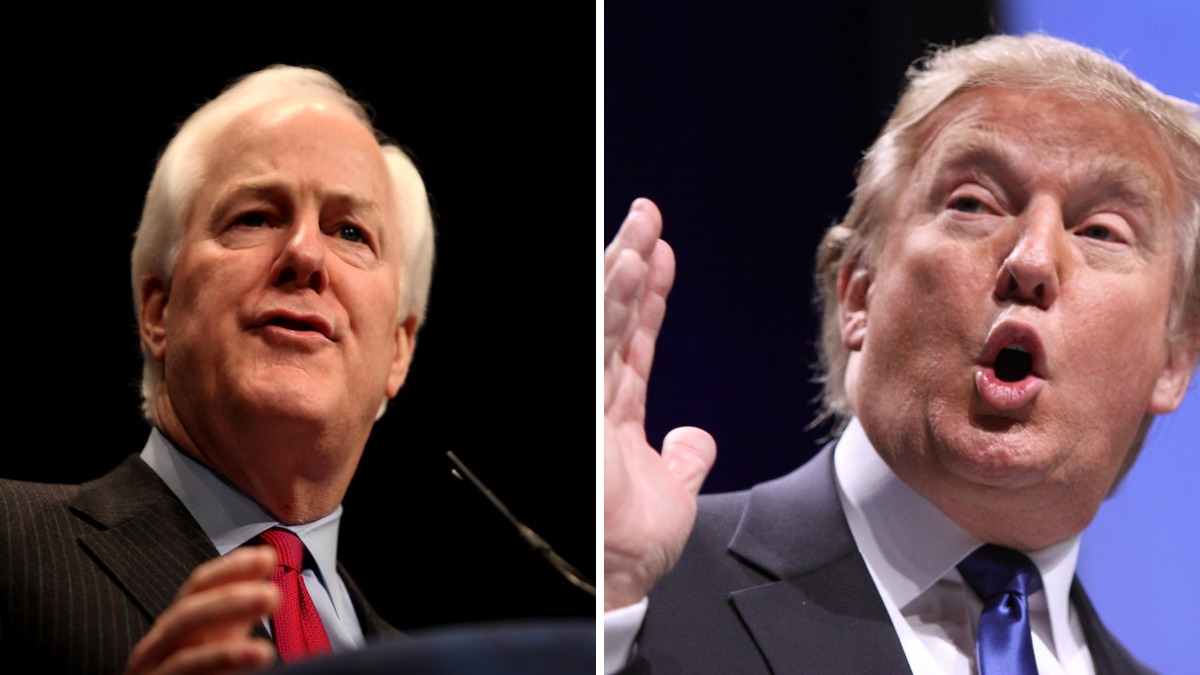

The political atmosphere in Washington is becoming increasingly strained as Republican senators express open frustration with the White House and its unpredictable approach to legislative priorities. Senator John Cornyn of Texas, who recently lost his primary to a Trump-backed opponent, has become one of the most vocal critics of this trend.
In an interview with Semafor, Cornyn noted that he no longer maintains regular communication with President Trump, stating that talking to the president is no longer useful. He pointedly remarked that the president seems to revel in chaos, which stands in stark contrast to any other leader he has observed in his time in office.
Many Republican senators are growing tired of the White House throwing curveballs into things they want to get done. The current friction centers on the reauthorization of a critical surveillance law, known as Section 702 of the Foreign Intelligence Surveillance Act, which allows intelligence agencies to spy on foreign threats. This law has lapsed, and intelligence officers now have limited ability to gain access to data from adversaries. While there was initial momentum to pass the legislation with bipartisan support, the process has been repeatedly derailed by last-minute shifts from the administration.
This sentiment of frustration is not isolated to Cornyn alone
President Trump has twice thwarted efforts to secure the necessary Democratic support to overcome a filibuster in the Senate. The first hurdle arose when he named Bill Pulte, the head of Fannie Mae and Freddie Mac, as the acting director of national intelligence. Because Pulte had no intelligence experience and had previously used his role to investigate political opponents, the nomination was met with immediate outcry from both sides of the aisle. The subsequent vote to reauthorize the surveillance law failed, leaving the authority to expire.
The situation appeared to stabilize when Trump formally nominated Jay Clayton for the director of national intelligence role at the end of last week. Clayton was viewed as a more acceptable choice for both parties, and a confirmation hearing was quickly scheduled. However, just hours before that hearing, the president changed the game yet again. He announced he was delaying the nomination and insisted that senators attach the Safeguard American Voter Eligibility Act to the intelligence reauthorization. This legislation, which would require proof of citizenship to register to vote, has failed repeatedly in the Senate.
Cornyn’s critique of this strategy highlights a broader concern among his colleagues. He emphasized that the president’s behavior is distinct from his own approach, noting, “I don’t know about you, but I like to minimize the chaos in my life. He just seems to revel in it. We’ve seen even recent evidence of it on the DNI.” Cornyn also warned that holding up the intelligence reauthorization is dangerous, particularly given the current global climate, including the war in Iran and the ongoing World Cup. He added, “There’s some frustration because now 702 is going to stay dark, and that’s a danger to the country.”
Other senators have echoed these concerns, describing the legislative process as a series of starts and stops. One Republican senator, who spoke on the condition of anonymity, compared the situation to someone putting a penny on a train track to derail it. This senator noted that it is already difficult to get 53 people moving in the same direction, making these surprise moves particularly disruptive to the institutional process.
Senator Thom Tillis, who is retiring and has frequently criticized the White House, told reporters that the president’s actions are undermining the ability of the Senate to produce the very results he wants. Tillis referenced another instance where the White House introduced a $1.8 billion anti-weaponization fund through the Department of Justice, which caused a revolt among Republicans and stalled an immigration enforcement funding package. Cornyn has also begun to use his own political leverage to secure victories for his home state of Texas as his time in the Senate winds down.
He recently threatened to withhold his vote on a party-line immigration funding package until the White House released reimbursement money for border security spending. Regarding that tactical move, Cornyn said, “That’s one example I think of what you can do when you have some cards to play.”
As the Senate attempts to navigate these priorities before the midterms, the growing willingness of Republicans like Cornyn and Tillis to push back against the administration could create further complications for the GOP agenda. While some senators remain hopeful that Democrats will eventually support the intelligence reauthorization regardless of who is in charge, the combination of legislative pairing and shifting nominations continues to hinder progress.
As Cynthia Lummis noted, Republicans must focus on the fundamentals and avoid being distracted by side issues, acknowledging that pairing the surveillance law with the failed election security bill will likely result in both failing. For now, the path forward remains uncertain as the Senate grapples with the unpredictable nature of the current executive strategy.







Published: Jun 22, 2026 05:15 pm