



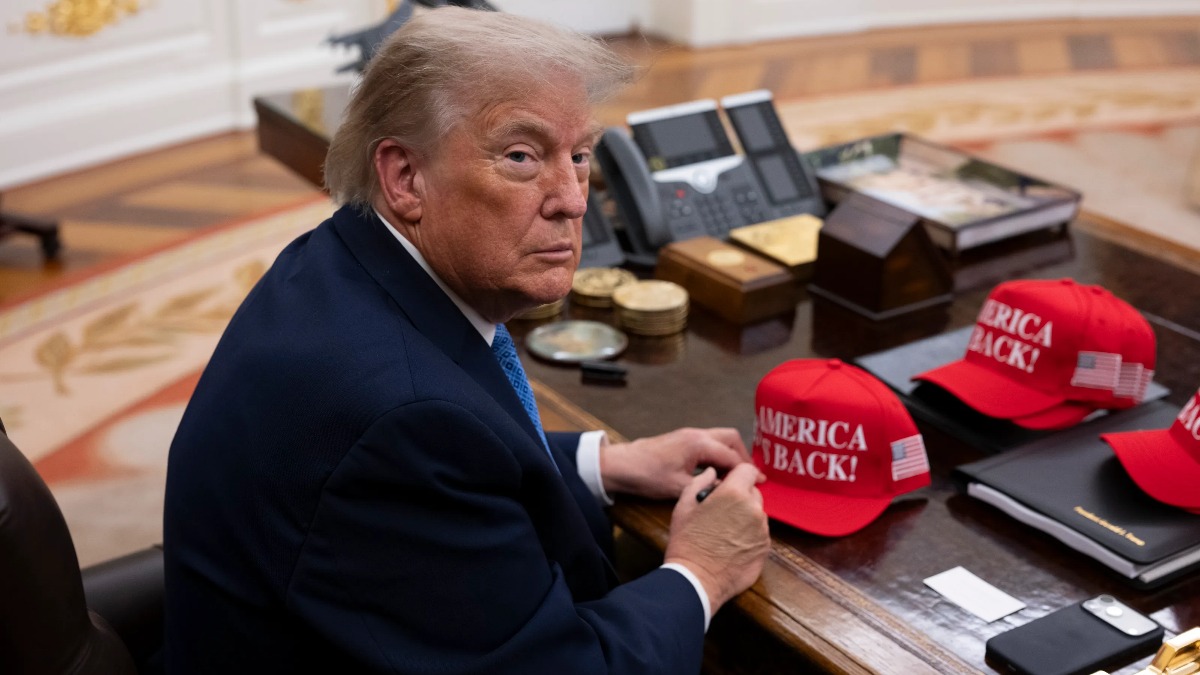

U.S. President Donald Trump said during a press conference on Wednesday that 111 missiles had been fired at an American aircraft carrier by the “Islamic Republic of Japan” – a statement that appeared to confuse Iran with Japan. Trump made the remarks while standing alongside Ukrainian President Volodymyr Zelensky, in what seemed to be an impromptu exchange with reporters.
“We had 111 missiles shot by the Islamic Republic of Japan. They were shot at the aircraft carrier over a period of about one hour. 111 missiles going to a very expensive ship, and every one of those missiles was knocked down, pretty much most by patriots, but by other means also,” Trump said, according to The Independent.
Trump appeared to be referring to a missile attack by Iran, not Japan, on the USS Abraham Lincoln. Japan and the United States have been close allies since the end of World War II in 1945, and Japan has not taken hostile military action against the U.S. in nearly a century. Modern Japan is also a constitutional monarchy with a small Muslim population estimated at around 420,000, according to available figures.
US and Iran trade fresh strikes as ceasefire appears to collapse
The press conference came on the same day that the United States and Iran exchanged a new round of military strikes, raising serious concerns about the future of ongoing peace talks between the two countries. Trump said at the same event that he believes the ceasefire and interim agreement with Iran are now “over.”
Trump said he would allow negotiators to continue talks, but added that it was “just a waste of time dealing with them,” according to NBC News. Iran’s foreign ministry had said, prior to Trump’s comments, that U.S. and Israeli actions had “rendered key and fundamental elements of the agreement to end the war ineffective.”
The exchange of strikes began after Iran allegedly attacked three commercial tankers in the Strait of Hormuz – vessels flagged to Liberia, Saudi Arabia, and the Marshall Islands, according to U.S. officials. One tanker reportedly caught fire after being struck off the coast of Oman, per the United Kingdom Maritime Trade Operations center.
The two other ships sustained some damage, but no injuries were reported, and both continued on their way, according to the same agency. In another case, Trump had told his team Iran would never close the Strait of Hormuz.
In response, U.S. Central Command said it carried out strikes against more than 80 targets in Iran, including air defense systems, command and control networks, coastal radar sites, anti-ship missile capabilities, and more than 60 small boats belonging to Iran’s Revolutionary Guard, according to the command’s statement.
A U.S. official described the operation as larger than previous U.S. retaliatory strikes against Iran, and said it was carried out using Air Force jets and Navy tactical aircraft. “This response is a direct result of the acts of international terrorism that have been perpetrated by Iran on innocent ships transiting the Strait of Hormuz,” the official told NBC News.
“The Iranians know the consequences to their ridiculous actions, yet they still chose to carry out these attacks.” A similar dispute saw Rubio threaten Iran after their attacks on ships in the Strait of Hormuz.
Iran’s Revolutionary Guard subsequently said it launched a joint missile and drone operation against what it claimed were 85 U.S. military sites, including the U.S. Navy’s 5th Fleet base in Bahrain and Ali Al Salem Air Base in Kuwait, according to Iranian state media. It also claimed to have shot down a U.S. MQ-9 drone.
The Pentagon had not commented on those claims at the time of reporting, and it was unclear whether any U.S. sites sustained damage. Missile alerts were reported in both Bahrain and Kuwait in the early hours of Wednesday.
Iran’s Parliament Speaker Mohammad Bagher Ghalibaf responded to the strikes on social media, writing: “The era of bullying and extortion is over. It leads nowhere. We don’t fold.” The renewed hostilities come as Trump was attending the NATO summit in Turkey, and as Iran was holding a multi-day state funeral for Supreme Leader Ayatollah Ali Khamenei, who was killed in the opening U.S.-Israeli strikes that began the war in February.
Peace negotiations, which had been ongoing through Qatari mediators in Doha, were reportedly paused during the funeral period. The U.S. also revoked a temporary sanctions waiver on the same day that had previously allowed Iranian oil sales on the global market, effective immediately, according to the U.S. Treasury Department.






Published: Jul 8, 2026 09:15 am