



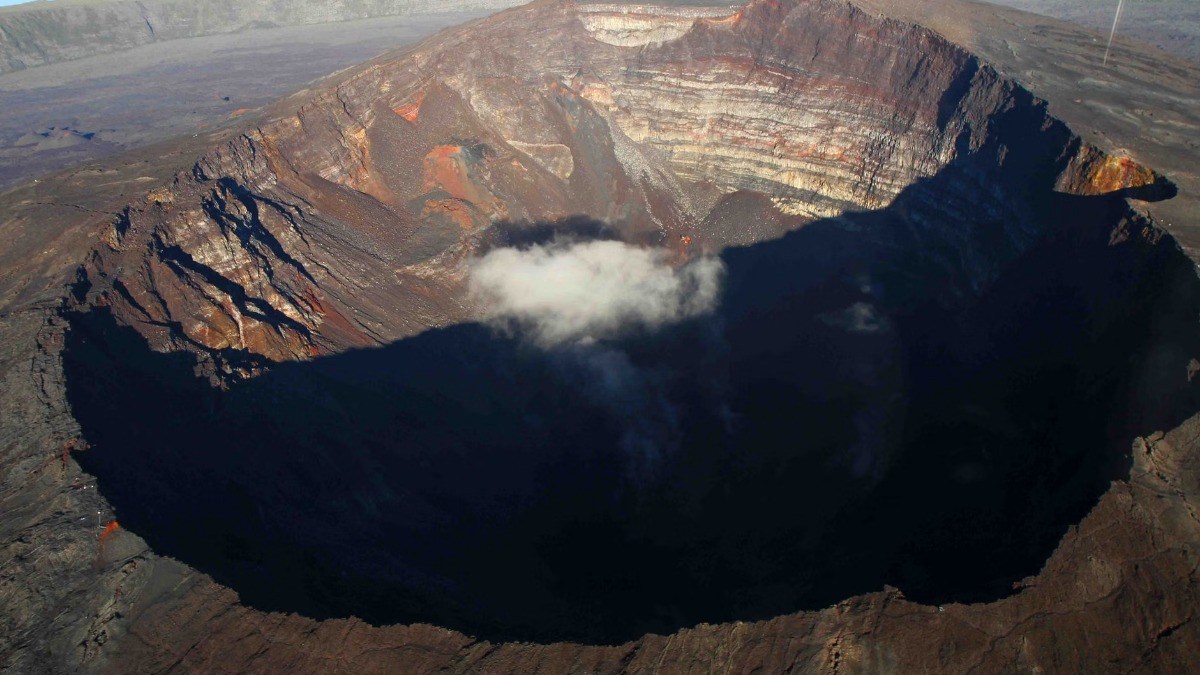

A massive discovery has been confirmed deep beneath the flat landscapes of England’s east coast. Scientists have identified an ancient supervolcano located beneath The Wash, an area that shows no visible trace of its explosive past. Experts estimate the supervolcano erupted with a force equivalent to one million nuclear bombs, making it thousands of times more powerful than modern volcanoes such as Mount Etna.
As detailed by the British Geological Survey, there is no risk of the supervolcano ever erupting again. “Unlike faults, which can be seismically reactivated, a volcano can’t,” said Dr Tim Pharaoh of the BGS, explaining that once a volcano goes extinct, it remains inactive permanently. The supervolcano last erupted around 454 million years ago, a gap so vast that more time separates that eruption from the earliest dinosaurs than separates the dinosaurs from the present day.
The discovery came through modern analysis of decades old material rather than new fieldwork. As reported by LadBible, scientists identified the supervolcano by studying rock samples collected roughly 80 years ago from North Creake in Norfolk and Claxby in Lincolnshire. Pandemic era restrictions had prevented researchers from collecting new samples at the time, so the team turned to material already in storage and used advanced techniques to examine tiny zircon crystals, smaller than the width of a human hair, that form inside magma before an eruption.
The ash from this eruption reached far beyond England
Analysis showed that the rock samples from Norfolk and Lincolnshire formed at the same time, confirming a shared volcanic origin. Data from researchers at the University of Oslo helped confirm that ash from the eruption traveled across the ancient Tornquist Sea and settled as far away as modern day Sweden, Norway, Poland and Belarus. The structure responsible for the eruption measured at least 40 miles across.
The scope of the eruption is central to why researchers are calling the find significant. During the event, classified as a super Plinian eruption, hundreds of cubic kilometers of the Earth’s crust were launched directly into the stratosphere. News of the discovery broke amid the same news cycle as a viral shopper complaint over shrinking Jif peanut butter packaging that had been circulating over shrinkflation claims.
Researchers say the level of precision now possible with modern dating techniques allowed them to draw conclusions that earlier studies could not support. Without newer analytical methods, the team would not have been able to confirm the timing and scale of the eruption with the same confidence. That precision is what ultimately let scientists connect samples collected decades apart into a single, unified picture of the ancient volcano.
Prof Jenni Barclay, a volcanologist at the University of Bristol, called the discovery “an important step forward in piecing together the geological history of the UK.” She added that understanding subsurface activity like this carries practical relevance for how the country manages resources such as water and minerals. The finding also surfaced the same week as a separate viral dispute over a Walmart self-checkout billing error that drew attention online.
The research dates the volcano’s activity to two closely timed eruptions, occurring approximately 454.4 million and 453.7 million years ago.









Published: Aug 30, 2026 09:15 am