



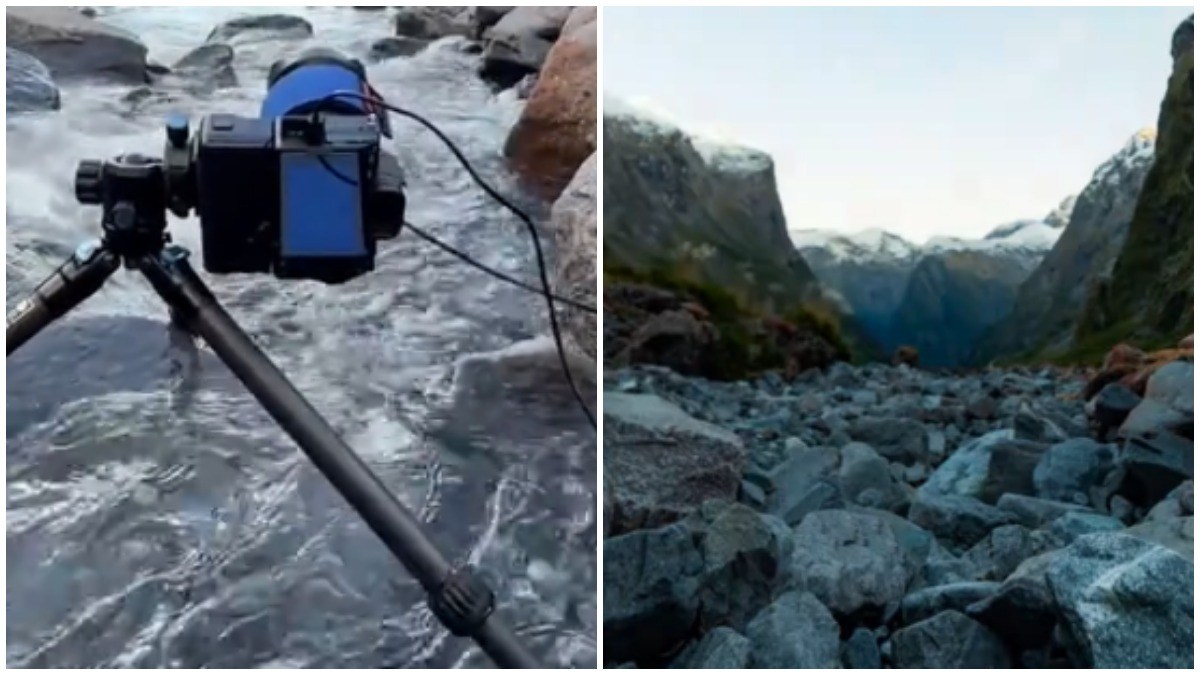

A TikTok creator who posts as Nas (@nas_ong) shared a time-lapse that began with a camera standing in moving water and ended with a dry bed of rock. The clip’s caption read, “insane to think the river just disappeared.” On-screen text in the video said, “I left my camera in a river all night to show you earths rotation (when I got back in the morning there was no river).”
Nas placed a black and blue camera on a tripod in the middle of a clear, fast-moving stream. Rocks sat around the tripod, and green, rocky mountains with some snow-capped peaks filled the distance under a bright blue sky with scattered white clouds. Further on-screen text read, “Let’s see how…” The clip had gained 2.9 million views, 225,500 likes, and 1,650 comments.
The video then moved into a time-lapse. The sun appeared to set, and the sky shifted from blue to orange and purple as clouds drifted. Water kept flowing and reflecting the changing light. As night came on, stars showed up, and the Milky Way became visible. The stars appeared to travel across the frame. By morning, the channel looked empty, and the final shots showed a dry bed of grey and reddish rocks under a clear sky.
Viewers offered snowmelt freeze cycles and scheduled releases as explanations
The night portion of the clip showed the sky shifting through purple, blue, and yellow, with faint green glows visible at times. The riverbed stayed dark but still suggested moving water until dawn. As the sky lightened, the stars faded, and sunrise arrived over a rocky bed that no longer held the flow seen the evening before.
Nas framed the moving stars as a record of Earth’s rotation with the camera left in place. Such long-term camera placements can yield unexpected results, as when a man finally retrieved a camera left in a cave 10 years ago.
A river that flows all night and is completely gone by morning is highly unlikely to be about Earth’s rotation.
Many rivers near mountains are fed or controlled by upstream dams, weirs, or hydroelectric plants that release water on a schedule; often during the day for power demand or irrigation, then cut off at night. If the camera was downstream of a controlled release point, the river can genuinely run dry once the flow stops.
Rivers fed by glaciers or snowmelt often have a strong daily pulse. Daytime heat melts snow/ice upstream, sending water down, but overnight temperatures drop, melting stops, and by early morning the flow can shrink dramatically or vanish entirely, especially in braided, rocky riverbeds like the one shown. This is common in high-mountain environments.
Less likely at a mountain river, but some braided rivers shift channels constantly. The water may have simply moved to a different channel nearby rather than disappearing altogether.
Given the snow-capped peaks and rocky terrain in the video, glacial/snowmelt daily flow cycles or a controlled upstream release are the most plausible explanations.
Viewers focused on the missing water and on whether the sequence was real. One wrote, “where the water go?” Another wrote, “kinda looks like edited.” A third wrote, “theres so many stars….i think it’s AI.” One more added, “little did i know rivers also rest at night.”
One commenter explained that waterfalls or springs coming from very high mountains usually stop at night because the temperature on higher mountains is very low and snow falls, freezing the water, while daytime sun melts the snow again and the flow continues. A few commenters said it was due to the tide.
Nas did not name the river or show an upstream control structure.








Published: Sep 12, 2026 11:30 am