



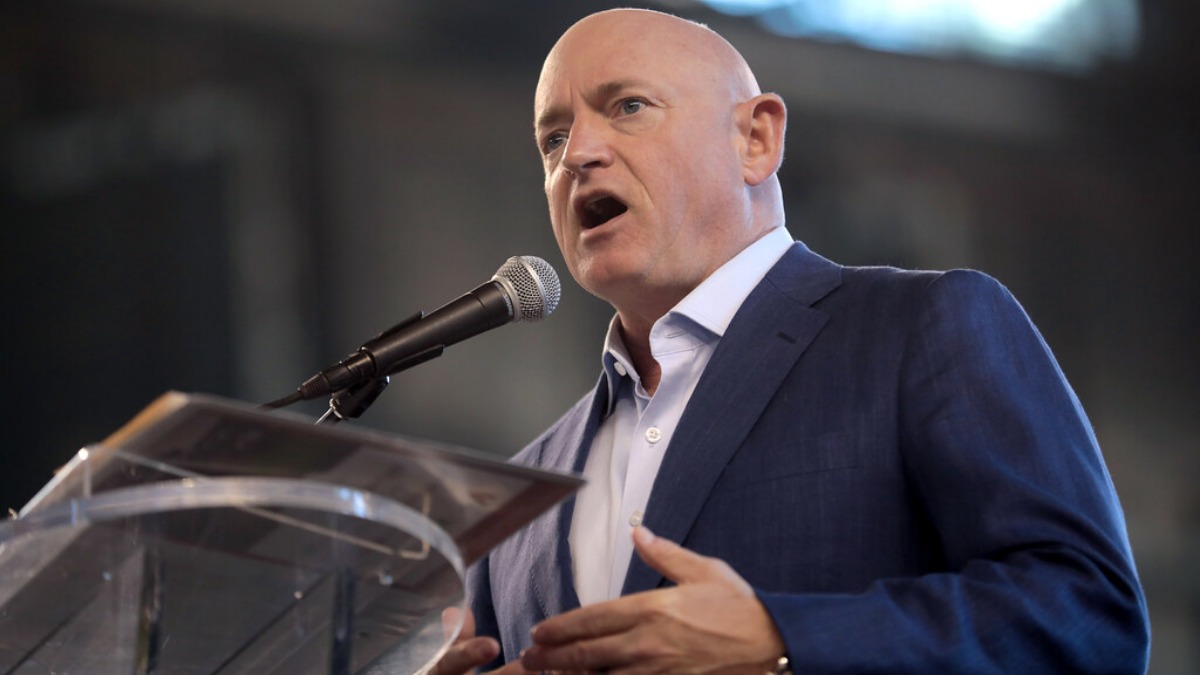

A federal appeals court panel recently signaled significant skepticism regarding the Department of Defense and its ongoing attempts to censure Senator Mark Kelly, The Hill reported. The retired Navy captain, who currently serves as a Democratic senator from Arizona, finds himself at the center of a tense legal battle over his participation in a video that encouraged service members to refuse illegal orders.
This case has now reached a three-judge panel on the U.S. Court of Appeals for the D.C. Circuit, where the government’s arguments were met with pointed, tough questions from the bench. The conflict began back in November when Kelly and five other Democrats with military or intelligence backgrounds released a video.
The other participants included Senator Elissa Slotkin and Representatives Chris Deluzio, Maggie Goodlander, Chrissy Houlahan, and Jason Crow. Following the release of this message, Defense Secretary Pete Hegseth announced that the Pentagon would initiate retirement grade determination proceedings and issue a formal letter of censure against Kelly.
In January, Mark Kelly responded by filing a lawsuit to challenge these actions
During the arguments, Judge Florence Pan, an appointee of former President Biden, pushed back hard against the Pentagon’s position that Kelly remains subject to military discipline as a retiree. She questioned the logic of requiring a veteran to choose between their retirement benefits and their constitutional right to speak.
“You’re saying that, if he wants to speak freely, he should discharge himself, which means giving up his retirement pay, giving up his rank, giving up all of those things,” Judge Pan said. She then asked, “That that is the price that our military retirees and veterans should pay if they want to speak freely?”
The government’s representative, Justice Department lawyer John Bailey, argued that the video was essentially a veiled instruction for troops to reject lawful directives. He claimed that the secretary inferred the message was a “wink, wink and a nod” regarding specific ongoing operations. However, the judges seemed largely unconvinced by this interpretation.
Judge Cornelia Pillard, an appointee of former President Obama, highlighted the lack of clarity in the video regarding which specific orders were being labeled as unlawful. She noted that the details about what Kelly considered to be unlawful orders only emerged in court filings months later. She pointedly asked if there was any basis to assume a service member watching the video would immediately infer that Kelly was characterizing current, lawful military orders as illegal.
Ben Mizer, who serves as counsel for Kelly, framed the Pentagon’s actions as a clear-cut case of retaliation. He described the punishments as “textbook retaliation against disfavored speech.” Mizer emphasized that Kelly did not urge anyone to disobey legal commands. Instead, he argued that the senator was merely reiterating a fundamental principle of military law that every service member is taught upon entering the armed forces, specifically that they have the right and the duty to refuse an illegal order.
The legal stakes are quite high, as the Justice Department maintains that the First Amendment rights of veterans are more constrained than those of average civilians. The government’s position is that retirement from active duty does not equate to a full separation from the military, meaning retirees should still be held to stricter standards.
Judge Pan challenged this view during the hearing by presenting a hypothetical scenario about an individual receiving a draft notice. When the government eventually acknowledged that military conditions would apply upon joining the armed forces, Judge Pan remarked, “I think that kind of proves the point that that can’t possibly be the correct interpretation.”
This appeal follows a February ruling by a federal judge who had previously blocked the Pentagon’s efforts to punish the senator. That judge determined that while service members indeed have limited First Amendment protections to ensure military discipline, no court has ever extended that doctrine to cover those who have already retired.
The district court granted a preliminary injunction specifically regarding the First Amendment claim, while keeping other legal questions open. Those remaining claims involve potential violations of the separation of powers, due process rights, and the Speech or Debate Clause, which protects lawmakers for their legislative activities.
Kelly has made it clear that he intends to continue his fight through the legal system. After the arguments concluded, he spoke to reporters and stated that he “will not back down.” He characterized the Pentagon’s actions as an attempt to intimidate veterans and stifle criticism of the administration. According to Kelly, “They’re trying to send a message to other retired veterans, and really, to all of us.”
He added, “If you say something that the president or this administration does not like, they’re going to come after you.” Kelly concluded his remarks by saying, “The president is trying to silence us, and I can’t think of anything that’s more un-American.”








Published: May 7, 2026 07:45 pm