



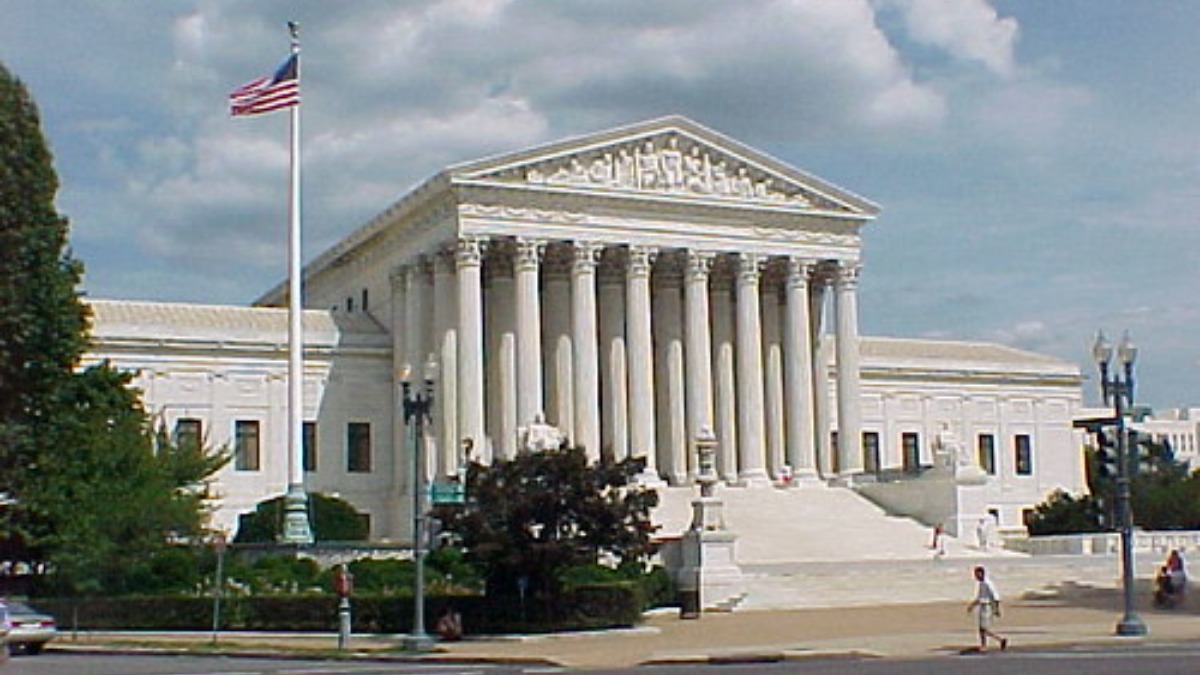

The Supreme Court’s decision to gut Section 2 of the Voting Rights Act was built on misleading data that experts are calling a deliberate manipulation. Justice Samuel Alito argued that the Voting Rights Act is no longer necessary because the era of widespread racial discrimination in voting has passed, claiming that Black voter turnout has exceeded white voter turnout in two of the five most recent presidential elections.
The DOJ calculated turnout as a proportion of the total population of each racial group over the age of 18, according to The Guardian. It is a flawed approach because that population includes non-citizens, people with felony convictions, and others who cannot legally vote. Keeping these ineligible people in the calculation produces a skewed result that makes Black turnout appear higher than it actually is.
Michael McDonald, a political science professor at the University of Florida and a leading voter turnout expert, said the DOJ included ineligible voters to reach their desired conclusion. He stated that “someone clearly knew what they were doing when they put these figures together.”
The data used to gut the Voting Rights Act falls apart under basic statistical scrutiny
When experts use the standard method, which looks at the citizen voting age population or the voter eligible population, the argument collapses. When the Guardian analyzed Louisiana data using this more accurate approach, it found that Black voter turnout only exceeded white turnout in the 2012 presidential election.
According to the Louisiana secretary of state’s office, which calculates turnout as a percentage of registered voters, Black turnout has not exceeded white turnout in any of the last five presidential elections. Alito’s argument also ignores the broader trend that the turnout gap is actually getting wider. After the 2008 and 2012 elections, where Black turnout was higher, the trend reversed.
In the three most recent presidential elections, Black voter turnout has consistently been lower than white turnout. Kevin Morris at the Brennan Center for Justice noted that the national turnout gap has grown significantly over the last 15 years. Morris described Alito’s claim as “simply not factual,” adding that in the last three presidential elections, Black turnout “hasn’t come anywhere near parity with white turnout.”
The timing of this ruling has had serious consequences for voting rights across the South. Just one week after the Supreme Court gutted the Voting Rights Act, Tennessee became the first Southern state to pass a new redistricting map that eliminates a majority-Black district. By splitting Memphis, which is over 60 percent Black, into three majority-white districts, the state has effectively removed its largest Black community’s political voice.
Similar efforts are now underway in Alabama, Louisiana, Mississippi, and South Carolina, where Republicans are moving to eliminate Democratic House seats ahead of the midterms. Voting rights advocates are warning that this is triggering the largest drop in Black representation in the South since the end of Reconstruction.
According to Mother Jones, democratic State Representative Justin Pearson said that “they are coming for Black political power in Tennessee, Mississippi, Alabama, and Louisiana.” The conservative majority on the Supreme Court has cleared the path for these states to redraw their maps quickly and with little legal resistance.
While Chief Justice John Roberts recently said it was wrong to view the justices as political actors, the situation on the ground tells a different story. The Court’s decision to rush the Louisiana ruling gave states just enough time to dismantle majority-Black districts before the upcoming elections.
The frustration over such rulings is growing beyond political circles, with some commentators calling for drastic responses to court decisions that they see as deeply unjust. It is a move that has directly shaped the conditions of the 2026 elections, and it is based on voter turnout data that standard statistical methods easily disprove.








Published: May 10, 2026 02:30 pm