



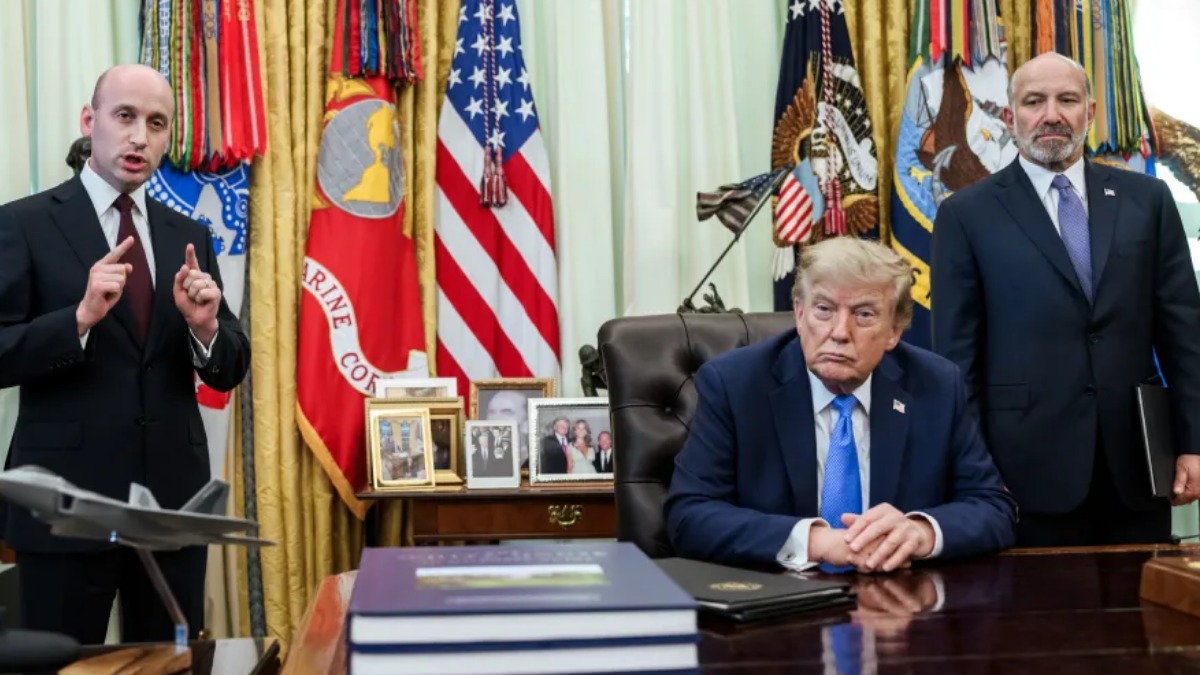

As the war with Iran reaches its six-month mark, President Trump has signaled a clear shift in strategy by opting to “low-key” the conflict rather than pursuing a new military offensive. This change in tone comes after the President was reportedly on the verge of ordering a return to major combat operations just one week ago. In a recent interview with Axios, he made it clear that he is taking a more patient approach to the situation.
“We are only semi-negotiating with them. We are just watching Iran with its huge inflation and the fact they have no money,” Trump told Axios on Sunday. He noted that the current economic reality for Tehran is dire, stating that the country’s economy is in very bad shape and that they lack the funds necessary to compensate their own forces.
This economic pressure is being driven in part by the ongoing U.S. naval blockade, which Trump suggests has significantly worsened the crisis for the Iranian regime. While the situation remains complex, he seems confident in this passive strategy. “It will work out. It always works out. It’s like a chess game,” Trump said of the tension between the U.S. and Iran.
This development arrives at a time when the conflict is causing notable strain on international relations with historic allies
Domestically, the war has become increasingly unpopular with the American public, and the closure of the Strait of Hormuz has had a tangible impact on the cost of living. According to data from AAA, the average price of a gallon of regular gas in the U.S. was about $4.00 on Monday morning. For context, the average price at this same time last year sat at approximately $3.14. Despite these rising costs, Trump pointed out that oil prices are currently hovering at slightly over $75 a barrel, which he believes helps mitigate some of the pain felt by U.S. consumers.
Behind the scenes, the path to a resolution remains rocky. An agreement to reopen the Strait of Hormuz had been negotiated between Iran, Oman, and the U.S., with mediators from Qatar and Pakistan expecting an announcement as early as Wednesday. However, those prospects have since faded. Part of the proposed deal would have granted Iran partial control over traffic in the waterway, a significant concession that was not in place before the war began.
U.S. officials believe that the delay is symptomatic of deep internal disagreements within the Iranian regime. One faction, led by President Masoud Pezeshkian, is reportedly worried about an impending economic collapse and wants to finalize the deal. Conversely, a group led by the commander of the Islamic Revolutionary Guard Corps, Ahmad Vahidi, is pushing back against any concessions.
The situation was further complicated on Saturday when Mohammad Bagher Zolghadr, the secretary of Iran’s Supreme National Security Council, issued a series of new, stringent demands for reopening the strait. These requirements, which were shared on state media, include a demand that the U.S. lift the naval blockade, withdraw its military forces from the region, and pay full war reparations.
Zolghadr also insisted that the U.S. must lift all sanctions, release frozen Iranian funds, and halt all attacks on Tehran’s allies. Furthermore, he stated that the U.S. must never threaten or insult Iran in any language and must permanently end the war against Iran and its allies in Lebanon, Gaza, Yemen, and Iraq.
These demands are particularly notable because they were previously framed as prerequisites for a nuclear deal, but are now being presented by Iran as simple conditions for reopening the vital shipping lane.
A diplomat from one of the mediating nations suggested that this pivot reflects the ongoing political infighting within the Iranian government. U.S. officials have noted that while the war is ongoing, it allows the Iranian regime to temporarily avoid confronting the damage to its infrastructure and the broader economic crisis. When the fighting eventually stops, they noted that the regime will be forced to face a reality with few viable solutions.
Officials report that about 8 million barrels of oil are moving through the southern lane of the Strait of Hormuz every night in coordination with the U.S. military, and the administration intends to keep pushing for increased output while the negotiations remain in limbo. Vice President Vance reinforced this stance during a Saturday appearance on Fox News, stating, “This thing is not over. It’s obviously not at the beginning. We’re in the middle of the game, and we’re applying a whole host of tools — diplomatic, economic, military tools — to ensure that we get the best outcome for the American people.”








Published: Aug 10, 2026 03:00 pm