



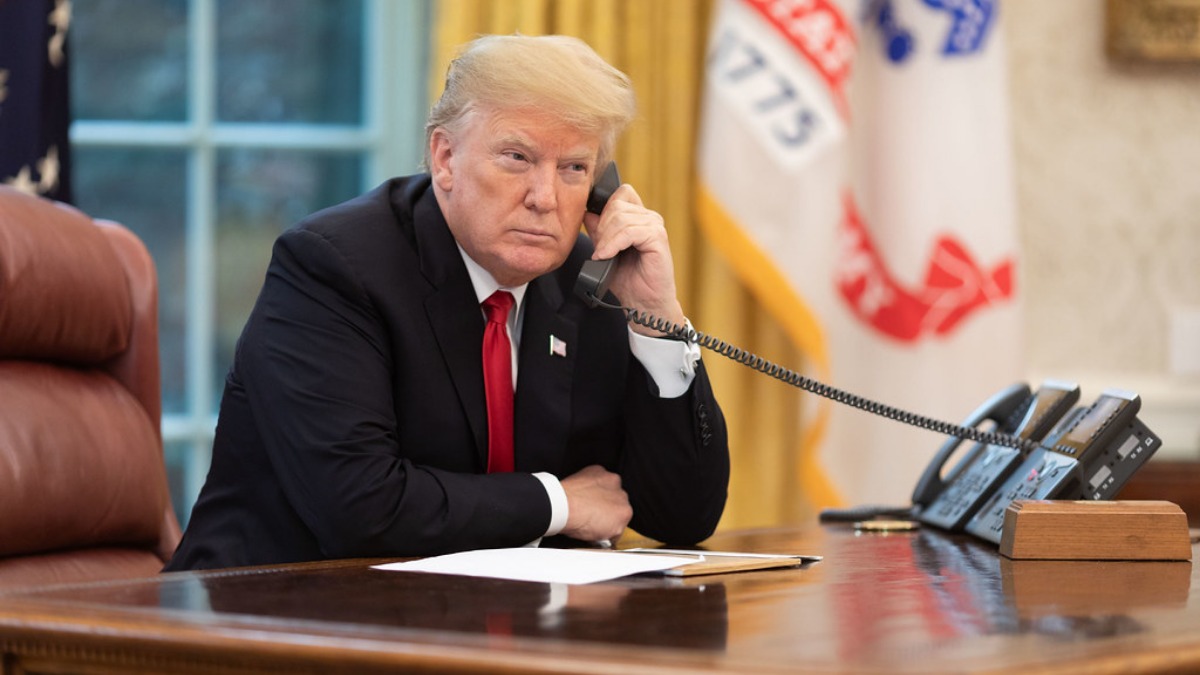

A federal judge in Massachusetts has officially struck down the controversial $100,000 fee that President Donald Trump imposed on H-1B visas last year, MS Now reported. In a 42-page ruling, Judge Leo Sorokin sided with a group of 20 Democratic states that challenged the executive order. The judge made it clear that the fee, which was roughly 50 times higher than the previous costs of $2,000 to $5,000, was an unauthorized tax rather than a regulatory payment.
This decision marks a significant moment in the ongoing battle over immigration policy. Judge Sorokin was firm in his legal reasoning, stating, “The President has no authority to levy a tax unless such a power is delegated by Congress through statute.” By blocking the fee, the court has effectively halted a policy that had caused widespread confusion and deep concern among employers, universities, and international allies since it was first announced in September.
When the fee was initially introduced, the rollout was anything but smooth. The White House press office spent an entire weekend issuing clarification after clarification to manage the fallout from the president’s proclamation. The administration attempted to blame the resulting chaos on corporate lawyers, but the frustration was felt globally. Leaders in U.S. allied nations and business owners were left scrambling, fearing that such a massive financial barrier would drive top-tier talent to other countries.
The ruling provides a temporary reprieve for the industries that rely heavily on H-1B workers
The H-1B program, which was created by Congress in 1990, allows 65,000 highly skilled workers with bachelors’ degrees to work in the United States annually for up to six years, with an additional 20,000 slots for those holding advanced degrees from U.S. universities. Despite being a frequent target for immigration opponents who claim these visas take jobs from Americans, that specific assertion is not supported by research.
The legal challenge, led by California, argued that the policy violated the Administrative Procedure Act and was unconstitutional. The plaintiffs specifically highlighted that the fee would likely lead to severe shortages in essential sectors, including medical professionals, academic researchers, and teachers.
The uncertainty was so intense that some companies and legal experts even urged visa holders currently outside the country to return immediately. This prompted the White House to clarify via posts on X that current holders would not be charged the fee to re-enter. White House press secretary Karoline Leavitt noted, “Those who already hold H-1B visas and are currently outside of the country right now will NOT be charged $100,000 to re-enter. H-1B visa holders can leave and re-enter the country to the same extent as they normally would.”
Even after those initial clarifications, the situation remained murky. The White House had to confirm that the fee was not an annual charge, but a one-time payment for new petitions. Furthermore, the policy did not provide exemptions for universities or non-profit hospitals, which typically do not participate in the standard lottery system.
Xiao Wang, the CEO of Boundless Immigration, summarized the frustration felt by many in the business community at the time. “I’m regularly getting pinged by other CEOs and job creators who are asking if they’re able to continue to afford their employees,” Wang said. “And so when you only see snippets of headlines, you really have a lot of concern around how you operate your workforce moving forward.”
The international response was equally sharp. India, which has the highest number of H-1B visa holders working in labs, tech start-ups, and hospitals, warned of humanitarian consequences. India’s commerce minister, Piyush Goyal, suggested the U.S. was “a little afraid of our talent.” Experts like Doug Rand, a former senior adviser for U.S. Citizenship and Immigration Services, pointed out the lack of precedent for such a move, noting that a president simply cannot condition entry on such a massive fee.
The White House remains defiant in the face of this ruling. White House spokesperson Taylor Rogers told MS NOW, “President Trump has clear legal authority to restrict entry of any class of aliens he determines is not in America’s best interests, and that is exactly what he did. The H-1B program has been abused for decades, and President Trump finally took action to fix it.” Rogers confirmed that the administration plans to appeal the order and is confident that the decision will be reversed.



Published: Jun 9, 2026 02:30 pm