



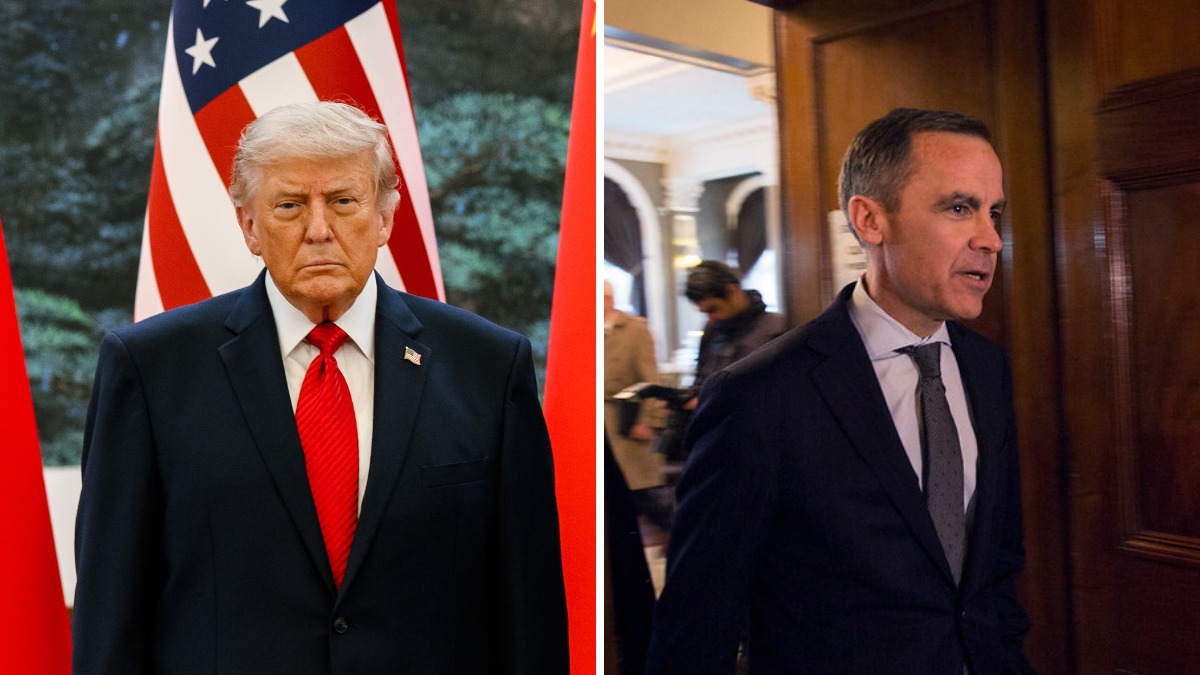

President Trump suggested that Canada should face new tariffs as a direct consequence of wildfire smoke drifting across the border and affecting American air quality, The Hill reported. The president stated that Canada “poisoned” U.S. air as smoke from wildfires in the northern regions swept across various American states. This development follows a conversation between the president and Canadian Prime Minister Mark Carney, which took place during the World Cup Final in New Jersey.
During his comments to reporters at Joint Base Andrews, the president noted that he spoke with the prime minister and told him, “you got to stop these fires from coming in and, you know, poisoning our air.” While the president acknowledged that he maintains a “good relationship” with Carney, he emphasized that the fires represent a significant problem that requires action.
The situation has become increasingly tense as the president considers economic measures to address the environmental impact. “If we can help them, we’ll help them. But maybe they should pay us some damages or something, or we should do some tariffs,” the president stated on Sunday.
The economic landscape between the two nations is already complicated by existing levies
Canada is currently subject to a 25 percent tariff on steel and aluminum products, along with a 10 percent tariff on all Canadian softwood timber and lumber imports. Additionally, a 12.5 percent tariff related to forced labor was implemented just last month. The second Trump administration has been actively looking to increase these financial pressures, and it recently decided against renewing the United States-Mexico-Canada Agreement.
The president further clarified his position in a post on Truth on Friday, describing the situation as “Willful Negligence” and a “yearly occurrence” that is costing the United States billions of dollars. He argued that the cost of this pollution must be added to the tariffs Canada is already paying. This sentiment is echoed by Environmental Protection Agency Administrator Lee Zeldin, who stated that the wildfires are causing “great concern” and “harm” to the United States. Zeldin emphasized that providing clean air remains a top priority for the agency under the current administration.
According to data from the Canadian Interagency Forest Fire Centre, there were 949 active fires as of Saturday afternoon across nearly every Canadian province and territory. Many of these fires are burning in remote areas where dry vegetation, persistent heat, and drought conditions make them incredibly difficult to contain.
More than 200 of these fires are considered “out of control,” and experts believe they could continue burning for months until the arrival of winter snow. The smoke has already had a tangible impact, with the president noting that some businesses in Michigan have been forced to shut down due to the poor air quality.
For the American public, the health risks are significant. More than 100 million people have been under air quality alerts, as shifting winds push a thick, hazardous haze into major metropolitan areas across the Great Lakes, Northeast, and Mid-Atlantic regions. This smoke contains fine particulate matter, known as PM2.5, which is small enough to penetrate deep into the lungs and enter the bloodstream.
Health officials have urged residents in cities from Chicago to New York to Washington, D.C. to limit outdoor activities and wear masks when necessary. The consequences of this exposure can be severe, ranging from headaches and eye irritation to increased risks of heart attacks and strokes for those with pre-existing conditions.
Prime Minister Carney has responded to the criticism by pointing to climate change as the root cause of the fires, asserting that it is everyone’s responsibility to address the issue. However, the administration’s focus remains on the immediate economic and environmental fallout impacting U.S. citizens.
As the smoke continues to waft into the country, the potential for further trade friction between the U.S. and Canada appears to be growing. With the president explicitly linking the environmental damage to the prospect of additional tariffs, the coming weeks will likely see continued debate over how these two neighbors manage both their shared borders and their shared atmosphere.








Published: Jul 20, 2026 03:00 pm