



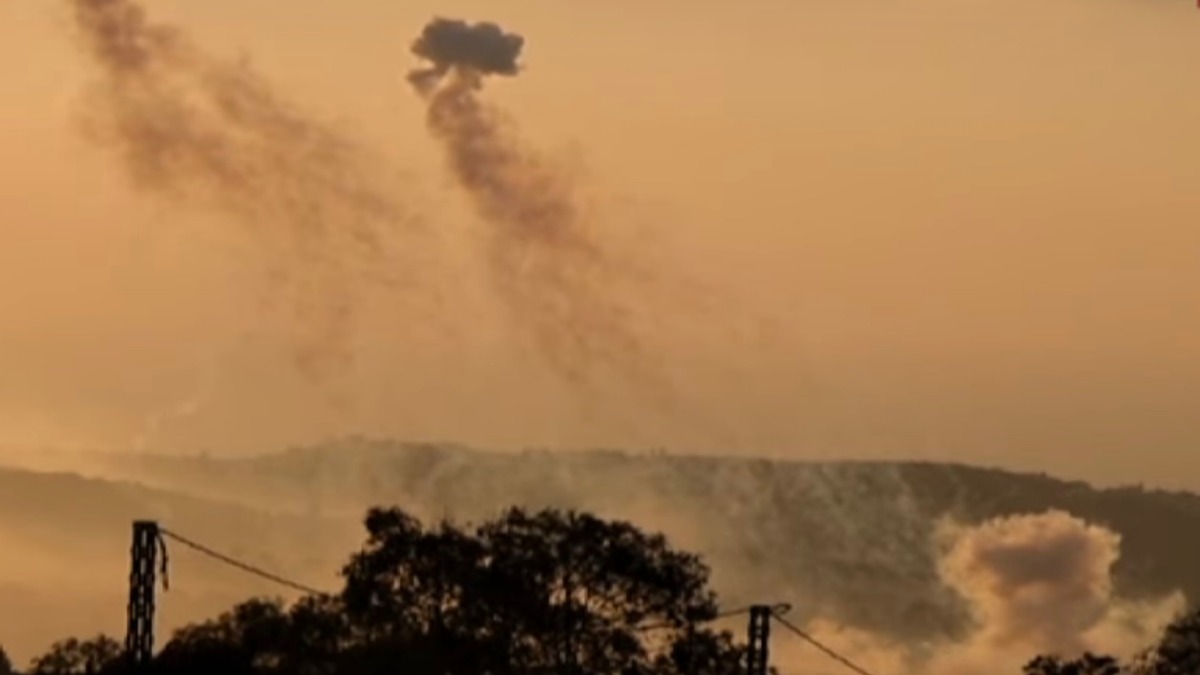

Human Rights Watch (HRW) researchers have confirmed that Israel is once again using white phosphorus munitions over south Lebanon, igniting fresh accusations that it’s violating the laws of war, as reported by The Guardian. The New York-based rights group said it verified and geolocated eight images showing airburst white phosphorus munitions exploding over residential areas in the southern Lebanese town of Yohmor during the initial days of Israel’s assault in the war on Gaza.
When an M825-series 155mm artillery projectile bursts, it expels felt wedges containing white phosphorus, leaving a distinctive knuckle-shaped plume. This is how HRW researchers were able to confirm the use of this notorious weapon. Since those initial reports, even more videos have surfaced, reportedly showing white phosphorus munitions exploding across south Lebanon. Researchers are concerned that with 800,000 Lebanese people displaced from the region after Israeli forces ordered them to leave, many more instances of its use might have gone completely undocumented.
White phosphorus is a chemical substance used in artillery shells, bombs, and rockets. It ignites upon exposure to oxygen, burning at an insane 800C and producing massive amounts of smoke. Military forces typically use it as a smokescreen to cover troop movements, mark targets, or light up terrain at night, and military lawyers argue these uses are totally legitimate. However, using it over civilian areas is super controversial, and some even claim it’s illegal, because it starts fires, causes serious burns, and emits toxic fumes.
Israel apparently does everything to minimize civilian casualty, according to the country’s ambassador to the UN
Ahmad Beydoun, an architect and PhD researcher at Delft University of Technology, has been meticulously documenting and mapping nearly 250 uses of white phosphorus by Israeli forces between October 2023 and November 2024. That last date marks the most recent full-scale attack on southern Lebanon.
Beydoun, who considers his count a conservative estimate, found that 39% of these uses were in residential areas, 17% in agricultural lands, and 44% in forested or open terrain. He believes the Israeli army might be using it to burn down fields for better visibility, making it harder for people or Hezbollah militants to hide under trees.
The environmental impact is pretty serious, too. A report by the Lebanese non-profit Public Works Studio revealed that white phosphorus was used to burn over 2,000 hectares (that’s about 4,940 acres) of southern Lebanese countryside. This includes a huge 873 hectares of dense forest with gum trees, along with vast areas covered in oak and pine trees.
This stuff can also lie hidden in the soil and spontaneously combust when farmers uncover it, posing a continuing threat if residents are ever able to return home. The report warned that repeated white phosphorus strikes can saturate the soil with phosphoric acid and toxic heavy metals like cadmium, lead, and zinc. This accumulation can reduce microbial diversity, deplete soil fertility, and decrease agricultural productivity.
An Israel Defense Forces spokesperson refused to comment on HRW’s specific claim about Yohmor. The spokesperson mentioned there can be visual similarities between smoke shells containing white phosphorus and those that don’t, advising caution before making factual determinations based solely on visuals.
Last week, Israel’s ambassador to the UN, Danny Danon, reportedly avoided directly addressing HRW’s allegations. He stated at a media briefing at the UN headquarters in New York that they do everything possible to minimize civilian casualties, which is why they asked people from southern Lebanon, south of the Litani, to move north.
Beydoun’s findings suggest a potentially more concerning motive. He believes Israel’s military might be using white phosphorus as a way to “maybe start pushing people out” to create a “buffer zone” on the Lebanese side of the border. He added that it’s simply a practical tool to burn fields, mostly for scorching the earth.
This comes as Israeli soldiers have been facing fierce resistance from Hezbollah fighters in south Lebanon in the last week, despite an intense bombing campaign that has seen Israeli forces bomb roads, petrol stations, bridges, and medical centers in an effort to cut southern Lebanon off from the rest of the country.







Published: Mar 26, 2026 03:15 pm