



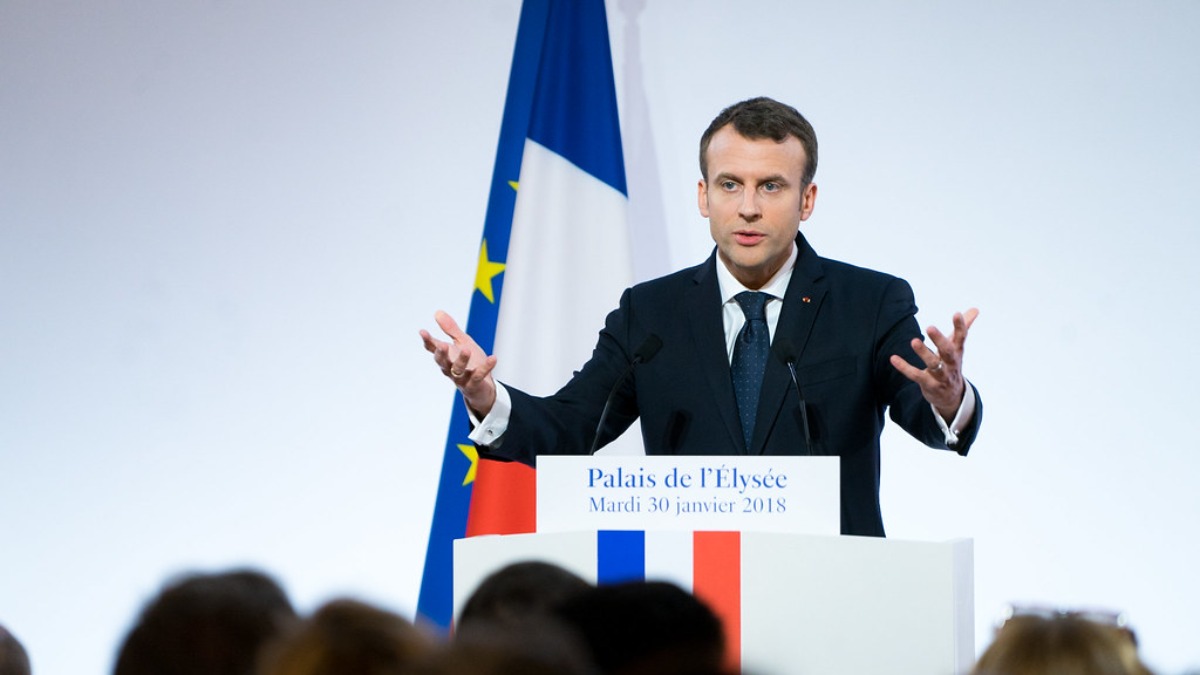

France has strongly pushed back against recent threats from President Donald Trump to pull the United States out of NATO, making it crystal clear what the military alliance is actually designed for. The French government emphasized that NATO’s core mission is to secure the Euro-Atlantic area, not to launch offensive military operations in far-flung regions like the Strait of Hormuz.
Junior Army Minister Alice Rufo, a close ally of French President Emmanuel Macron and a top diplomat, articulated this stance during the War & Peace conference in Paris. She stated, “Let me remind you what NATO is. It is a military alliance concerned with the security of the Euro-Atlantic region. It is not designed to carry out operations in the Strait of Hormuz, which would be a breach of international law.” This statement directly counters the narrative that NATO should be involved in every international flashpoint, particularly those outside its traditional geographic scope.
President Trump had previously stated that he was “absolutely” considering withdrawing the United States from NATO, echoing earlier comments he made. These remarks came after he expressed frustration that allies weren’t backing U.S. military action against Iran, specifically concerning the Strait of Hormuz.
It seems the president’s frustration with perceived lack of support from allies has reached a boiling point, leading to threats that could fundamentally reshape the global security landscape
The Strait of Hormuz is a crucial waterway for global oil supplies, and Iran has effectively asserted control over it in various ways. President Macron has proposed a different approach to the situation, suggesting a United Nations framework for any action in the strait. He believes international efforts could only move forward once hostilities subside, and after consulting with insurance and shipping firms, and crucially, with Iran’s consent.
Rufo acknowledged the American irritation regarding France’s refusal to immediately join a coalition aimed at unblocking the strait. However, she maintained that Paris favors a plan to restore transit and freedom of navigation through “means not of an offensive nature.” It’s clear that while France understands the American perspective, it holds firm on its own principles regarding international law. “I understand this irritation, but I am not speaking on behalf of the United States,” Rufo said.
She also pointed out that France is a founding member of both the Atlantic Alliance (NATO) and the European Union, and has spent the last two decades advocating for European nations to take a greater share of responsibility for collective defense within Europe. This perspective suggests that France isn’t just reacting to current events but is also pushing for a long-term vision of European self-sufficiency in defense.
This diplomatic friction isn’t just about the Strait of Hormuz or NATO’s mandate. France also drew President Trump’s ire recently after it reportedly refused Israel the use of its airspace to transfer American weapons intended for the conflict in Iran.
This decision sparked a strong reaction from the president. He took to social media to criticize France, calling the country “very unhelpful” in the conflict against Iran. “The Country of France wouldn’t let planes headed to Israel, loaded up with military supplies, fly over French territory,” President Trump stated, adding, “France has been VERY UNHELFPUL with respect to the ‘Butcher of Iran,’ who has been successfully eliminated!”
The repercussions of France’s actions weren’t limited to presidential remarks. Following France’s decision to deny airspace, the Israeli Defense Ministry announced it was halting all acquisition of defense-related goods and services from France.
The Director General of the Israel Ministry of Defense, Maj. Gen. (Res.) Amir Baram, made the decision to reduce all defense procurement from France to zero, opting instead for domestic Israeli procurement or purchases from allied countries. A Defense Ministry spokesperson explicitly stated that France “has taken a series of actions that have harmed Israel’s security and the operational capabilities of its defense industry.”
Beyond the policy disagreements, President Trump also reportedly took aim at President Macron personally, along with his wife, Brigitte Macron, during a private lunch. Reports indicated that the president ridiculed President Macron and suggested that Brigitte Macron “treats” her husband “extremely badly,” even attempting a French accent during his remarks.
When asked about these comments while in South Korea, President Macron responded with a measured tone. He described President Trump’s remarks as “neither elegant nor up to standard.” He then added that he would not respond to them, stating they “do not merit a response.”







Published: Apr 3, 2026 01:00 pm