



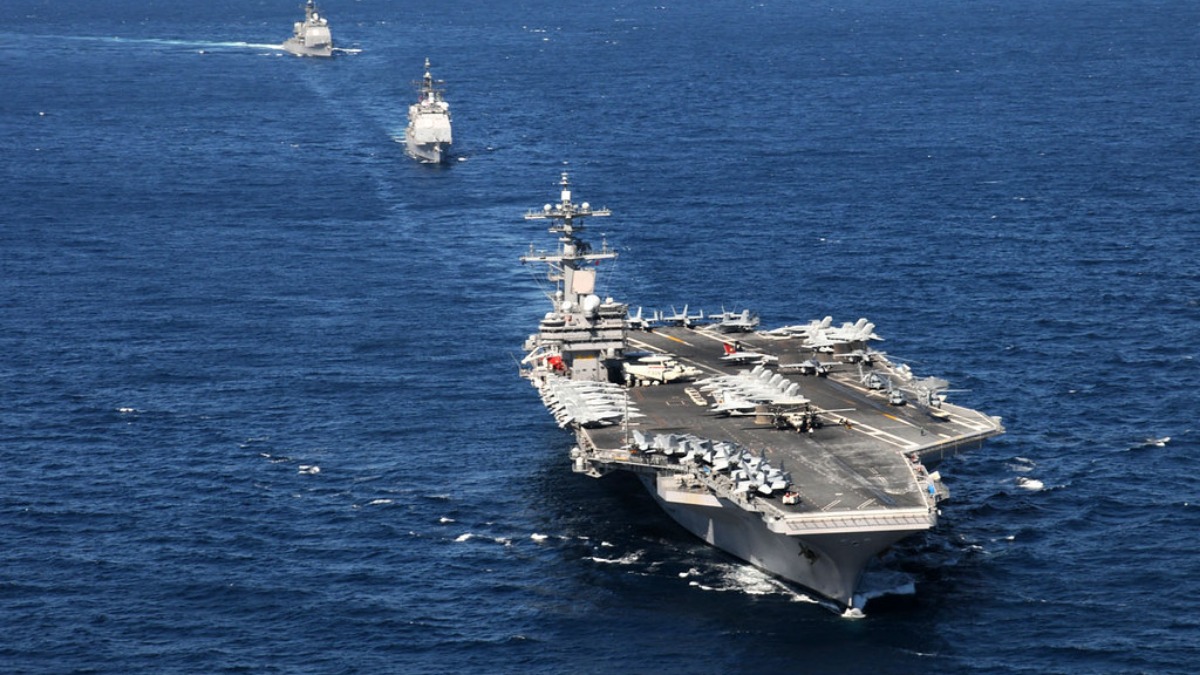

The US military command overseeing American forces in the Middle East now has three aircraft carriers at its disposal. US Central Command announced Thursday that the Nimitz-class USS George H.W. Bush has arrived in the Indian Ocean, marking a significant addition to an ongoing naval buildup. The deployment comes as the US continues to enforce a blockade of Iranian ports, a strategy that has strained military resources and heightened tensions across the region.
As detailed by Business Insider, the Bush departed Virginia in late March and sailed around the coast of Africa to reach its current position, a route made necessary by conditions in the Red Sea. With its arrival, the Bush joins two carriers already operating in the area: the USS Gerald R. Ford and the USS Abraham Lincoln. Three carriers in a single theater represents a significant concentration of combat power, with each vessel capable of launching dozens of strike aircraft equipped with precision-guided munitions, supported by electronic warfare jets and early warning aircraft.
The Abraham Lincoln is currently in the Arabian Sea supporting the US blockade of the Strait of Hormuz, while the Ford recently returned to the Red Sea following repairs in Croatia. The Ford has been on a record-breaking deployment that included a serious fire, and both carriers were active during the early weeks of the US campaign against Iran, supporting strikes on Iranian command and control systems, drone infrastructure, and defense industrial facilities.
The US blockade is a massive operation, and it is showing real strain
The scope of the enforcement effort is substantial. The US has redirected over 30 vessels, most of them oil tankers, to turn around or return to port. On Sunday, the Navy destroyer USS Spruance turned its deck gun on the M/V Touska, disabling the cargo ship by firing several rounds into its engine room after the vessel was identified as non-compliant. The blockade is enforced by over 10,000 US troops, more than 100 fighters, rotary wing aircraft, surveillance planes, and over 17 warships.
The US military is also conducting mine-clearing operations in the Strait of Hormuz. On Thursday, President Donald Trump stated that he had ordered US forces to shoot and kill any Iranian boats laying mines in the strait. He also said there is “no time pressure” in ongoing talks with Iran and “no time frame” on ending the war. Iran recently announced an agreement to reopen the strait, but the naval blockade remains in place pending a final political deal, with ceasefire negotiations remaining fragile amid ship attacks in the region that followed Trump’s open-ended truce extension.
By committing these assets to the operation, the US is accepting risks to other strategic priorities, including deterrence of China. The blockade accounts for 15 percent of the total deployed US Navy fleet, and with the Bush now in theater, 75 percent of all available US carriers are committed to the region. The deployment also ties up 66 percent of available littoral combat ships with mine countermeasures packages and 75 percent of available E-3 Sentry AWACS. Iran’s top negotiators had described ceasefire talks as a “table of surrender” before the latest round of negotiations collapsed, leaving the diplomatic path uncertain.
These extended deployments have cascading effects on maintenance, training, and deployment cycles. The USS Tripoli amphibious ready group, intended for the Indo-Pacific, was redirected to the Middle East and may soon be joined by a second group led by the USS Boxer. General Dan Caine, chairman of the Joint Chiefs of Staff, confirmed that US forces aboard destroyers have transmitted blockade warnings to vessels thirteen times since enforcement began, and so far all have chosen to comply.








Published: Apr 24, 2026 05:30 am