



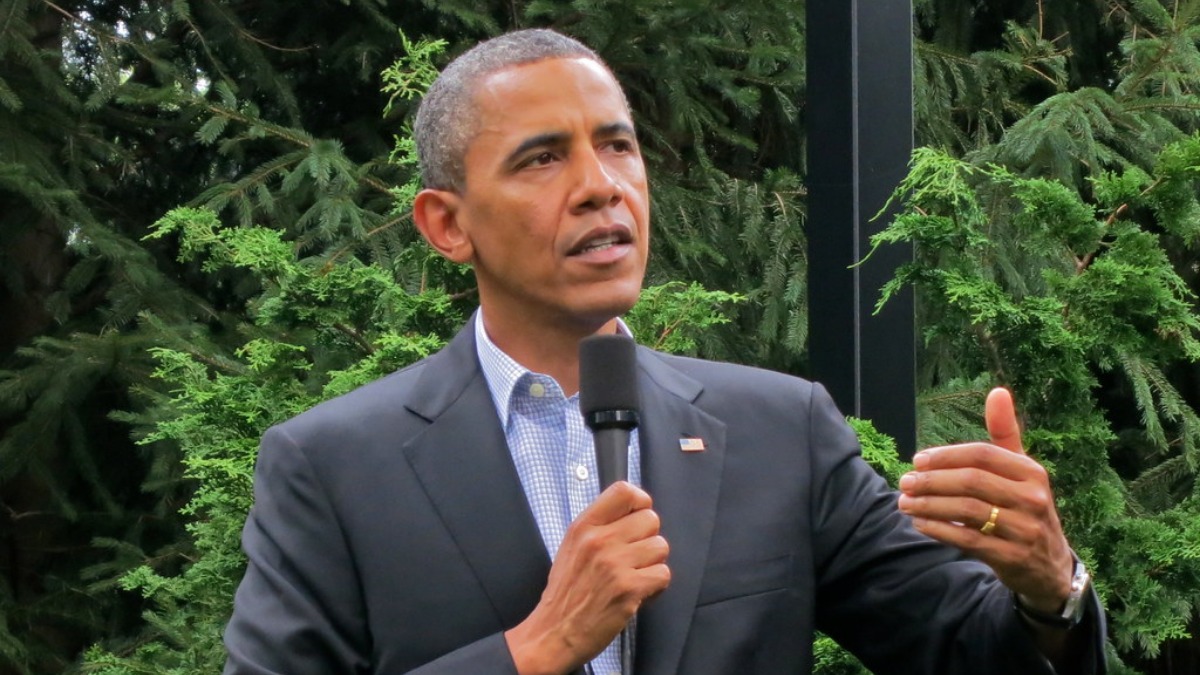

Former President Obama is actively advocating for a diplomatic approach to the ongoing conflict with Iran, pointing directly to the success of the 2015 nuclear deal as proof that military intervention is not the only path forward. As tensions rise and the current administration navigates a fragile ceasefire, Obama is using his past experience to argue that Tehran’s nuclear ambitions can be effectively constrained without the need for a kinetic conflict.
As reported by The Hill, Obama reflected on the complex process of securing the Joint Comprehensive Plan of Action, known as the JCPOA. “We went about trying to negotiate a diplomatic agreement that would get the enriched uranium out of Iran, that would assure they could not get to a nuclear weapon without us knowing about it…and that there were mechanisms in place to enforce it and verify it,” Obama explained. He emphasized the result of that effort, stating, “And we pulled it off without firing a missile.”
This perspective is gaining renewed attention as the United States and Iran exchange fire, threatening to destabilize the region further. The JCPOA, negotiated during Obama’s second term, was designed to curb Iran’s nuclear program in exchange for sanctions relief from a coalition including the U.S., Russia, China, France, the United Kingdom, and Germany. Obama noted that while his administration considered military force, it was always viewed as a last resort.
Obama expressed a belief that the Iranian regime, while often aggressive and dangerous, possessed a survival instinct that made diplomacy a viable alternative to the loss of life that accompanies military strikes
The effectiveness of that 2015 deal was significant. By January 2016, the Obama administration reported that Iran had shipped 25,000 pounds of enriched uranium out of the country. Furthermore, Tehran dismantled two-thirds of its centrifuges, removed the calandria from its heavy water reactor, and provided unprecedented access to international inspectors.
This reduced the nation’s stockpile of enriched uranium by nearly 98 percent, while still allowing for limited low-grade material for civilian energy. Obama argued that the results speak for themselves, noting, “There’s no dispute that it worked, and we didn’t, we didn’t have to kill a whole bunch of people or shut down the Strait of Hormuz.”
However, the political landscape shifted dramatically when President Trump withdrew the U.S. from the agreement in 2018. Trump characterized the deal as “a horrible, one-sided deal that should have never, ever been made.” This withdrawal has become a major point of contention in current foreign policy debates.
Senator Tim Kaine recently criticized the move during an appearance on ABC’s This Week, stating, “I think that decision by President Trump to tear up a diplomatic deal will go down in history as one of the worst decisions in the foreign policy space ever made by an American president.” Kaine warned that when diplomacy is made impossible, war often becomes inevitable.
Since the U.S. withdrawal, the situation has deteriorated. While European partners attempted to keep the framework alive, Iran eventually defied the agreement and accelerated its uranium enrichment. According to the Center for Arms Control and Non-proliferation, Iran now maintains a stockpile of uranium enriched to 60 percent, which is significantly closer to the 90 percent threshold required for weapons-grade material than the 4 percent cap established under the original JCPOA.
Despite these setbacks, the current administration remains confident in its ability to secure a more favorable outcome. President Trump has maintained that he can negotiate a stronger deal, writing in an April post on Truth Social, “If a Deal happens under ‘TRUMP,’ it will guarantee Peace, Security, and Safety, not only for Israel and the Middle East, but for Europe, America, and everywhere else.” He added, “It will be something that the entire World will be proud of, instead of the years of Embarrassment and Humiliation that we have been forced to suffer due to incompetent and cowardly leadership!”
The stakes remain high as recent high-level negotiations in Islamabad, Pakistan, have yielded little progress. Vice President Vance, alongside Steve Witkoff and Jared Kushner, led discussions with Iranian officials, but the talks ended without a breakthrough. Vance described the sessions as “substantive” but acknowledged that no peace agreement was reached. “The bad news is that we have not reached an agreement, and I think that’s bad news for Iran much more than it’s bad news for the United States of America,” Vance said.
Mohammad Bagher Qalibaf, the speaker of the Iranian parliament, countered that the U.S. officials simply failed to gain the necessary trust from their counterparts. As Pakistani intermediaries continue to shuttle proposals between the two sides, the legacy of the 2015 deal remains a central, and deeply divisive, reference point for what is possible through international diplomacy.




Published: May 14, 2026 04:15 pm