



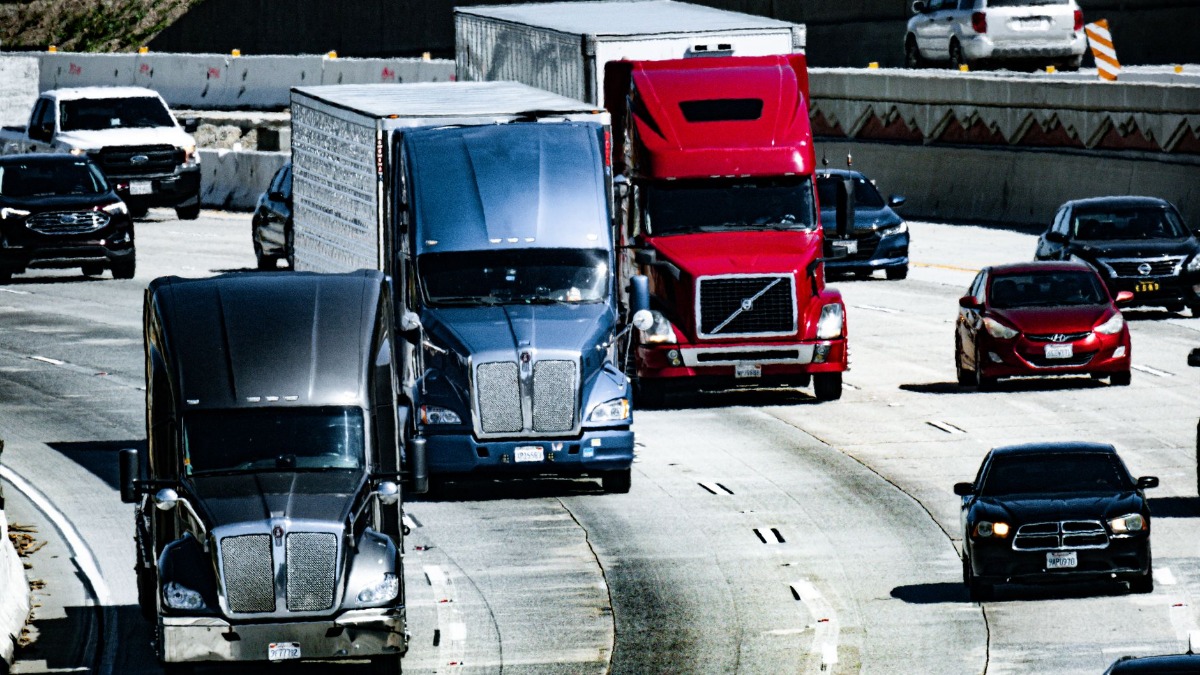

Nearly 200,000 US truck drivers are now facing the risk of losing their commercial driver’s licenses after the US Department of Transportation (DOT) implemented a new rule that restricts many foreign-born truck drivers from getting or renewing their licenses, The Guardian reported. This change has left tens of thousands of immigrant drivers in a difficult situation since the rule took effect in March, and federal courts are still reviewing lawsuits challenging it.
The new rule specifically restricts licenses to immigrants who hold particular employment authorization statuses. This means it disqualifies those with other authorizations, including asylum seekers, refugees, and individuals with Deferred Action for Childhood Arrivals, or DACA, status.
Take Sarabjeet Singh, for instance, a truck driver from India who has been working in central California for the past 12 years. He tried to renew his license last month when it expired, but he was turned away. His wife, Kavita Patel, shared just how devastating this has been for their entire family. She explained, “This not only affected us financially, but this is a huge burden mentally, emotionally, physically.”
It’s a huge blow to immigrant drivers who have dedicated years to the trucking industry
Patel also highlighted that people often think you can just find another job, but an entire skill set and experience are built around driving these massive rigs. “It’s kind of a fear and helplessness that comes from waking up one day and realizing, ‘Oh, guess what, your career that you built is suddenly all gone in one night,’” she added.
The Trump administration has framed this rule as a safety measure. The US transportation secretary, Sean Duffy, stated in a press release that licenses were “being issued to dangerous foreign drivers, often times illegally.” He emphasized, “This is a direct threat to the safety of every family on the road, and I won’t stand for it.” Duffy cited five fatal accidents involving immigrant truck drivers to justify the rule. However, these accidents represented only 0.31% of all large-truck fatal accidents in the US for the first half of 2025. It’s also worth noting that a fifth of truck drivers involved in fatal accidents were driving without a commercial license at all.
Interestingly, when a non-domicile truck driver with DACA status confronted Duffy at an event in April 2026, asking why DACA recipients were now ineligible for commercial driver’s licenses, Duffy claimed “well, it shouldn’t.” A spokesperson for the Federal Motor Carrier Safety Administration, or FMCSA, later clarified that Duffy had misheard the driver and misspoke. The FMCSA also denied that the policy change targeting immigrants was racist.
The US Secretary of State, Marco Rubio, has made similar claims. He stated that the increasing number of immigrant truck drivers posed a safety threat and was “undercutting the livelihoods of American truckers.” This followed the state department’s abrupt announcement last August that it would stop issuing work visas for commercial truck drivers.
Critics of the rule are quick to point out that the Trump administration hasn’t provided any data to back up these claims that foreign commercial driver’s license, or CDL, holders pose a specific safety threat. In fact, according to the National Safety Council, about 5,200 large trucks were involved in fatal accidents in 2024, which was actually a 3% decrease from the previous year.
The AFL-CIO, the largest federation of labor unions in the US, even wrote in a letter to Congress in March, “While DOT premised its rule on safety, its own data indicated that the CDL holders excluded by the rule (immigrant drivers) were involved in fatal crashes at a lower rate than CDL holders who are not excluded, meaning the rule would worsen, and not improve, safety.”
The Trump administration’s framing of immigrant truck drivers seems to be shaping public perception. Many of the public comments supporting the rule mention or cite “illegal” immigrants, even though the rule affects immigrants who have legal work authorization in the US. Some Democratic-led states, like New York, have tried to resist the DOT’s demand to revoke CDLs from certain drivers, but the DOT has threatened to withhold federal transportation funding in retaliation.
Immigrant truck drivers feel that the rule unfairly targets those who are legally in the country, obtained their commercial licenses properly, and have maintained clean driving records. Narinder Johal, a California-based truck driver for nearly 30 years, argued that the rule doesn’t even affect those who violate laws and obtain illegal licenses. He said, “The people who were working, paying their taxes, fulfilling all the rules and regulations, what the government issued, they’re off the road right now.”
Ignacio Romero, who has worked as a truck driver in California for 37 years, believes there’s a broader movement targeting foreign and drivers of color. He thinks this probably stems from the recent influx of immigrant truck drivers into the industry. From 2000 to 2021, the number of foreign-born truck drivers in the US surged from 316,000 to more than 720,000.
Romero shared his own experiences, stating, “I experienced a lot of racism throughout my 37 years of driving. We are constantly being profiled. I’ve been stopped three times this year.” He questions the broad approach, asking, “Why just put a general blanket statement and punish 200,000 for the actual five drivers [who were in accidents]?” He added, “I’ve always been suspicious that it was more racism, more blanket statements than holding the individuals involved in those events accountable.”
This targeting isn’t entirely new. Last April, Arkansas’s governor, Sarah Huckabee Sanders, signed a law requiring English proficiency for truck drivers. Julio Ortiz, a truck driver based in Mexico who frequently travels in and out of the US, also finds the rule unfair. He remarked, “I believe it’s a grave error to place such an obstacle in the path of people who simply wish to work honestly.”
Billy Randel, a truck driver based in New York for decades and chief organizer of the Truckers Movement for Justice, pointed out that changes in the trucking industry have negatively impacted all truck drivers, including US citizens. He argues that all drivers have faced lower wages and worse working conditions in recent decades for the sake of profit, yet the animosity is specifically aimed at immigrants. Randel concluded, “They’re focused on the worker who speaks little, if any, English, who came here looking for a better life. They forgot their ancestors did the same thing.”









Published: May 26, 2026 04:15 pm