



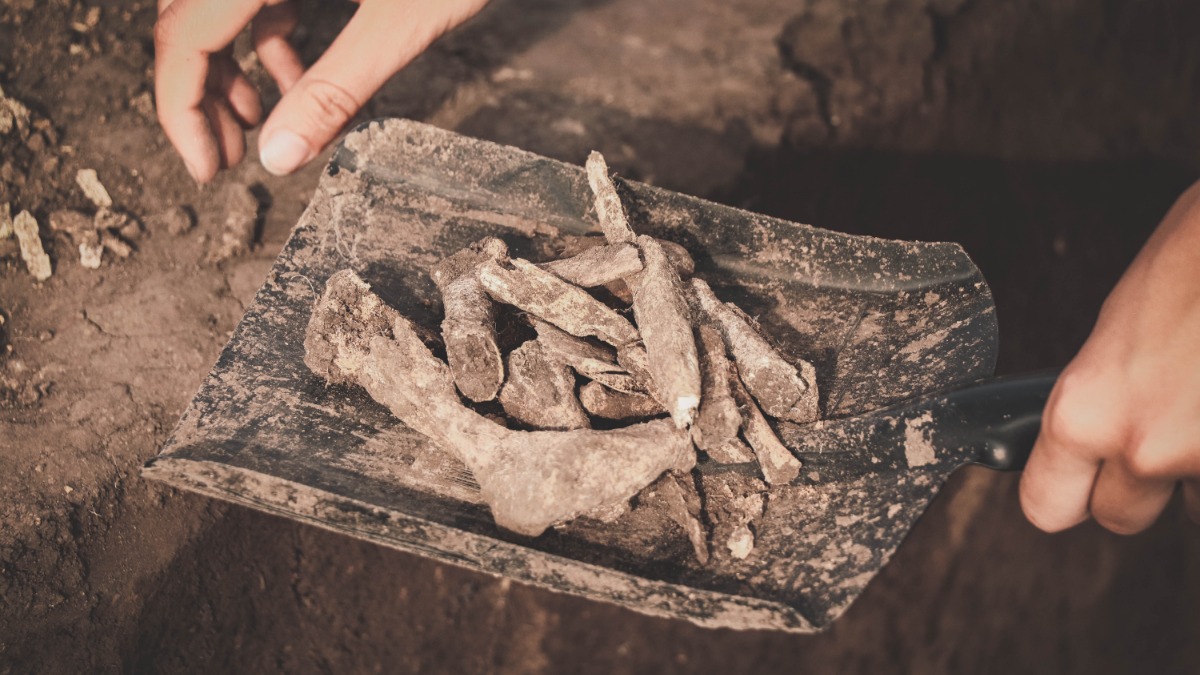

Archaeologists have uncovered a truly puzzling discovery at a 7,000-year-old settlement near the town of Vráble in Slovakia, where they have found the remains of dozens of individuals who were buried without their heads, BroBible reported. While finding a mass grave might initially make you think of a violent conflict or a dark moment in history, the team working on this site believes the reality is much more complex and likely part of a structured social practice rather than a massacre.
The settlement at Vráble was a massive farming community that thrived between roughly 5250 and 4950 BC. Researchers from Kiel University and the Slovakian Academy of Sciences in Nitra have been investigating this area since 2012, and their work has revealed a site that is incredibly significant for the study of the Linear Pottery culture, also known as the LBK. The site itself is huge, featuring the outlines of more than 300 houses spread across three neighborhoods, with up to 80 buildings being occupied at the same time during its peak.
When the team began excavating the ditch that surrounded one of these neighborhoods, they found a scene that would look pretty terrifying to the average person. Since 2022, the number of remains found at the entrance has grown significantly, reaching at least 78 individuals. The way these bodies were placed is chaotic, with skeletons lying on top of or next to each other in all sorts of positions. Some were face down, some were on their backs, and others appeared twisted or overlapping. Out of these 78 people, 77 were missing their heads, with only one child’s skeleton found with its skull intact.
Our understanding of the past shifts when we look closer at the evidence
You might be wondering if this was the result of a brutal battle, but the lead researchers aren’t so sure. According to initial bone analyses and the compiled excavation results, there is evidence that these burials were intentional social practices rather than signs of a crisis or violent struggle.
Dr. Katharina Fuchs, a biological anthropologist at Kiel University, noted that the remains show clear signs of deliberate body manipulation. She explained, “The features clearly exhibit an intentional manipulation of the bodies. First analyses suggest, above all, that violent ‘decapitations’ were not conducted here, but rather skillful removal of the skulls.”
Instead, the team suggests that the removal of the skulls was likely done after the individuals had already passed away. The preliminary data even indicates that there wasn’t a long gap between the time of death and the burial, which tells us that the community was likely following a specific, perhaps even ritualized, process.
While we don’t have a definitive answer for why this was happening, the researchers are looking at a few different theories. One possibility is that the heads were kept in a separate location, which is a phenomenon seen in other historical contexts, even if it hasn’t been directly confirmed for Vráble just yet. It is important to remember that these Neolithic societies functioned in ways that are very different from our own.
As Prof. Dr. Martin Furholt of Kiel University pointed out, “We must assume that these practices were embedded in completely different contexts of meaning than those of modern societies. This is what makes an interpretation of them so challenging.”
The team is now working hard to learn more through a project called Neolithic Bodies, which has been funded by the German Research Foundation since 2025. They are currently analyzing the bones to determine the age and sex of the individuals, and they are taking a closer look at the cut marks on the cervical vertebrae to better understand the process. They are also planning to use isotope and DNA analysis to figure out more about the diet, origins, and kinship ties of the people who lived there.
Even though it is easy to look at a site like this and assume the worst, it is much more interesting to consider that these burials were part of a complex, meaningful system that helped structure the social lives of these early farmers. The researchers are continuing to piece together how these practices changed over time and what they meant for the community as a whole.
It is a massive undertaking, but Vráble is clearly one of the most important keys we have for understanding how people in the Neolithic era perceived death and the body.








Published: Jun 11, 2026 07:30 pm