



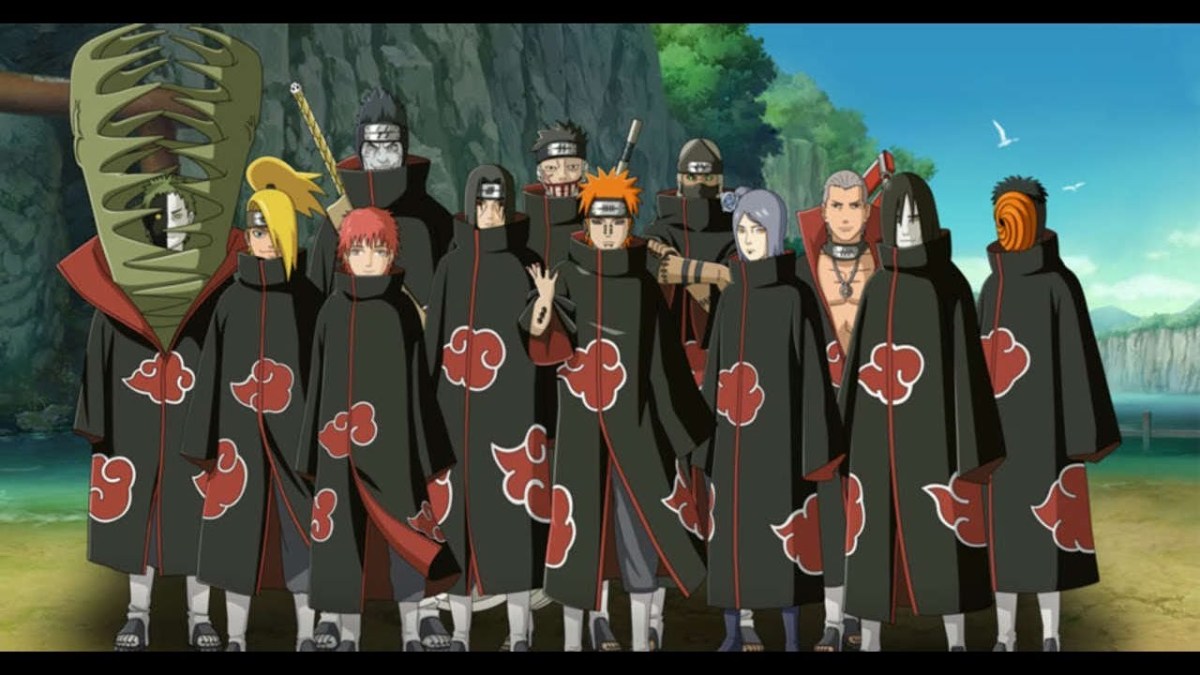
The Akatsuki organization represents the most sophisticated antagonist collective in the Naruto franchise, evolving from a regional resistance group into a global Private Military Contractor (PMC). Beyond their iconic black cloaks with red clouds, which symbolize the rain of blood that fell in Amegakure during the Second Shinobi World War, the group followed a precise economic and metaphysical strategy to dismantle the existing shinobi world order. Understanding the group requires analyzing their four distinct chronological iterations and the ancient Taoist traditions that underpin their ritualistic jewelry.
The Evolution of the Akatsuki: A Four Phase Timeline
The history of the organization is defined by shifting ideologies and leadership changes across several decades. While often viewed as a single group, the Akatsuki progressed through four distinct phases that transformed them from pacifists into an army of 100,000 clones.
Phase I: The Original Foundation (The Yahiko Era)
Founded during the Third Shinobi World War, the original Akatsuki was a pacifist resistance group established by Yahiko, Nagato, and Konan. As survivors of the previous world war, the trio sought to end the cycle of violence in the Village Hidden in Rain (Amegakure), which served as a perpetual buffer zone for larger nations. This iteration focused on diplomacy and grassroots protection until Hanzo of the Salamander and Danzo Shimura orchestrated Yahiko’s death, radicalizing the remaining members.
Phase II: The Mercenary Era (The Nagato and Pain Era)
Following the death of Yahiko, Nagato adopted the alias Pain and restructured the group into a criminal mercenary organization. This phase focused on recruiting S-rank missing-nin to capture Tailed Beasts for a three-step plan involving capital accumulation, market undercutting of hidden villages, and total global monopoly on war.
Phase III: The Eye of the Moon (The Tobi Era)
After Nagato’s death, Obito Uchiha, acting under the guise of Tobi, assumed overt control to execute the Eye of the Moon Plan (Infinite Tsukuyomi). This period was marked by the initiation of the Fourth Shinobi World War and the utilization of 100,000 White Zetsu clones alongside reincarnated shinobi to challenge the Allied Shinobi Forces. If you check out the Boroto arcs, you can see how these events directly influenced the next generation.
Phase IV: The Post-War Revival (The Shin Uchiha Era)
Approximately fifteen years after the war, the name was briefly resurrected by Shin Uchiha, an experiment of Orochimaru who viewed conflict as a tool for evolution. This final attempt failed when Shin’s own clones betrayed him, leading to their integration into the Konoha Orphanage. You can see how these themes of inheritance continue by looking at the filler lists as well as the core narrative.
The chronological recruitment order during the mercenary era is best understood through the sequence established in the Creation of the Akatsuki side story, which provides context for why certain pairings were formed.
| Recruitment Order | Recruiter | Persuasion Tactic |
|---|---|---|
| Kakuzu | Nagato and Zetsu | Financial control and immortality |
| Sasori | Konan | Artistic legacy |
| Itachi Uchiha | Obito (Tobi) | Strategic double-agent role |
| Kisame Hoshigaki | Obito (Tobi) | Access to the World of Truth |
| Orochimaru | Self-Recruited | Infiltration for the Rinnegan |
| Deidara | Itachi and Kisame | Humiliation via Genjutsu |
| Hidan | Kakuzu and Orochimaru | Platform for religious evangelism |
The Occult Origins of the Ten Akatsuki Rings
The rings worn by the Akatsuki are essential technical requirements for the Sealing Technique: Phantom Dragons Nine Consuming Seals. Each ring acts as a ritual frequency conduit, dictating where a member must stand on the fingers of the Demonic Statue of the Outer Path (Gedo Mazo) during extraction rituals.
Symbolism and Kuji-in Origins
The kanji on eight of the ten rings are derived from the Kuji-in, a system of nine syllables from the 4th-century Taoist text Baopuzi. These syllables were originally protective charms for travelers to ward off demons in wild mountains.
The placement of these rings reveals a deep symbolic hierarchy and connection to the zodiac.
| Ring Name | Kanji | Placement | Bearer | Symbolic Meaning |
|---|---|---|---|---|
| Zero (Rei) | 零 | Right Thumb | Pain | The void and rain |
| Blue (Sei) | 青 | Right Index | Deidara | The Azure Dragon |
| White (Bya) | 白 | Right Middle | Konan | The White Tiger |
| Scarlet (Shu) | 朱 | Right Ring | Itachi | The Vermilion Bird |
| Boar (Gai) | 亥 | Right Little | Zetsu | 12th Zodiac scavenger |
| Void (Ku) | 空 | Left Little | Orochimaru | Ether and transcendence |
| South (Nan) | 南 | Left Ring | Kisame | Southern Dipper |
| North (Hoku) | 北 | Left Middle | Kakuzu | Big Dipper |
| Three (San) | 三 | Left Index | Hidan | Jashinist triangle |
| Jewel (Gyoku) | 玉 | Left Thumb | Sasori / Tobi | Black King in Shogi |
When Orochimaru defected from the group seven years before the series began, he intentionally kept his Void ring. Because the Akatsuki could not replace his specific frequency, it forced the remaining members to work significantly harder. This technical delay is why the extraction of a Tailed Beast took exactly three days and nights of continuous chakra projection.
The Economics of War: Breaking the Ninja Market
While often viewed simply as combatants, the Akatsuki were corporate mercenaries who leveraged macroeconomics to destabilize nations. Pain’s business model was designed to bankrupt the Five Great Shinobi Countries by offering S-rank military services at rates significantly lower than those of the traditional hidden villages.
Currency Conversion and Financial Stakes
The canonical currency of the series, the Ryo, converts to 10 Japanese Yen, making 1 Ryo approximately 0.075 USD. Applying this to known bounties highlights the massive financial scale of the group’s operations.
| Financial Metric | Ryo Amount | USD Equivalent |
|---|---|---|
| D-Rank Mission | 50,000 | $3,750 |
| Chiriku Bounty | 30,000,000 | $2.25 million |
| Asuma Sarutobi Bounty | 35,000,000 | $2.6 million |
| Konan’s 600 Billion Bombs | 600,000,000,000 | Trillions in Ryo |
The logistics of their operations also suggest a massive world scale. Modeling travel times reveals the planet is approximately twice the size of Earth, with the route from Konoha to Suna covering 6,336 km, or roughly the width of the African continent. This vast geography allowed the Akatsuki to operate from their headquarters in a permanent low-pressure zone in Amegakure.
Complete Akatsuki Roster: Rarity and Lore
Every member of the core roster possessed unique traits that went beyond their S-rank classification, many of which are explored in the Akatsuki Hiden: Evil Flowers in Full Bloom novel.
Itachi Uchiha and Kisame Hoshigaki
Introduced in Chapter 139 during the funeral of the Third Hokage, this pair shared a psychological bond often masked by their roles. Lore from the novels reveals that Itachi once spared the lives of two brothers, Kiiro and Kodaka, because hearing them call each other brother reminded him of Sasuke. Itachi also intentionally left Orochimaru’s ring in the Sannin’s possession to subtly hinder the organization’s efficiency.
Hidan and Kakuzu (The Zombie Combo)
Kisame nicknamed this pair the Zombie Combo due to their functional immortality. A specific production trivia point is that Hidan is the only core member who never actually met the series’ protagonist, Naruto Uzumaki, as he was buried alive by Shikamaru while Naruto was fighting Kakuzu. Kakuzu himself lived for 91 years by stealing the hearts of others after a failed attempt to assassinate Hashirama Senju.
Sasori and Deidara (The Artist Duo)
The ideological conflict between Sasori’s Eternal Art and Deidara’s Fleeting Art defined their partnership. Sasori converted his own body into a puppet to achieve immortality, but he revealed his true human form to the Akatsuki leadership during his initial induction. Deidara, whose bomb designs were inspired by the Japanese artist Taro Okamoto, was recruited only after Itachi humiliated him with a single genjutsu.
| Member | Village | Status | Unique Lore Point |
|---|---|---|---|
| Pain | Rain | Deceased | Used Yahiko’s corpse for the Deva Path |
| Konan | Rain | Deceased | Yahiko warned her never to trust Tobi |
| Itachi | Leaf | Deceased | Held back his maximum power for Sasuke |
| Kisame | Mist | Deceased | Happy to die by Itachi’s hand |
| Sasori | Sand | Deceased | Developed puppets from humans |
| Deidara | Stone | Deceased | Mouths on palms are from stolen kinjutsu |
| Kakuzu | Waterfall | Deceased | Techniques are Gundam homages |
| Hidan | Hot Water | Incapacitated | Only member to disrespect Pain openly |
| Zetsu | None | Sealed | Manipulated Madara for centuries |
| Tobi | Leaf | Deceased | The Black King mastermind |
Behind the Scenes: Production Trivia and Meta
Creator Masashi Kishimoto has shared several insights into the development of the organization that challenge common fan perceptions.
- Original Monster Concept: Kishimoto originally envisioned the Akatsuki as a group of physical monsters with no human characters. This original design intent survived in the shark-like Kisame and the plant-like Zetsu.
- Gundam Influences: Kakuzu’s attacks were named after mech units from the Mobile Suit Gundam franchise. Earth Grudge Fear is a nod to the Zeong (MSN-02), while False Darkness references the Gyan (YMS-15) and Earth Spear refers to the Dom (MS-09B).
- The Dog Hokage: Before deciding on Minato Namikaze, Kishimoto’s original plan for the Fourth Hokage’s spot on the monument was a ninja dog (Ninken), reflecting the more whimsical tone of early Naruto.
- Character Designs: Konan was initially designed with revealing clothing and a belly button piercing to emphasize her rebellion against village tradition, though this was largely covered by her cloak in final versions.
Gaming Meta for the Akatsuki
Ultimate Ninja Storm Connections (Version 1.60)
The latest balance patch has elevated Itachi Uchiha to S-tier support status because his Redline Amaterasu is now unblockable. Pain has also received significant buffs, with the startup lag on his Almighty Push being reduced, making him a more viable defensive choice in competitive play.
Naruto to Boruto: Shinobi Striker (Season 9)
In the latest Shinobi Striker updates, Hidan has been introduced as a front-line Defense Type with a 7-stage physical buff stack. This makes him a direct counter to the Claw Edge Kurama builds that currently dominate the online environment. Sasori has been reworked into a Ranged Type specializing in poison damage through his Iron Sand Thorns.


Published: Apr 22, 2026 03:28 pm