



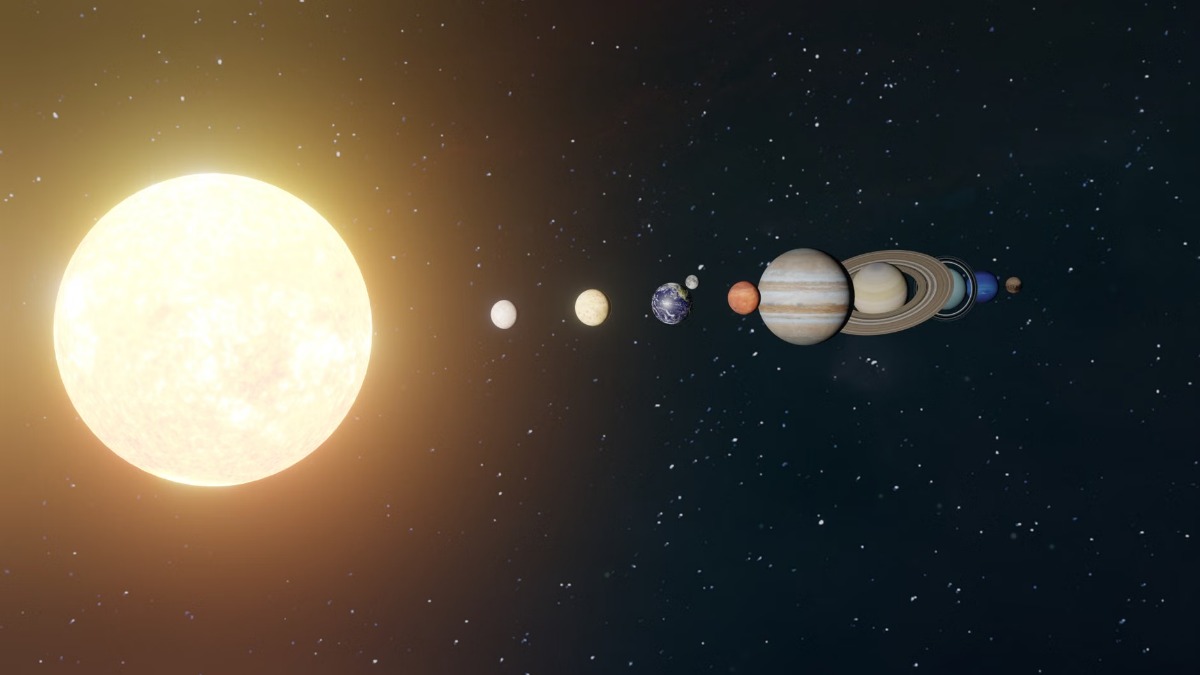

Independent researcher Gabriel Harry has proposed a series of megascale engineering projects designed to keep Earth habitable for up to 9.1 billion years, primarily by turning Jupiter into an artificial sun and using a particle beam to shift Earth’s orbit. The concept, published in the Journal of the British Interplanetary Society, addresses the long-term threat posed by the Sun’s eventual expansion into a red giant. As detailed by Universe Magazine, the plan spans several stages of construction across vast timescales.
Astronomers have long agreed that the Sun’s expansion will render Earth uninhabitable in about one billion years, as rising temperatures eventually boil the oceans and strip away the atmosphere. Harry’s proposal does not dispute that trajectory, but instead outlines how a sufficiently advanced civilization might counter it through large-scale engineering rather than abandonment of the planet.
The plan calls for a giant sunshield roughly 700,000 kilometers wide, positioned just beyond the Moon’s orbit and secured by a carbon cable anchored to a counterweight at the L1 Lagrange point, the region between Earth and the Sun where gravitational forces balance out. The shield would cover 70 degrees of the sky despite being made of aluminum only 0.1 millimeters thick, a design that echoes the sunshield used on the James Webb Space Telescope on a far larger scale.
Building the shield alone would require raiding two celestial bodies for material
Constructing the shield would require extracting aluminum from about 0.01 percent of the Moon’s mass. It would also require producing two million kilometers of carbon cable, a task that would consume 40 percent of the material found in the dwarf planet Ceres, according to the proposal.
Blocking the Sun would leave Earth in darkness and cold, which is where the second stage of the plan comes in. Harry proposes placing fusion reactors roughly 6,500 kilometers into Jupiter’s atmosphere to consume hydrogen and helium-4, generating power that would be transmitted to Jupiter’s L1 point and beamed back to Earth through lasers and relay stations, functioning as an artificial sun.
The most ambitious phase involves moving Earth itself, from its current orbit of one astronomical unit to 1.2 astronomical units, in order to avoid being engulfed during the Sun’s red giant phase. Harry suggests extracting oxygen from Jupiter to create a particle beam aimed at Earth, with the force gradually nudging the planet into a wider orbit over hundreds of years, according to the preprint posted to arXiv.
Proposals of this scale sit alongside a broader run of unusual space findings in recent months, including a rare sugar detected in a Milky Way cloud that researchers say may have contributed to the earliest building blocks of life on Earth. That discovery, alongside Harry’s proposal, reflects how far astronomers and engineers are willing to look, both backward and forward, to understand Earth’s place in the universe.
Other researchers have also revisited older data for new answers, including a review of decades-old sky photographs that identified unexplained transient flashes predating the launch of the first human satellite. Neither finding is connected to Harry’s proposal, but both illustrate the range of open questions still surrounding Earth’s cosmic neighborhood.
Recent data published in The Planetary Science Journal shows that Pluto’s atmosphere is beginning to shrink as the dwarf planet moves farther from the Sun along its 248 Earth-year orbit. Researchers led by Amanda Sickafoose from the Planetary Science Institute compared measurements from the 2015 New Horizons flyby with more recent observations and found a 16 percent decline in atmospheric parameters by 2022.
The contraction is occurring because Pluto is cooling as it moves away from the Sun, causing nitrogen-based gases in its atmosphere to condense and fall to the surface as frost. Scientists tracked the change using stellar occultations, analyzing 10 such events recorded between 2017 and 2023 to confirm the trend.
Pluto is not expected to begin moving back toward the Sun until 2114.









Published: Aug 6, 2026 07:15 pm