


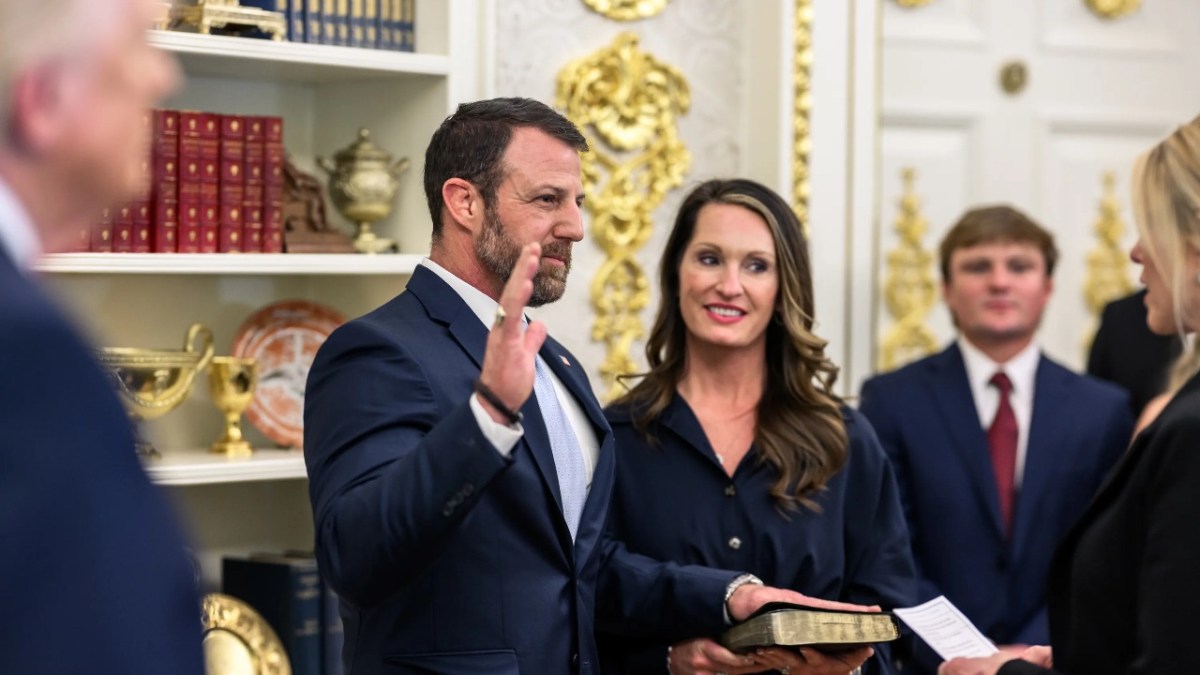

Homeland Security Secretary Markwayne Mullin spent five days outside the country visiting Azerbaijan, Jordan, and the United Arab Emirates as the United States handled a wave of technology outages that left people questioning the government’s readiness against cyber threats.
Documents from the Department of Homeland Security that the Washington Examiner obtained show he left quietly on Wednesday, November 18, for meetings with the presidents of those three nations. Officials at the department explained that the trip stayed unannounced for safety reasons.
Some people inside DHS and the White House viewed the timing poorly, with a few declining to say more than that the optics looked bad. A senior Trump administration official who checked the travel papers said, “That trip doesn’t make sense in its own right and makes absolutely no sense given recent events.” That same official added, “His priorities are not aligned with the DHS mission.”
Questions raised over the secretary’s overseas schedule during outages
In a separate text, the official wrote, “Mullin’s Middle East junket in the midst of multiple cyber incidents is indicative of the lack of leadership DHS has at the moment. His judgment is terrible.” The message continued, “There is no urgent DHS need in the Middle East and the fact that he brings his wife along for the trip doesn’t instill confidence that he takes the job seriously.”
Mullin had been set to join other interior and security ministers at a G7 meeting in France on November 19 and 20, but riots forced organizers to push the event to December. He pressed ahead with the Middle East stops and brought his wife, Christie, with him.
During the visit, he sat down with Jordan’s King Abdullah, the U.S. ambassador there, and DHS agents based in the country. From there, the group moved on to the United Arab Emirates, where he met President Mohamed Bin Zayed al Nahyan and President Ilham Aliyev while still in Jordan, then flew home on Monday.
Capitol Hill reporter Pablo Manriquez broke the news of the travel and pointed out that Mullin departed 16 days before a possible funding deadline for the government. Jessica Vaughan, who directs policy studies at the Center for Immigration Studies, argued that the secretary should concentrate on locking in money for DHS, the third-largest federal department, and on advancing the White House’s immigration goals while also preparing for expected congressional reviews.
In an email she wrote, “He should be working the phones and walking the halls on Capitol Hill to try to get the lame duck Congress to pass some kind of meaningful changes to the laws.” She further said he needs to map out how he will handle coming hearings and oversight, protect the agencies and their policies, and push back against Democratic ideas for amnesty, cutting ICE, and opening the border. She added, “Unless … maybe the White House doesn’t want him on those tasks?”
Mullin had already been one of two main officials asked to walk Americans through a nationwide air-travel ground stop that hit on November 13. That stop arrived in the same week that outages struck both private companies and government systems and raised fears of a foreign attack.
On the Monday before his trip, during a Fox News interview that led White House chief of staff Stephen Miller to keep him off television for the time being, Mullin said “a guy that’s very smart with tech” had suggested artificial intelligence could explain the recent problems.
The following Wednesday he appeared before the House Homeland Security Committee. Instead of outlining his prepared testimony at the start, he used the opening minutes to defend taking a government luxury jet to Baton Rouge, Louisiana, the day after the ground stop so he could watch a college football game he described as important to his great-niece.
Members of both parties raised worries about the outages that touched Apple, Microsoft, United Airlines, JPMorgan Chase, and the National Security Agency. Mullin told the committee he was “98% confident that this has nothing to do” with foreign adversaries, a reply that left some listeners uneasy.
Simon Hankinson, a senior research fellow focused on border security and immigration at the Heritage Foundation, said Mullin sits “between a rock and a hard place as he can’t make everyone, or anyone, fully happy” while carrying out the president’s immigration plans.
Hankinson noted that the DHS secretary post ranks among the hardest jobs in Washington because of the department’s size and reach, and that “No one could possibly be on top of it all, and there is no education or career that could prepare someone to do it. Mullin seems engaged and competent to me, and he’s certainly less of a showboat than Noem was.”
An unnamed DHS official said Mullin remains “very” popular at the department’s Washington headquarters “probably because memories of who he succeeded is still fresh.” The same person added, “There isn’t much criticism of his travel, because the machine of DHS turns whether he’s in DC or not.”
A department spokesperson responded that “Mullin is laser focused on the DHS mission to deliver a safe and secure homeland.” The statement continued, “Secretary Mullin works 24/7 to secure the homeland, and that includes engaging with international partners for diplomatic meetings and bilateral security discussions that advance America’s national security interests.”
It also reads, “Proactively engaging with international partners allows DHS to strengthen partnerships that benefit the United States, improve information sharing, prevent foreign threats from ever reaching the homeland, and keep the American people safe. This is what it looks like when DHS takes a proactive approach to securing the homeland.”





Published: Nov 29, 2026 06:45 am