



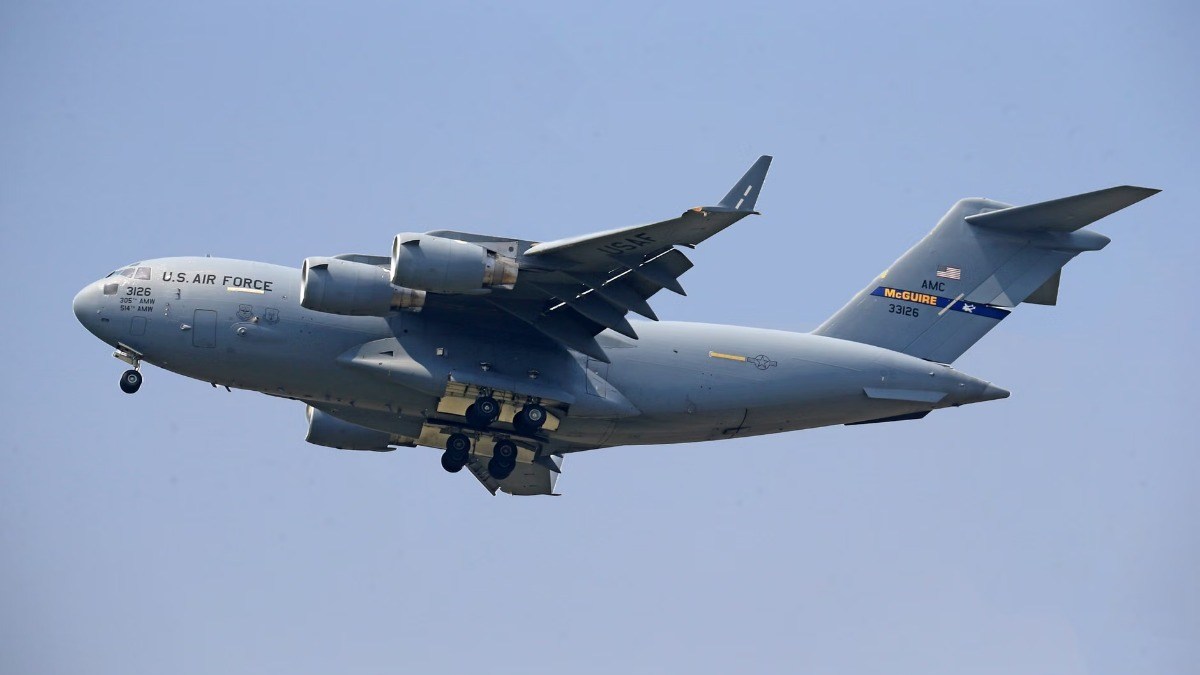

A Coast Guard plane carrying Homeland Security Secretary Markwayne Mullin and more than a dozen other people made a safe emergency landing on Wednesday following a sudden engine failure. As reported by NBC News, the incident occurred at Ronald Reagan Washington National Airport in the Virginia suburbs of Washington. No injuries were reported among the 14 people on board.
The situation unfolded around 1:35 PM, when the pilot contacted air traffic control. In an audio recording of the exchange, the pilot said the aircraft had lost its right engine and requested an immediate emergency landing at DCA, confirming there were 14 people aboard and roughly two and a half hours of fuel remaining. A statement from the Metropolitan Washington Airports Authority said the call cited a possible mechanical issue, prompting the decision to divert the flight to Reagan Airport.
Mullin shared his account of the landing on X, saying the crew handled the situation with skill and that the pilots later told him it was “a first for them.” Once the plane touched down, it was checked by Airports Authority Fire and Rescue personnel before proceeding off the runway, and officials confirmed there was no disruption to other flights during the process.
The smooth landing comes as the Coast Guard’s fleet keeps showing its age
The Coast Guard relies on approximately 200 aircraft to cover more than 100,000 miles of US coastline and inland waterways, supporting search and rescue missions across the service. Data shows the fleet generally fell short of its 71 percent availability target during fiscal years 2018 through 2022, with actual availability ranging from 66 percent to 68 percent, a gap officials have tied to maintenance and repair challenges.
The service is now in the middle of a multibillion-dollar effort to modernize its aircraft. As of January 2024, four major acquisition programs were underway with a combined estimated cost of $105.6 billion, including a plan to consolidate the current fleet of 98 short-range and 48 medium-range helicopters into an all medium-range fleet, reducing the total helicopter count from 146 to at least 127. The modernization push comes the same week New York officials raised a dispute over police funding with the Trump administration.
Investigations have found the Coast Guard has not fully assessed whether the shift to an all medium-range fleet will provide the right type and quantity of aircraft for its operations, and the service has not conducted a comprehensive analysis of alternatives for replacing its short-range helicopters. Staffing remains a separate concern, with 9 percent of authorized military aviation workforce positions vacant as of July 2023.
The Coast Guard is working on several recommendations to improve readiness, including establishing uniform procedures for collecting air station data and coordinating an analysis of whether a third rotary-wing airframe is needed as current models near the end of their service lives. The reporting on the fleet’s gaps arrived the same week as a dispute over cut polling sites in Texas drew hundreds of protesters.








Published: Sep 3, 2026 06:00 am