



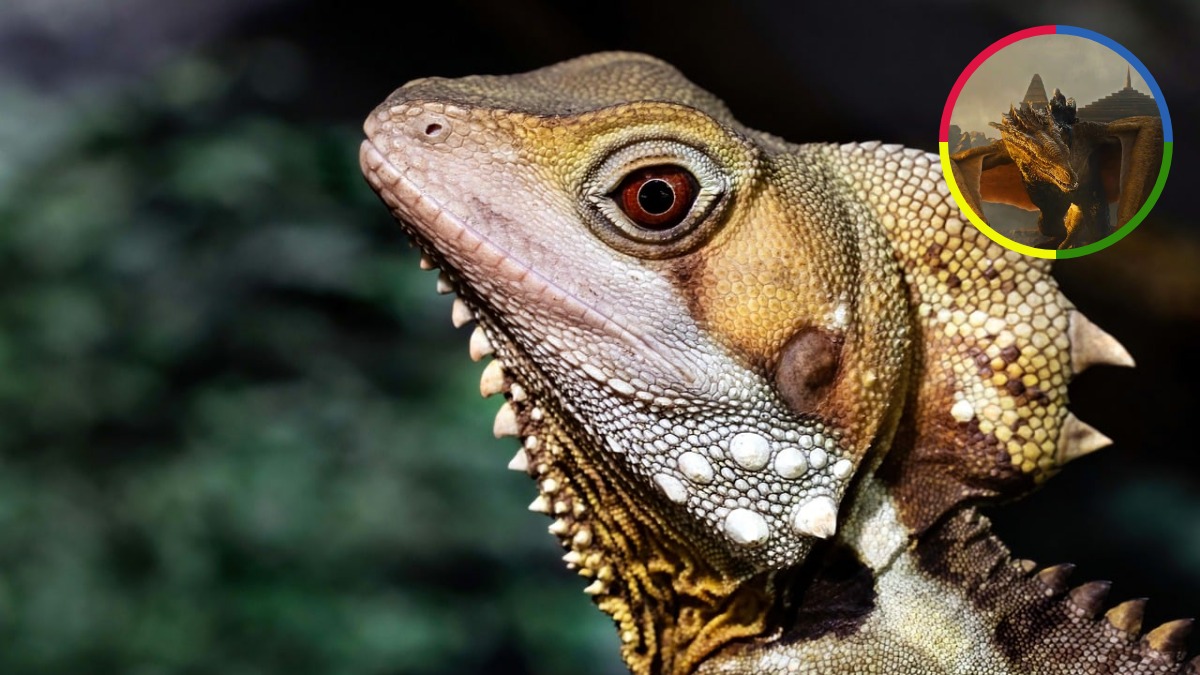

A tiny dragon has emerged from Thailand’s forests. Scientists have discovered a new mountain horned lizard and named it after one of the most recognizable dragons from House of the Dragon.
The species has been named Acanthosaura syrax. Its name pays tribute to Syrax, the dragon ridden by Queen Rhaenyra in the HBO series. The researchers found several similarities that made the fictional connection especially fitting.
According to Dexerto, the new lizard lives in high-elevation evergreen forests in Mae Wong National Park. Its habitat sits above 4,265 feet in western Thailand. The discovery also adds another species to the remarkable biodiversity of the region.
A tiny yellow-green lizard with an attitude just joined the Targaryen family tree
The researchers from Chulabhorn Royal Academy and Kasetsart University found that A. syrax stands apart from its relatives in several ways. It has a smaller body and the tiniest nuchal and dorsal scales recorded in the genus. The lizard also has yellowish-green coloring and a distinctive dark collar.
Unlike several related species, it does not have a black patch around its eye. It also produces unusually large clutches for its size. Females can lay up to 16 eggs. Those traits helped inspire the choice of Syrax as its namesake. Unexpected animal discoveries have made headlines before; a Vancouver serval sighting under a resident’s porch drew similar attention.
DNA testing provided stronger evidence that the lizard was a distinct species. Phylogenetic analysis used mitochondrial ND2 and COI genes. The results showed A. syrax as a reciprocal monophyletic lineage. Maximum-likelihood analysis produced 76% and 99% nodal support. Bayesian analysis produced 0.78 and 1.00 support. Interestingly, animal research can also shed light on human evolution, as an Oxford study of monkeys and apes explored why most humans are right-handed.
Genetic distances also separated the species from other Acanthosaura. ND2 differences ranged from 14.1% to 15.9%. COI differences ranged from 14.96% to 28.13%. Intraspecific variation remained extremely low at 0 to 0.01% for ND2 and 0 to 0.34% for COI.
The species follows a seasonal pattern. Activity peaks from April through mid-June. It disappears during colder months when temperatures can fall to around 50°F.
Its habitat is limited to a narrow band of high-altitude forest. That makes it vulnerable as pressure on the habitat increases. Researchers want stronger protection for Mae Wong’s upper forests. They also believe the lizard could become a flagship species alongside the Indochinese tiger and Asian forest tortoise. As the ZooKeys paper notes, “This discovery brings the number of Acanthosaura species to 23.”









Published: Aug 16, 2026 03:30 pm