



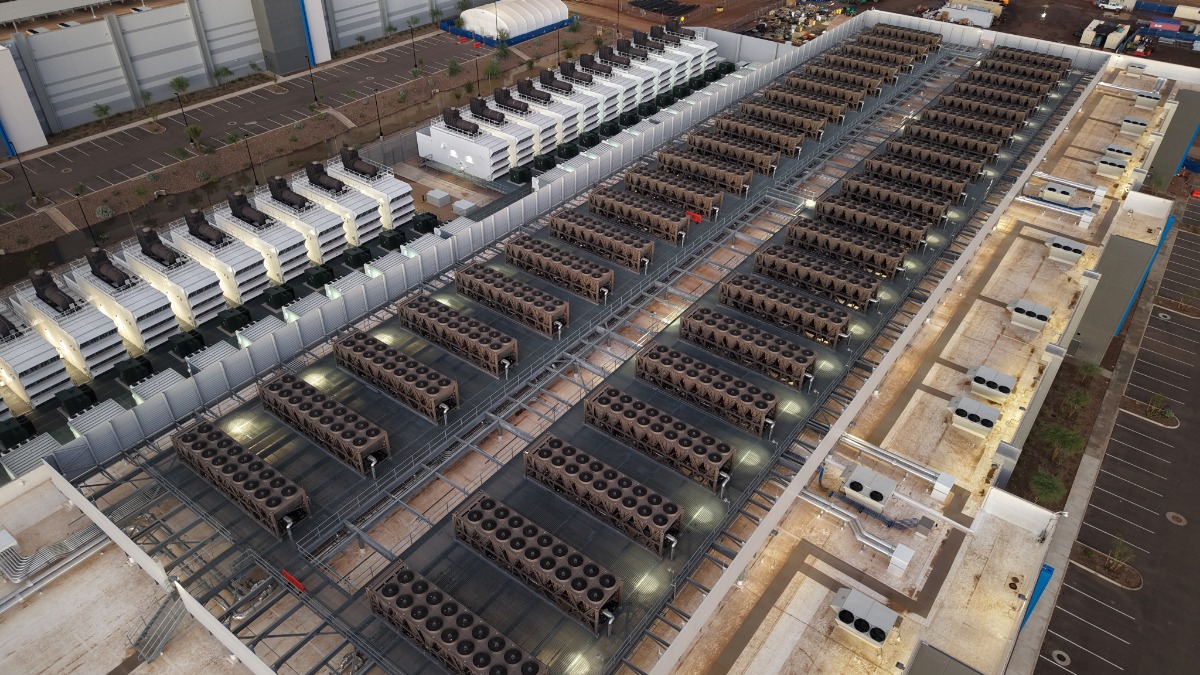

The Box Elder County commissioners have officially approved the Stratos artificial intelligence datacenter, a massive project that is set to cover more than 40,000 acres across three separate sites in northwestern Utah, The Guardian reported. This project is absolutely massive, spanning an area more than twice the size of Manhattan.
It is a development that has triggered a significant amount of public pushback, with thousands of residents lodging formal objections against the plans. The concerns are primarily centered on the incredible amount of energy required to run the facility and the potential impact it will have on local water supplies, which are already under extreme stress.
The facility is expected to require about 9GW of power to function. To put that in perspective, that is more electricity than the entire state of Utah currently uses. The project is backed by venture capitalist Kevin O’Leary, who you might recognize from the television show Shark Tank. O’Leary has positioned this project as a necessary step for the United States to keep up with global competition in the AI industry.
When you look at the raw numbers, the scale of this project is honestly hard to wrap your head around
O’Leary told Fox News, “I don’t think there’s a bigger site in the world than this,” and added, “It shows the Chinese and the rest of the world we are not messing around, we are going to get this done, move it forward and provide the compute power to our AI companies that defend the country.”
Despite these claims of national importance, the environmental concerns are substantial. The region has faced severe drought conditions in recent years, and experts are worried that the datacenter will consume an unsustainable amount of water.
Environmentalists, including the Sierra Club, have warned that the project could threaten the ecosystem of the Great Salt Lake. This is already a fragile habitat for migratory birds, and the lake is shrinking due to agricultural diversion and the ongoing climate crisis. There is a real fear that as the lake bed dries up, residents in nearby Salt Lake City could be exposed to toxic dust clouds.
Franque Bains, who serves as the director of the Sierra Club’s Utah chapter, put it bluntly: “At a time when the Great Salt Lake is already in crisis, approving a project that will consume water and energy at this scale is irresponsible and dangerous,” and continued, “Utahns want to see the Great Salt Lake restored, not stripped.”
The heat generated by the facility is another major point of contention. Rob Davies, a physics professor at Utah State University, conducted an analysis suggesting that the industrial-scale fans required to cool the hot pipes could significantly raise local temperatures. He estimates that daytime temperatures in the Hansel valley could rise by 2F to 5F, with night-time temperatures jumping by as much as 8F to 12F. Davies warned, “The thermal load from the proposed Stratos project is extreme,” and noted that “this facility imposes substantial drying on a watershed and ecosystem already in active collapse.”
O’Leary has pushed back against the criticism, specifically addressing concerns about water and energy. In a post on X, he stated, “We’re not gonna drain the Great Salt Lake. That’s ridiculous. We are gonna create incremental jobs.” Regarding the massive power requirements, he claimed that the project would not hike up energy bills for residents because the developers intend to build new gas-fired generation from scratch. “We are building power from scratch, from the pipeline,” he said, adding, “We are going to burn it with turbines, clean.”
The situation on the ground has been quite tense. Lee Perry, a Box Elder county commissioner, mentioned that the public meetings have been so contentious that they have left him feeling “physically sick,” citing death threats and false accusations. O’Leary has further complicated things by claiming in social media posts that the protesters are not local residents. “There are professional protesters that are paid by somebody, I don’t know who,” O’Leary said in a video posted to X. “They’re being bused in.”
Local opponents have strongly rejected these accusations. Brenna Williams, the lead sponsor of the referendum push, noted, “Instead of speaking with us, Kevin O’Leary went on social media saying we were out-of-state, paid protesters, and we don’t want people from out-of-state making decisions for us.” She added, “The only thing he’s right about is that we don’t want him, an out-of-state billionaire, making decisions for us.” A group called the Box Elder Accountability Referendum is now trying to collect 5,422 signatures within 45 days to force a vote on the project in November.
Meanwhile, Governor Spencer Cox has stepped in to address the situation, stating that he will require the project to avoid harming the Great Salt Lake or raising power costs for the public. The current plan is to build the datacenter in phases, starting with 2,000 acres, with further expansion subject to future reviews. As Governor Cox stated on Friday, “Utahns should expect clear standards and accountability,” and added, “Industry is our state’s motto. And in our pursuit of economic strength, we must always ensure that development is thoughtful and in line with Utah values.”



Published: May 14, 2026 05:15 pm