



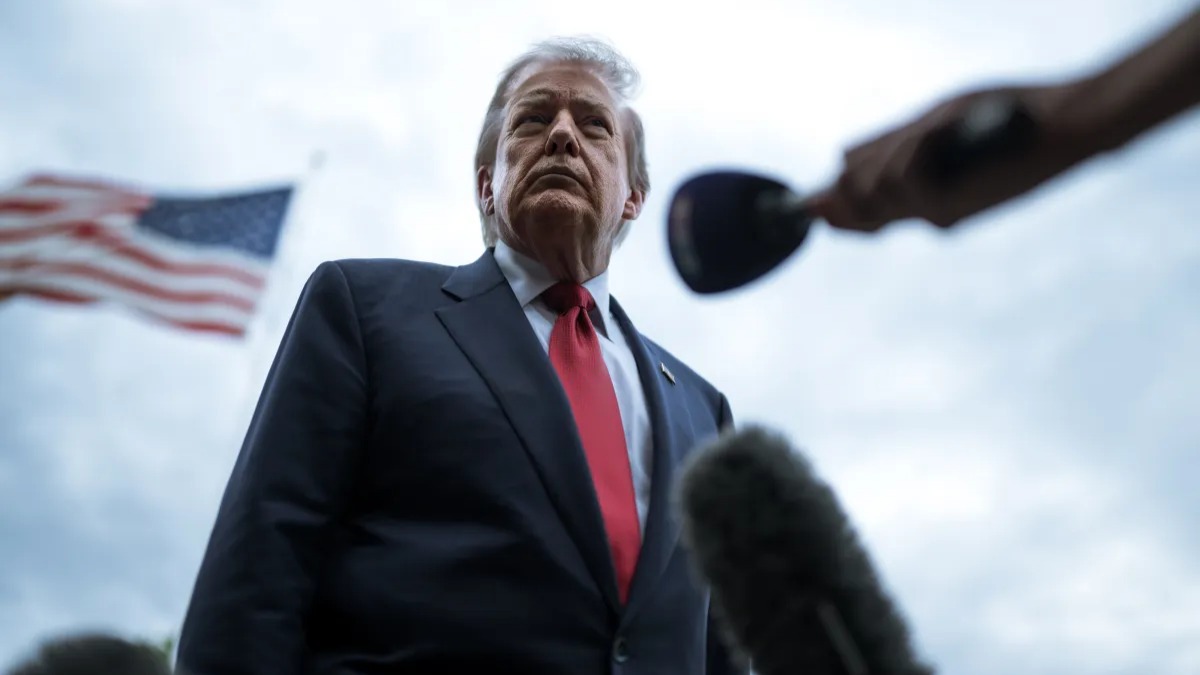

Donald Trump has stated that the financial pressure currently weighing on Americans due to the ongoing war with Iran is not even a little bit motivating him to pursue a peace deal with Tehran, The Guardian reported. This bold admission came as the President prepared to board a plane to China, signaling that his administration remains singularly focused on the nuclear issue despite the clear economic pain being felt across the country.
When speaking to reporters at the White House, Trump was very clear about his priorities. “The only thing that matters when I’m talking about Iran [is] they can’t have a nuclear weapon,” he said. “I don’t think about Americans’ financial situation. I don’t think about anybody. I think about one thing: We cannot let Iran have a nuclear weapon. That’s all.” This rhetoric is certainly going to turn heads as we head into a midterm election season where the cost of living is consistently the top concern for voters.
Official figures showed that US prices jumped 3.8% in April, marking the fastest pace since 2023. This spike is largely driven by energy costs that have surged since the conflict began in late February. The Bureau of Labor Statistics confirmed that energy prices rose 3.8% in April alone, which accounted for more than 40% of the overall monthly increase. Beyond the pump, families are seeing food prices climb by 3.8%, while electricity and utility bills have ticked up by 5.4%. Even air travel has become significantly more expensive, with fares rising by more than 20% over the last year.
The root cause of this energy squeeze is the ongoing closure of the Strait of Hormuz, a critical chokepoint where a fifth of the world’s oil and gas typically moves
While the administration is pushing for lower interest rates to stimulate the economy, the reality on the ground is difficult to ignore. Chris Wright, the US energy secretary, has struggled to provide a clear timeline for when these costs might stabilize. After previously suggesting that fuel could return to prewar levels by summer, he recently admitted to the press that he can’t make predictions. In a separate appearance on CNN, he noted that gas prices falling below $3 a gallon might not happen until next year.
The economic strain is definitely not limited to the United States. Global inflation is accelerating in places like Australia, Canada, and South Korea, while British households are bracing for a fresh cost-of-living crisis. Marco Rubio, the Secretary of State, attempted to frame the situation by suggesting that Americans should count themselves fortunate compared to other nations suffering big time.
Rubio argued that the US is insulated to some degree because it is a net oil exporter. Trump echoed this sentiment, pointing out that inflation was running at 1.7% before the war and claiming that the worst-case scenarios, such as $300-a-barrel crude or a massive stock market crash, have not materialized.
Despite the data from the University of Michigan showing that consumer confidence has slid to levels last seen in 2022, Trump remains remarkably optimistic about the long-term outlook. He insists his economic policies are working incredibly well and that a resolution to the war will trigger a golden age. “When this war is over, oil is going to drop, the stock market is going to go through the roof, and truly, I think we’re in the golden age right now,” he said. “You’re going to see a golden age like we’ve ever seen before.”
Whether this optimism will hold up as the Federal Reserve navigates its next steps remains to be seen. Incoming Fed chair Kevin Warsh is expected to be confirmed by the Senate in the coming days, taking over from Jerome Powell on Friday. Warsh faces the difficult task of convincing the Central Bank’s board to lower interest rates while inflation remains stubbornly above the 2% target.
With rates currently between 3.5% and 3.75%, the board has been cautious, citing uncertainty in the Middle East and slow job growth. Even as Trump’s top economic adviser, Kevin Hassett, claims that relief is coming relatively quickly and ahead of the election, the current reality for most Americans involves navigating a significantly more expensive daily life.







Published: May 14, 2026 04:45 pm