



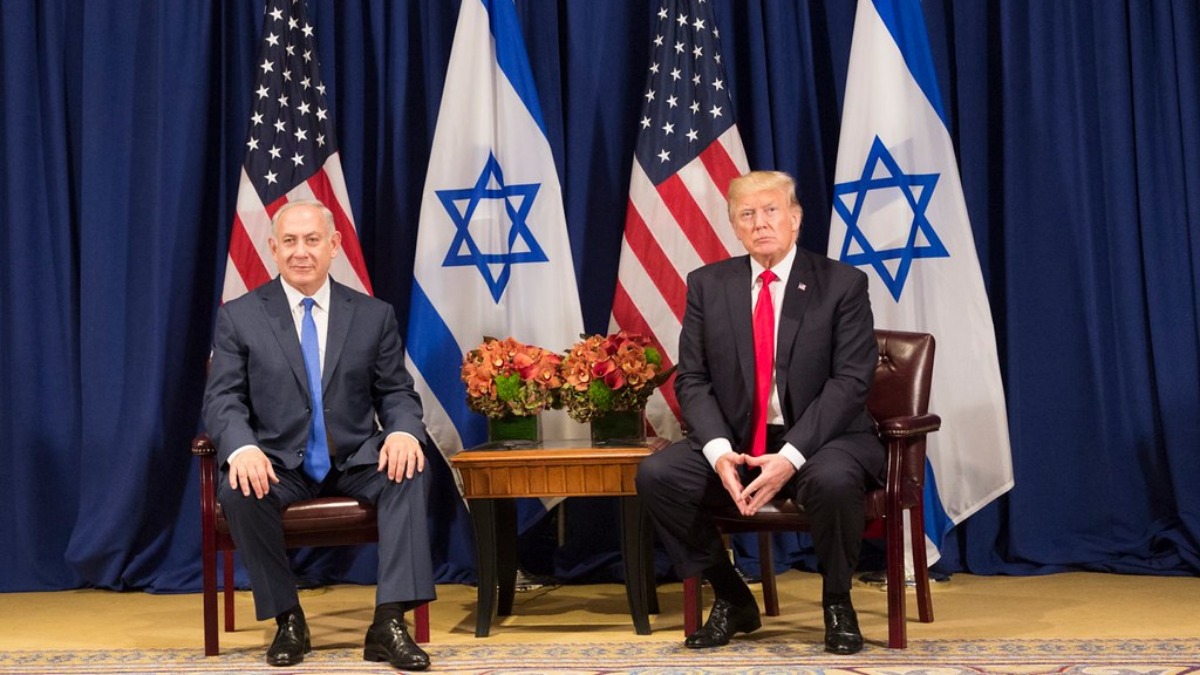

President Trump voiced his frustration with Israeli Prime Minister Benjamin Netanyahu while attending the Group of Seven summit in France, The Hill reported. The president took the opportunity during a press conference to publicly address the tension between the two leaders, specifically regarding Israel’s recent military actions in Lebanon. It is clear that the president wants a shift in strategy, urging the Israeli government to adopt a more measured approach while negotiations with Iran reach a critical point.
The president explained that while he understands the need for self-defense, he believes the current military responses are disproportionate. During the press conference, he specifically addressed the recent strikes in Beirut, which were carried out following drone activity.
Trump noted, “I’m not saying they shouldn’t protect themselves. I’m saying when two drones are shot into the desert and drop harmlessly, you don’t have to knock down buildings in Beirut. They could behave better, and frankly, they could do a better job.” He went on to express his personal sentiment, stating, “I love them as a partner, they were terrific, but they could do a much better job with Hezbollah on that. I don’t think they’re doing well, and I feel very bad for Lebanon.”
This public critique follows a much more aggressive stance taken by the president earlier in the week
In an interview with Axios on Sunday, the president did not hold back his anger regarding the timing of the strikes. When discussing the impact of these military actions on the diplomatic process, he said, “Why did Bibi have to do a f—ing attack? I was so p—ed off. I let him know. He has no f—ing judgment. I let him know that.” The president also revealed his immediate reaction upon hearing the news from his advisers, noting, “It is so bad — I couldn’t believe it. An hour before we are supposed to sign the deal.”
The stakes are incredibly high as the president works to finalize a formal agreement with Iran. This deal, which is expected to be signed on Friday, aims to end the ongoing war, reopen the Strait of Hormuz, and establish new terms for negotiations regarding Iran’s nuclear program. Trump has maintained that this agreement will ultimately benefit Israel by preventing Iran from acquiring nuclear weapons, requiring the disposal of existing nuclear materials, and allowing for snap inspections of Iranian facilities.
Despite these goals, the situation remains volatile. Iranian officials have expressed significant hostility, with Ebrahim Azizi, the chair of the Iranian parliament’s national security committee, writing on X, “A strong response is coming.” Additionally, the Iranian state news agency IRNA quoted Maj. Gen. Ali Abdollahi, who stated that Iran’s armed forces have their “finger on the trigger” and are prepared to deliver an “unforgettable and final lesson” should there be any further missteps.
The president acknowledged that the escalation in Lebanon almost derailed the entire diplomatic effort. In a phone call, he noted, “It shook it up. It delayed the signing by a few hours. It was supposed to be now. Now it is scheduled for a few hours from now.” While the president has expressed optimism that the deal remains on track for completion, it is not immediately clear if he has received direct assurances from Tehran confirming that the signing will proceed as planned.
The friction between the president and Netanyahu also extends to past military decisions. During his press conference on Wednesday, the president reflected on the January 2020 operation to assassinate Iranian general Qassem Soleimani. He claimed that Israel was prepared to participate in the attack but ultimately backed away at the last moment. “Israel, but they didn’t want to do that attack. They were all set the night before the attack, then for me they didn’t want to do it,” the president stated.
As the summit concluded, the president summarized his view of the Israeli leader by saying, “In all fairness to Bibi Netanyahu, happens to be a good man, gets a little excited sometimes.” He emphasized that the two men are currently on separate pages regarding the best path forward for ending the war. With Iran actively using the situation in Lebanon as a wedge to drive a divide between the United States and Israel, the president’s focus remains on navigating these complex international pressures.







Published: Jun 17, 2026 06:00 pm