



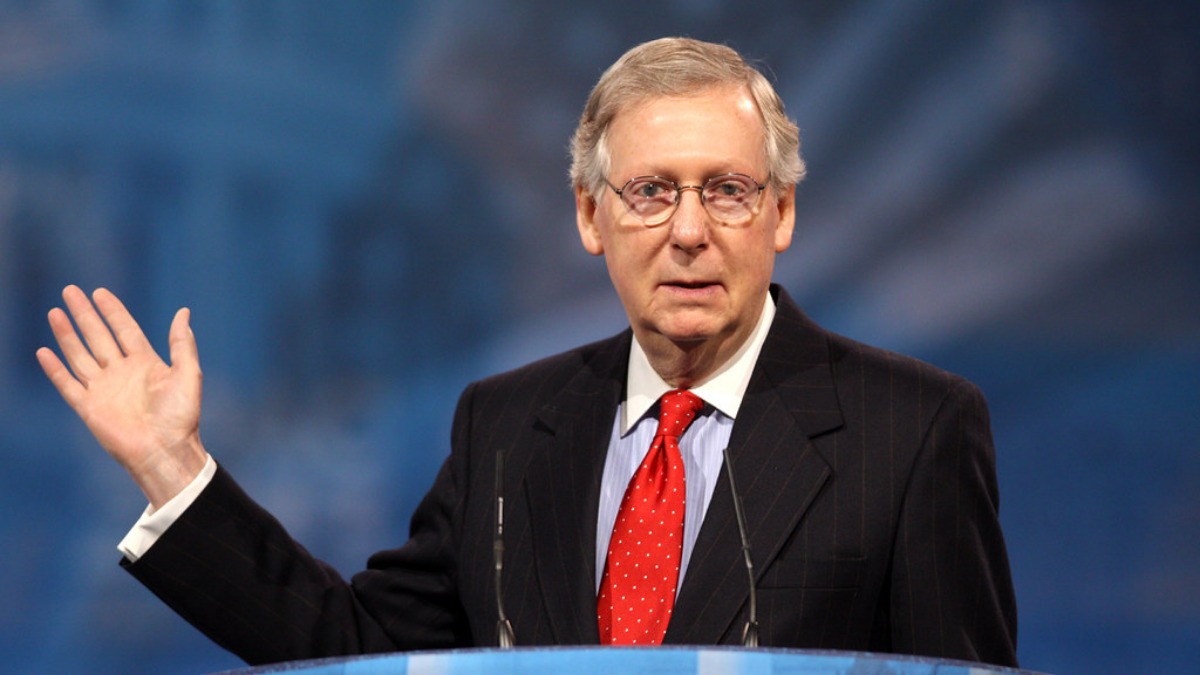

Sen. Mitch McConnell issued a sharp critique regarding the American conservative fascination with Hungarian Prime Minister Viktor Orbán following the defeat of his party in parliamentary elections. The former Senate GOP leader used a Fox News opinion piece to push back against the trend of U.S. politicians involving themselves in the internal affairs of other sovereign democracies.
While he did not mention any individuals by name, the timing of his comments follows a recent visit to Budapest by Vice President Vance, who traveled there to campaign for Orbán just days before the election results were finalized.
McConnell argued that U.S. politicians have historically maintained the standard that politics stopped at the water’s edge. He noted that there was a long-standing tradition of avoiding even the appearance of telling other nations how to manage their internal business. He expressed his frustration with the shift in perspective that has occurred over the last decade, stating that Hungarian politics has persisted as an object of intense fascination for conservatives stateside.
This is a significant pivot from the traditional isolationist leanings often associated with the right, and McConnell clearly finds the current alignment concerning
The core of McConnell’s argument is that the appeal of Orbán to some American conservatives is based on a fundamental misunderstanding of his governance. He wrote that America’s self-proclaimed national conservatives spoke of Orban’s Hungary as an oasis of traditionalism amid the wasteland of an ailing, liberal and decadent postmodern Europe. McConnell labeled this view a myth.
He pointed out that while supporters might overlook issues like court-packing, crony capitalism, or the restriction of free speech as the price for a social utopia, the reality does not match the rhetoric. He explicitly noted that despite claims of reviving faith and family through state intervention, Hungary has seen its religious participation and birth rates decline in line with the rest of the West.
The political landscape in Hungary shifted significantly on Sunday when the center-right Tisza Party, led by Peter Magyar, defeated the far-right Fidesz party that Orbán has led since 2010. This outcome serves as the backdrop for the friction within the American right. During his visit to Budapest on a Tuesday, Vice President Vance made his support for the Hungarian leader clear.
Vance stated at a press conference, “I want to help as much as I possibly can, the prime minister, as he faces this election season, which I believe is happening in just about a week, the election to elect the next prime minister of Hungary.” He also aimed his criticism at European bureaucrats, claiming they have done everything that they can to hold down the people of Hungary because they don’t like the leader who has actually stood up for the people of Hungary.
McConnell’s critique went beyond internal social policies and touched on the geopolitical reality of Orbán’s leadership. He specifically highlighted Orbán’s fealty to Moscow and his ties to the Chinese and Iranian governments as evidence that his policies do not reflect American values. This is a point of major contention, especially considering that Orbán has stood out among European leaders for his refusal to support Ukraine following the Russian invasion in 2022. He has also consistently opposed sanctions against Russia and attempted to block aid to Kyiv.
The alignment between Orbán and certain American figures is not new. President Trump has been a vocal supporter for years, even issuing an endorsement in February where he described the Hungarian leader as a truly strong and powerful Leader, with a proven track record of delivering phenomenal results.
Trump further praised him by saying, “He fights tirelessly for, and loves, his Great Country and People, just like I do for the United States of America. Viktor works hard to Protect Hungary, Grow the Economy, Create Jobs, Promote Trade, Stop Illegal Immigration, and Ensure LAW AND ORDER!”
McConnell concluded his piece by questioning the strategic logic of the American right. “Watching this from Kentucky, it is hard to understand how some on the American right thought that staking U.S. influence on the outcome of a parliamentary election in a small, central European country was putting America’s interests first.”
He maintained that if Hungary is to matter to the United States, it should be based on whether its actions on the world stage align with American strategic interests, rather than its internal social policies.








Published: Apr 14, 2026 04:30 pm