



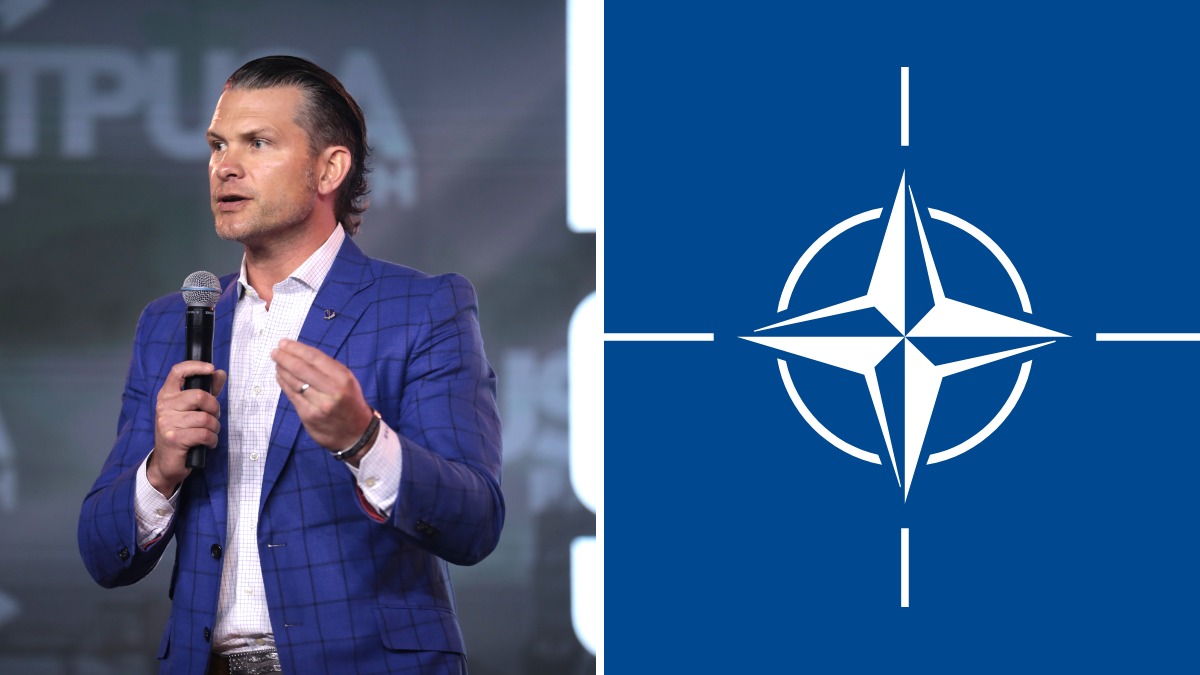

Secretary of Defense Pete Hegseth is shaking things up in a major way at NATO headquarters. During a recent visit to Brussels, Hegseth delivered a sharp critique of the alliance and announced that the United States is launching a six-month review of how it deploys troops across Europe. It’s a move that signals a massive shift in how the U.S. views its role in the alliance, with Hegseth bluntly labeling the organization a “paper tiger” that has lost its way over the years, The Hill reported.
Hegseth made it clear that the U.S. is done with what he called a “one-way street.” He told defense ministers that the review is designed to ensure the alliance moves “fast and irreversibly toward Europe leading.” While he stopped short of confirming exactly what this means for current troop levels, the message to European allies was loud and clear: they must step up their game.
Hegseth’s frustration seems rooted in the belief that NATO drifted away from its original purpose. He argued that the alliance needs to transform into a “NATO 3.0” that mirrors the version of the alliance that successfully navigated the Cold War. In his view, the era of “NATO 2.0” was defined by distractions like gender equity, climate change, and defense austerity. He went as far as to say that this period was marked by “distraction, deindustrialization and demilitarization” and described it as an “era of free riding.”
The administration is putting its money where its mouth is regarding member contributions
Hegseth stated that U.S. dues to the alliance will now be contingent on other member nations actually hitting their own defense spending targets. If allies don’t start spending with more urgency, the U.S. plans to lower its own financial commitments. This push for burden-sharing has been a consistent theme, especially as the U.S. recalibrates its military footprint.
The tension has been brewing for a while, particularly regarding the U.S. conflict with Iran. Hegseth blasted allies for failing to support the U.S. during this time, accusing them of hiding behind “arcane legal debates” or offering public criticism instead of actual support. Some European countries even went so far as to refuse access to their bases for U.S. aircraft heading to the Middle East. President Trump had previously used the “paper tiger” label back in March, specifically regarding Europe’s collective reaction when Iran shut down the Strait of Hormuz.
Changes are already hitting the ground. There have been reports of planned reductions in U.S. fighter jets and warships, including a drop from roughly 150 to 100 F-16 and F-15E fighter jets and a decrease in P-8 Poseidon reconnaissance aircraft from 26 to 15. Furthermore, all eight aerial refueling tanker jets previously available to Europe are being reallocated.
While some might be worried about these gaps, NATO Secretary-General Mark Rutte insisted that there won’t be an immediate impact. Rutte noted that U.S. Gen. Alexus Grynkewich believes allies have, or will soon have, enough in their own arsenals to make up for these changes.
The situation in Poland remains a focal point of this broader strategy. While there was some confusion earlier in May when the Pentagon paused a planned troop deployment, President Trump later announced that 5,000 additional troops would be heading to Poland. This decision followed the election of Polish President Karol Nawrocki.
Vice President Vance defended the earlier pause as a “minor thing” and a “standard delay,” emphasizing that it is reasonable for Europe to take more ownership of its own integrity. Poland is currently a standout ally in this regard, spending 4.8 percent of its GDP on defense, which is the highest in the alliance.
As the U.S. continues to push for a more robust, European-led defense, the next six months are going to be critical. The Pentagon policy chief, Elbridge Colby, has been busy meeting with officials like Polish Secretary of State Pawel Zalewski to re-emphasize the need for real burden-sharing.







Published: Jun 18, 2026 12:30 pm