



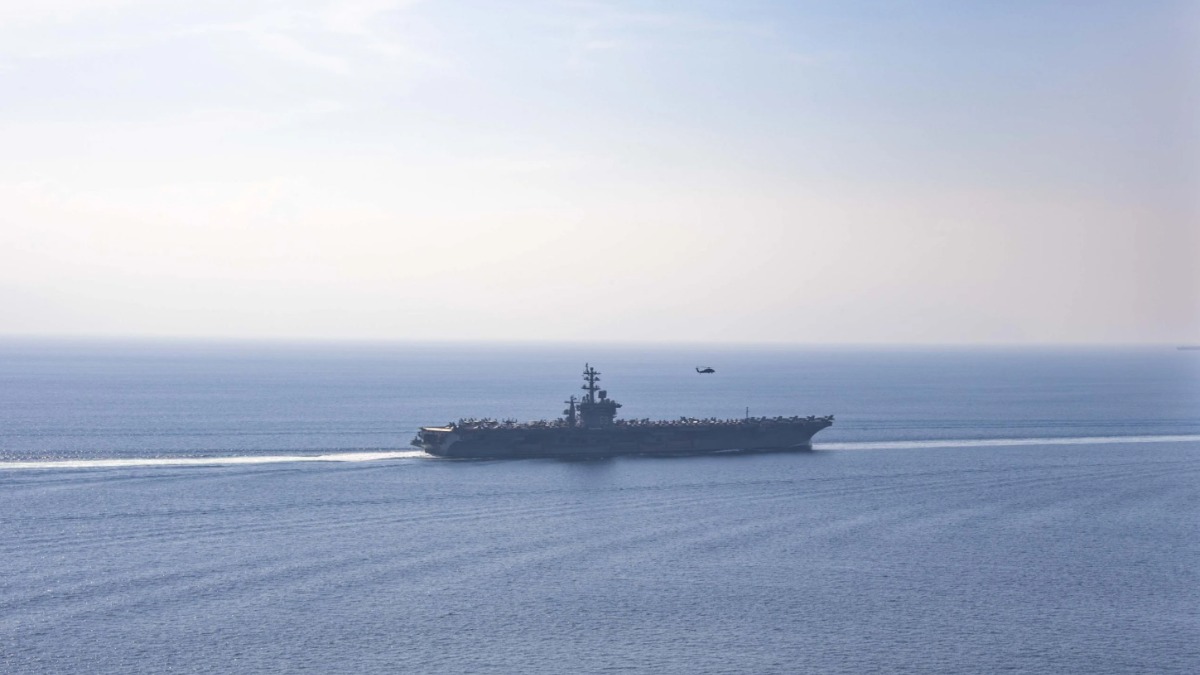

The United States has taken an Iranian-flagged cargo ship into custody after it attempted to bypass a naval blockade in the Gulf of Oman. As reported by Axios and NBC News, President Trump announced Sunday that the vessel, named the Touska, was disabled by the US Navy after ignoring warnings for six hours. The seizure marks the first time a ship has been fired upon since the US blockade began the previous Sunday, itself a response to Iran effectively closing the Strait of Hormuz since the war began on February 28.
Trump detailed the incident in a post on Truth Social, stating that the Navy destroyer USS Spruance “gave them fair warning to stop” before the crew refused to comply. US Central Command later confirmed that the USS Spruance fired “several rounds from the destroyer’s 5-inch MK 45 Gun into Touska’s engine room.” After the nearly 900-foot cargo vessel was disabled, US Marines boarded and took custody of the ship. Central Command stated that “American forces acted in a deliberate, professional, and proportional manner to ensure compliance” throughout the six-hour standoff.
Iran’s military swiftly condemned the action, accusing the US of violating the ceasefire agreement and committing “maritime piracy.” Military spokesperson Ebrahim Zolfaghari said on state television that Iran’s armed forces “will soon respond to this act of armed piracy and theft by the American military and will retaliate.” The reaction underscores how fragile the current two-week ceasefire is, with it set to expire on Wednesday, April 23.
Both sides are trading accusations as the ceasefire teeters
Earlier on Sunday, Trump accused Iran of firing on ships in the Strait of Hormuz, calling it a “total violation” of the ceasefire. In a separate post, he issued a stark warning: “We’re offering a very fair and reasonable DEAL, and I hope they take it because, if they don’t, the United States is going to knock out every single Power Plant, and every single Bridge, in Iran.” Iran had reimposed an effective closure of the Strait of Hormuz on Saturday, citing the continued US naval blockade of Iranian ports, just a day after declaring the waterway “completely open” under the ceasefire.
Trump announced that negotiators including Vice President JD Vance, special envoy Steve Witkoff, and Jared Kushner were expected to travel to Islamabad, Pakistan, on Monday evening for a second round of talks. Iran’s state-run IRNA news agency, however, denied reports of new negotiations, stating there is “no clear prospect” for talks under current conditions. Iranian officials cited excessive US demands, shifting positions, and the naval blockade as reasons for their position, with Iran viewing the blockade as a breach of the ceasefire. The White House Situation Room was convened earlier after Iran shut down the strait.
The Strait of Hormuz has been the site of several maritime incidents. French shipping company CMA CGM confirmed one of its vessels was targeted with warning shots, and maritime authorities reported gunfire involving Indian vessels in the strait, which Iranian state media confirmed. Iran’s semiofficial Tasnim news agency also reported that two tankers sailing under Botswana and Angolan flags were forced to turn back by Iranian forces on Sunday. The Islamic Revolutionary Guard Corps warned that vessels attempting to cross the strait would be considered “cooperation with the enemy.”
UN Ambassador Mike Waltz said of the planned talks that Iran could “choose to be a responsible member of the international community, or they can continue to be a rogue regime that masters its own people and seeks to hold the world hostage with a nuclear weapon.” He suggested that mixed messaging from Iran on the status of the strait could indicate “real confusion on the Iranians’ part” and “discord within their ranks.” Iran’s Parliament Speaker and chief negotiator Mohammad Bagher Ghalibaf acknowledged on state TV that “some issues in the negotiations have been concluded, while others have not,” adding that “there is still a distance to a final agreement.” He warned that if the naval blockade continues, Iran will not resume negotiations and “will start the war.”
Iranian President Masoud Pezeshkian accused Trump of seeking to deny Iran its “nuclear rights” and said Iran was trying to end the war “with full dignity.” Amid Trump’s escalating rhetoric toward foreign adversaries, French President Emmanuel Macron and British Prime Minister Keir Starmer, following a summit of 51 countries co-chaired by France and the UK on Friday, jointly called for the “unconditional, unrestricted, and immediate re-opening of the Strait of Hormuz” and announced a joint neutral mission to provide reassurance to merchant vessels in the region.







Published: Apr 19, 2026 07:30 pm