



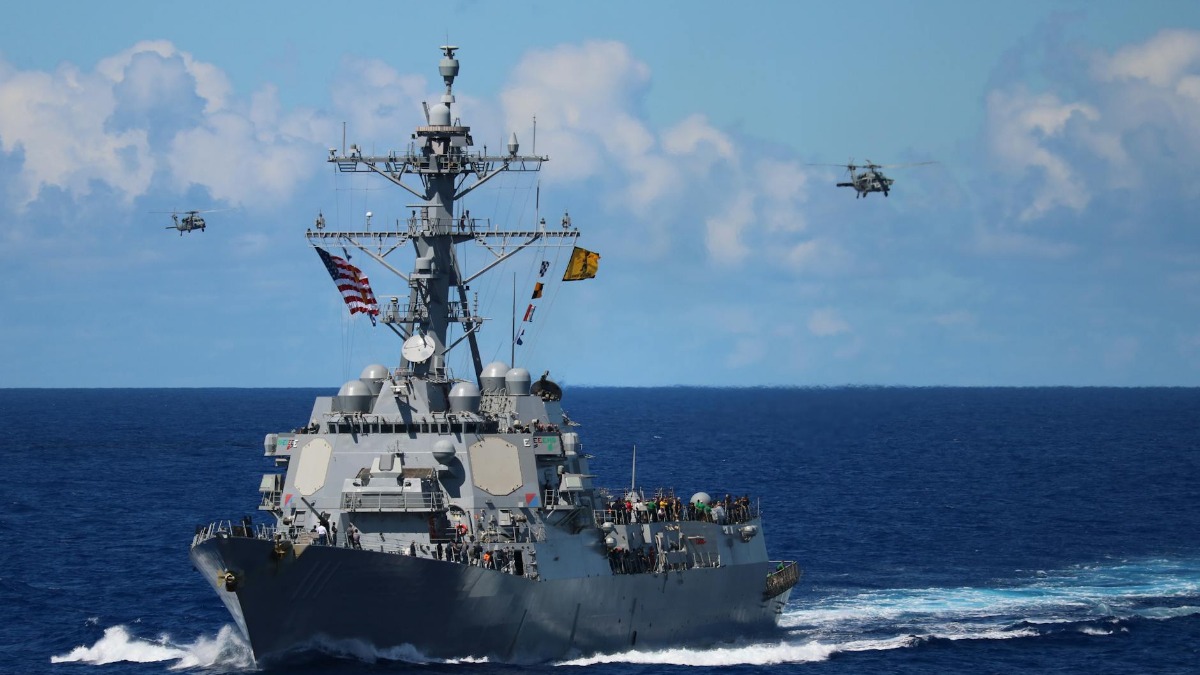

The United States Navy has seized an Iranian cargo ship in the Gulf of Oman after the vessel tried to get past a naval blockade. The USS Spruance fired on the cargo ship, called the Touska, to force it to stop. The US military confirmed they disabled the ship by blowing a hole in its engine room after the crew ignored repeated warnings.
President Donald Trump announced the news on his Truth Social. According to BBC, Trump wrote, “Today, an Iranian-flagged cargo ship named TOUSKA, nearly 900 feet long and weighing almost as much as an aircraft carrier, tried to get past our Naval Blockade, and it did not go well for them.” He added that after the ship ignored fair warnings, “our Navy ship stopped them right in their tracks by blowing a hole in the engineroom.”
The US Central Command released footage of the interception, showing a naval vessel firing toward the cargo ship. According to the military, the USS Spruance directed the crew to evacuate the engine room before firing several rounds from a five-inch caliber gun. The US now has full custody of the ship and is inspecting its cargo. Trump noted the vessel is under US Treasury sanctions due to a prior history of illegal activity.
Iran is calling the seizure an act of armed piracy and threatening to retaliate
Iran has called the seizure an act of armed piracy and a direct violation of the existing ceasefire. A spokesperson for Iran’s top military headquarters, Khatam al-Anbiya, stated that the US military opened fire on a commercial vessel, disabled its navigation system, and deployed marines to take control. The spokesperson warned that “the armed forces of the Islamic Republic of Iran will soon respond to and retaliate for this action.”
The timing of the seizure is especially sensitive, as the current ceasefire is set to expire on Wednesday, April 22. While the White House confirmed that Vice President JD Vance is scheduled to lead a delegation to Pakistan for a second round of peace talks, Iran’s state news agency IRNA has denied that these negotiations are taking place. Iranian officials have said they will not take part in further talks while the US blockade remains in effect.
The blockade was put in place after a first round of negotiations earlier this month failed to reach an agreement on key issues, including Iran’s nuclear program and control of the Strait of Hormuz. Experts have noted that the blockade is putting serious pressure on Iran’s economy, though it may not be enough on its own to force a deal.
According to Le Monde, the Strait of Hormuz is a critical shipping route for about 20 percent of the world’s oil and liquefied natural gas, and the Islamic Revolutionary Guard Corps closed the strait again on Saturday, citing the US blockade as a violation of ceasefire terms, leaving traffic at a standstill according to tracking data from MarineTraffic.
Trump has also threatened further consequences if a peace deal is not reached, including the possible destruction of bridges and power plants in Iran. The US has said it will keep the blockade in place until a deal is finalized, further complicating any chance of a quick resolution.
Meanwhile, Iran is also reported to be receiving advanced missiles that are very hard for the US Navy to intercept, adding another layer of danger to the standoff. Both sides continue to accuse each other of violating the ceasefire. On Saturday, reports came in of multiple ships being attacked in the strait, including a French vessel that confirmed it was the target of warning shots.
India also reported that two of its flagged ships were involved in a shooting incident in the same area. With the ceasefire deadline arriving on Wednesday, the coming days will be critical in determining whether the ongoing peace talks in Islamabad can hold things together or whether the situation in the region gets significantly worse.





Published: Apr 20, 2026 08:00 am