



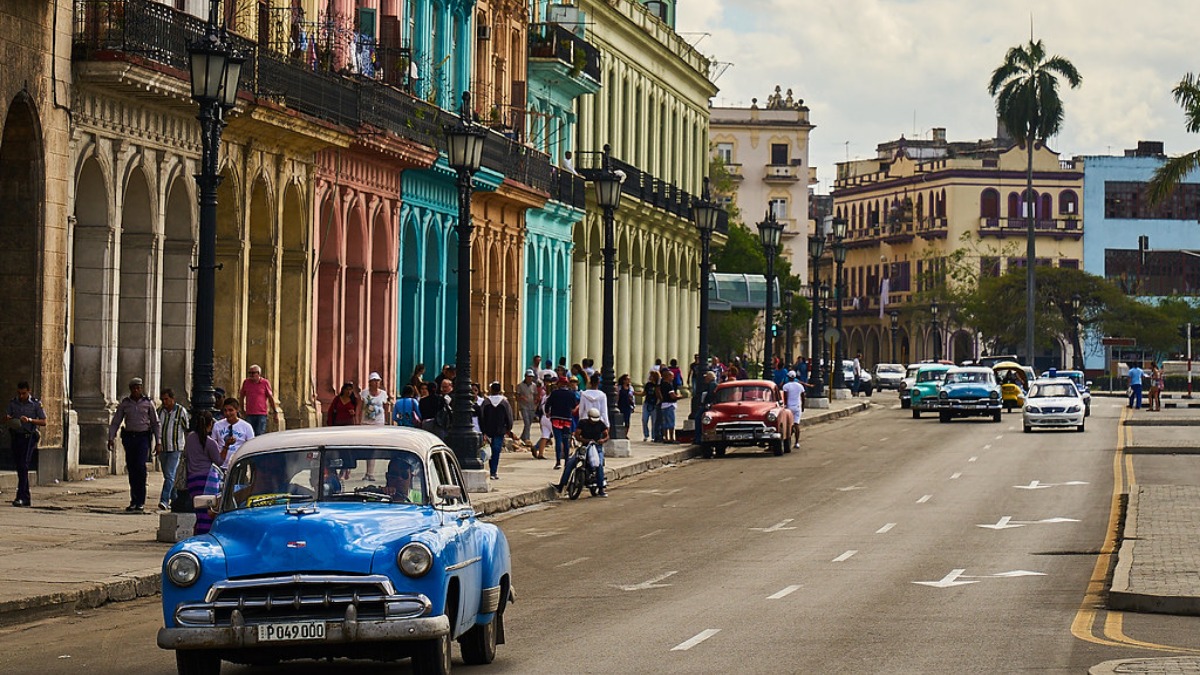

President Donald Trump’s administration has claimed that Cuba hosts a major Russian spy facility on the island. But journalists who visited the site say they found a university campus, not an active intelligence base.
The claim appears in an executive order Trump signed in January, which threatens tariffs on countries that ship fuel to Cuba, reports Drop Site. The order calls Cuba a “national emergency” and states that “Cuba hosts Russia’s largest overseas signals intelligence facility, which tries to steal sensitive national security information of the United States.”
Reporters from Belly of the Beast, an independent outlet covering Cuba, spent two days at the site, called Lourdes, on the outskirts of Havana. They said they found no evidence of an active Russian intelligence base or the kind of equipment described in a New York Times report on the claim.
New York Times report described antennas and eavesdropping equipment
On March 24, the New York Times published a report by Michael Crowley that said the Russian base at Lourdes “bristles with antennas and other eavesdropping equipment,” and claimed it could be used to spy on U.S. Central Command, the satellite launch site at Cape Canaveral, and Trump’s Mar-a-Lago residence. Crowley wrote that the base had been “temporarily shut” by Vladimir Putin in 2001 and reopened in 2014, according to the Times.
The State Department did not respond to a request for comment from Belly of the Beast. The Times and Crowley also did not respond to requests for comment. The spy base claim comes amid separate reporting on Cuba stockpiling armed drones and rising tension between Washington and Havana.
Today, the Lourdes site is home to Cuba’s University of Computer Sciences (UCI), located about two miles from Havana’s José Martí International Airport. Reporters walked the campus and spoke with students, faculty, and staff, but said they found no signs of an intelligence facility.
Malcolm Jarrozai, a 40-year-old art professor who has taught at UCI and lived on campus since 2006, questioned the claim. “Do I look like a Russian spy?” he said. “It’s truly laughable that these kinds of claims are being made and that major outlets like The New York Times give them a platform and allow them to be used to justify policies against Cuba.”
The Soviet Union began building a signals intelligence facility at Lourdes as early as 1962. By the 1980s, U.S. intelligence described it as the USSR’s largest and most valuable base outside Soviet territory for gathering intelligence on the United States. In 2001, Putin announced Russia would abandon the base, and Russian officials fully handed the site over to Cuban authorities in August 2002.
Rafael Torralbas, a Cuban engineer who helped convert the site into a university starting in April 2002, said Russian officials removed all equipment before leaving. “There were huge [satellite dish] antennas, and I witnessed the process of dismantling them,” he said. “There was technological equipment connected to the antennas, which we never saw. We knew it had been there, but the Russian officials had dismantled it all and they handed over the buildings completely empty.”
Torralbas, who now leads the Havana Science and Technology Park on the UCI campus, said the idea that Lourdes was reopened as a spy base “could only exist in the mind of the person who made up that news.” He added, “At no time, in this university, has anything existed that is not school buildings, students, computer science development centers, postgrad programs, that is, the normal activities of a university.”
According to Torralbas, more than 80 percent of the campus buildings were constructed after the Russians left. Reporters said they found only one remaining structure from the old base: a crumbling watchtower with a rusted, unusable ladder.
Regarding the Times’ description of antennas on the site, reporters said they found two mobile phone antennas belonging to ETECSA, Cuba’s state telecommunications company. UCI graduate Héctor González, who works in the university’s communications department, said the antennas provide phone and internet service in the area.
“The antennas that were here [under the Russians] that were dismantled were different,” he said. “They were enormous satellite dishes that you can see in some old photos, giant radars many meters high. These are just ordinary mobile network antennas.”
Reporters said the campus had minimal security, with unarmed guards from a state-run security company and no military checkpoints. Cuba’s oil shortages have disrupted public transportation, leading universities to shift to remote and hybrid instruction since February, which reporters said left the campus largely empty during their visit.
Secretary of State Marco Rubio referenced intelligence sites in Cuba during June testimony before the Senate Foreign Relations Committee, saying, “Cuba continues to host a pretty substantial collection of intelligence sites on behalf of the Chinese and the Russians.”
Similar claims about foreign intelligence sites have also fed into Cuba’s warning of a possible military conflict with the United States. Belly of the Beast also visited three sites identified in a separate report by the Center for Strategic and International Studies as possible Chinese intelligence facilities, and said they found no evidence of Chinese personnel or heightened security at those locations either.







Published: Aug 1, 2026 03:45 pm