



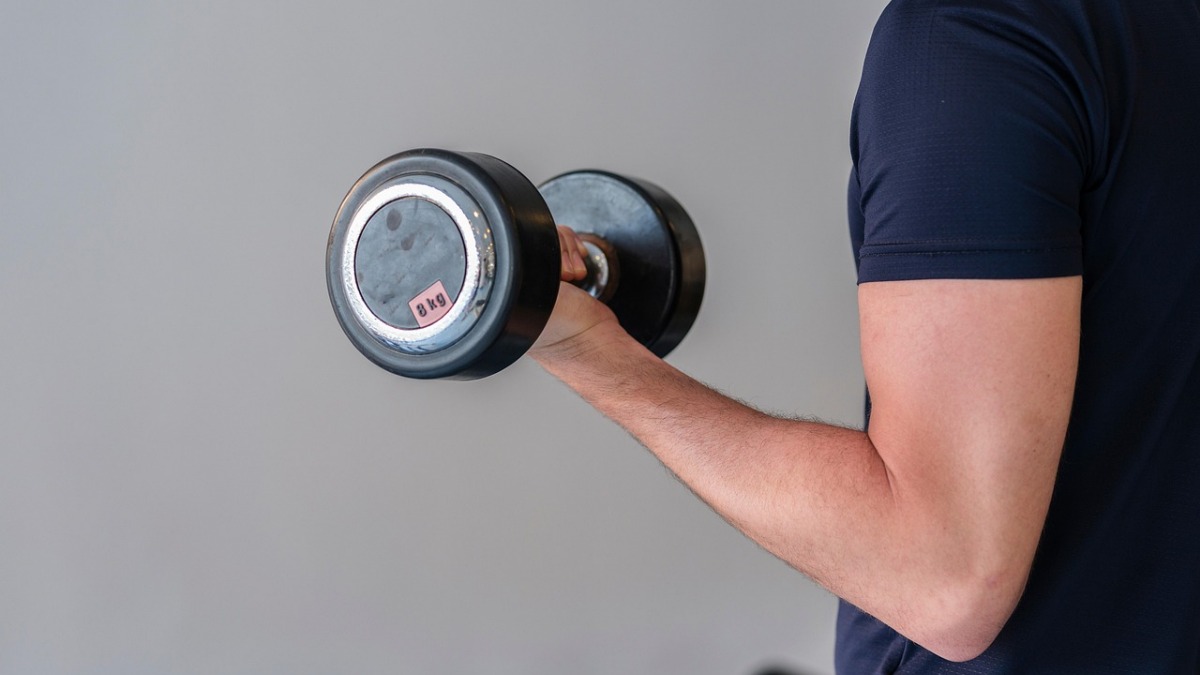

Skye Mackintosh, a 29-year-old dad of two from Utah, has been completing a strict 20-minute daily workout for more than 260 consecutive days and posting every session online. As detailed by LADbible, the approach has earned him more than 200,000 subscribers on TikTok and Instagram, where he goes by the Daily Reps Guy. His transformation has been hard to ignore.
Mackintosh reached a turning point in 2024 after seeing a photo of himself during a period of weight gain that he said he did not recognize. He initially cut sugar out of his diet for a year before deciding he needed something more sustainable. That is when he settled on a short daily workout as a consistent, long-term habit rather than a dramatic overhaul.
His choice of 20 minutes was deliberate. “I chose 20 minutes because 30 isn’t always achievable, and 10 didn’t seem to be enough,” he said. “My wife and I are going to have more kids, and then I’ll have grandkids, and who knows where my career will take me. But regardless of what’s going on, I figure I’ll always have 20 minutes.”
The science behind short, consistent workouts is more solid than most people think
He started with basic movements like push-ups and jump squats, targeting core muscle groups without needing much space or equipment. His routines are built to be adaptable, whether he is at home with kettlebells or stuck in a hotel room with nothing. One recent routine included three rounds of flutter kicks, jump squats, leg raises, jump lunges, and planks. TikTok has increasingly become a platform for this kind of grassroots fitness content, amid TikTok’s own push into wellness features that experts say still center the app’s business model over genuine health outcomes.
Research by experts at Edith Cowan University supports his approach. The study found that slow, controlled, eccentric movements, the phase where muscles lengthen rather than shorten, such as the lowering portion of a squat, can build significant strength while requiring far less effort than traditional workouts. Professor Ken Nosaka, Director of Exercise and Sports Science at the university, said the idea that exercise must be painful or exhausting is holding people back. “Instead, we should be focusing on eccentric exercises which can deliver stronger results with far less effort than traditional exercise, and you don’t even need a gym,” he said.
The study notes that muscles produce greater force during these lengthening movements while using less energy than during traditional lifting or pulling actions. This makes the method accessible to beginners and older adults as well. Mackintosh has previously run a 50km ultramarathon, though his current routine is intentionally built around sustainability, not peak athletic performance.
On diet, Mackintosh is relaxed. He admits to a sweet tooth and has a treat almost every day, with portion control being his guiding principle over total restriction. “You can still have your Oreo. But just have one,” he told his followers. “Often times we have a portion control issue, not always a food item issue.” His outlook on fitness applies to his home state in some unexpected ways: Utah, which is known for its strict limits on alcohol consumption, has also produced one of social media’s most low-key wellness advocates.
For anyone looking to start, Mackintosh’s advice is to keep it simple. If 20 minutes feels like too much, he says to start with 10 or even five. “My main advice is just to start and keep it simple,” he told Business Insider. “I wanted to test whether even something small, stacked over time, is better than great spurts of effort, and I’ve found that it is. It’s all about consistency.”









Published: May 12, 2026 08:15 pm