



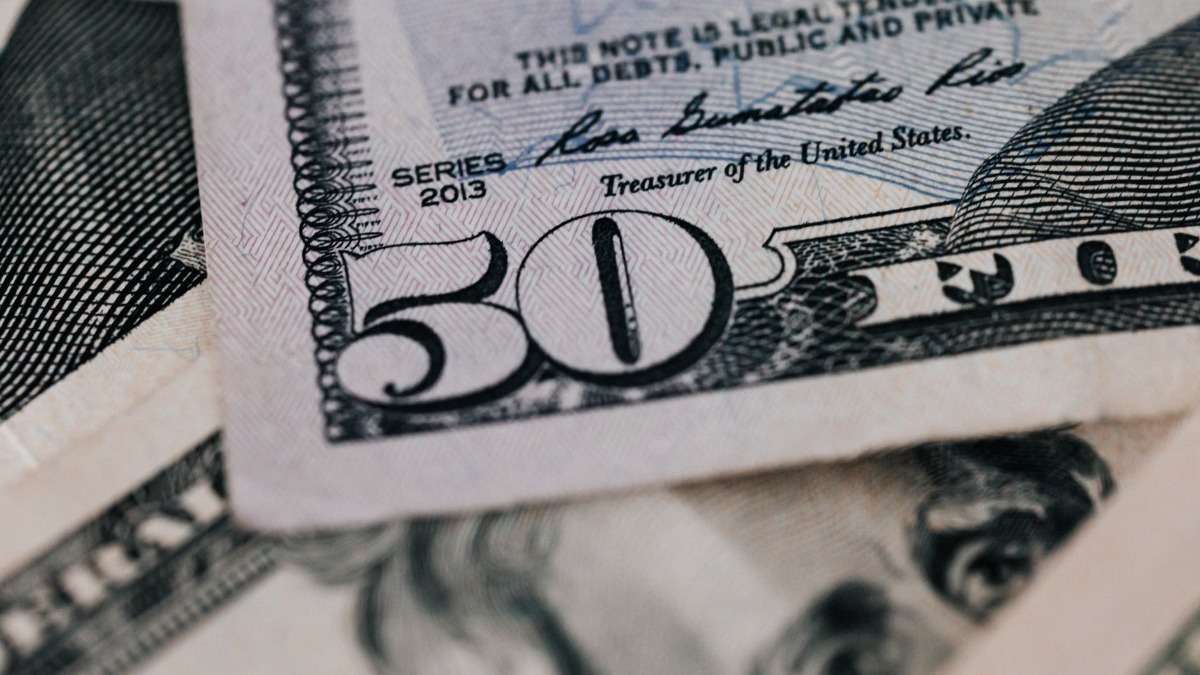

A Philadelphia woman says her routine lunch at a chain restaurant turned into a standoff after her server accused her of paying with a fake $50 bill and refused to return it. The woman, who posts under the name Bridget (@bridgetgoes) on TikTok, shared the story in a video that has drawn 1.3 million views, 189,200 likes, and more than 4,000 comments.
Bridget said the meal itself was ordinary. Her bill came to $35, and when the server dropped it off, she said, “Whenever you’re ready,” and walked away. Bridget placed a $50 bill on the table to cover the check.
The server picked up the bill, left, and then came back to say she could not accept it. That single line is at the center of the story: “Do you have a different payment method? I can’t accept the $50.”
Server told the customer the bill could not be returned because it was counterfeit
Bridget said she first assumed the restaurant simply didn’t take $50 bills, similar to policies at some fast food chains. She offered to pay with a card instead if the server gave her cash back for the $50. According to Bridget, the server said, “I can’t give you the cash back,” and when asked why, said, “I can’t give back counterfeit bills, it’s against our policy.”
Bridget said she asked the server directly if she was being accused of paying with fake money. The server repeated the same line about counterfeit bills and restaurant policy, then told Bridget she needed to provide a different payment method or police would be called.
Bridget said she told the server to go ahead and call the police, adding that she wanted them to confirm the bill was real and that she was not leaving without it. Disputes over bills and tips can escalate quickly, as when a server asked a customer whether they preferred a 100 or 200 tip before being left 5 on a 45 bill.
Bridget said the restaurant was mostly empty, since it was the middle of the lunch period. As the exchange continued, a man she identified as the manager, wearing a plaid shirt and dress pants, walked by and heard her mention calling the police. He approached the table and asked if everything was okay. Bridget said she told him it was not.
She said the server’s expression changed immediately. “It’s like all the blood drains from her face,” Bridget said in the video. The manager asked the server if she was okay, and Bridget said the server did not answer. He then led her toward the back of the restaurant, which Bridget clarified in on-screen text was not aggressive. Such disputes over bills and tips can quickly escalate, as when a server’s claim about a tip on a large bill was contradicted by her own receipt.
The manager returned a few minutes later and asked Bridget to explain what happened. She repeated the sequence of events: a normal meal, a $50 bill placed down to pay, and the server’s claim that the bill was counterfeit and could not be returned unless Bridget paid another way. Bridget said she told him again that the $50 was real and that he should call the police if there was any doubt.
According to Bridget, the manager asked her to repeat the story a second time before leaving again, this time for close to ten minutes. When he came back, he had her original $50 bill and the check. He told her, “I’m so sorry for your experience today. I went ahead and comped your check. You’re fine, we’re not calling the police, have a great day.” Bridget said she took her bill and left.
In the video, Bridget said she was still unsure what the server’s intention had been, and asked viewers whether they had experienced anything similar or had theories about what the server may have expected to happen.
The comment section included a range of reactions. One commenter wrote, “That manager paused because it all clicked for him. He finally figured her out.” Another asked, “Why would someone risk losing their job over $50?” A user identifying as a former server wrote, “As a former server she was absolutely trying to pocket your money.”
Another commenter laid out a theory directly: “idk how you’re confused. She keeps the $50 and you still pay the bill with the other payment method.” One comment raised the legal side of handling suspected counterfeit currency, noting, “So, if there is real counterfeit money the establishment is required to call the police. The person passing the counterfeit money will be charged. They do not mess around. Federal charges.”
Federal Reserve research on counterfeit currency estimates that the total stock of counterfeit bills in circulation across the United States is likely around $15 million, or about one counterfeit note for every 80,000 genuine ones, based on a paper by economist Ruth Judson. The paper notes this is a decline from an earlier estimate of one in 10,000 notes.
Separately, the Harford County Sheriff’s Office issued a public alert in March 2015 warning businesses and residents about a rise in counterfeit currency, “particularly $50 bills,” being passed in the region at the time. The office advised anyone who receives a suspected counterfeit bill to avoid handling it directly, place it in a protective cover, and contact law enforcement rather than returning it to the person who passed it.





Published: Jul 28, 2026 01:30 pm